Brahmaloka
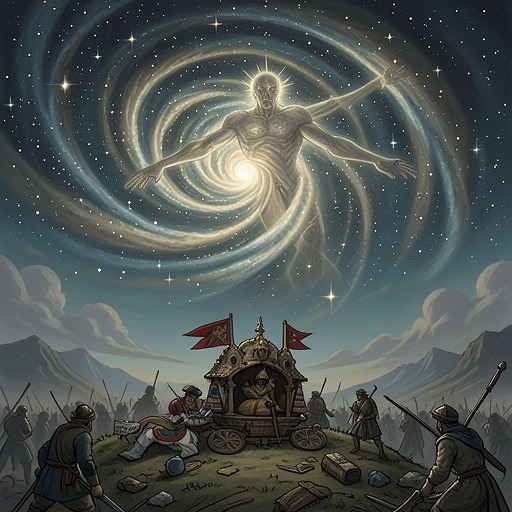
Bhagavad GitaBrahmaloka, the abode of Brahman, occupies the highest visible level of the cosmic hierarchy described in the dialogue between Krishna and Arjuna. It is a realm associated with Brahman, the Supreme and indestructible reality, but the teaching gives it a precise limitation: reaching Brahmaloka does not by itself end rebirth. Its importance lies in this tension between exalted status and impermanence. The location marks the upper boundary of conditioned existence while directing attention beyond every world formed within the cycle of manifestation.
Position in the Cosmic Order
Brahmaloka appears within a universe governed by immense cycles of manifestation and withdrawal. A day of Brahma lasts for a thousand Yugas, and a night lasts for another thousand. When the day begins, manifested beings arise from the unmanifest; when night arrives, they disappear again into that unmanifest condition. Brahmaloka therefore belongs to a cosmos measured not by ordinary human chronology but by vast alternations of emergence and dissolution.
The teaching explicitly places all worlds, “from the abode of Brahman downwards,” within the round of births. The phrase establishes Brahmaloka as the highest named station in the ascending sequence, while also refusing to confuse height with final liberation. Even the summit of the manifested order remains caught in cosmic recurrence; the Supreme state reached through Krishna is distinguished from it by the absence of return.
Access and Spiritual Direction
Brahmaloka is connected with disciplined knowledge, meditation, and the final orientation of consciousness. The teaching states that a person who remembers Krishna at the moment of leaving the body reaches Krishna’s essence, and that the form remembered at death determines the destination toward which the departing person goes. Brahmaloka thus belongs to a larger system in which inward practice, habitual meditation, and the direction of the mind shape postmortem passage.
The prescribed discipline is exacting. The practitioner withdraws the mind from other objects, restrains the senses, gathers the life-breath between the eyebrows, and utters the single syllable Om while thinking of Krishna. This practice leads to the highest goal. Brahmaloka is consequently not described as a place reached by ordinary worldly success, but as part of a spiritual geography governed by concentration, remembrance, devotion, and knowledge.
The Two Paths Beyond Death
The route associated with Brahman is described through a sequence of luminous signs: fire, light, day, the lighted fortnight, and the six months of the northern solstice. Those who know Brahman and depart by this path go to Brahman and do not return. In contrast, the path of smoke, night, the dark fortnight, and the six months of the southern solstice carries a devotee to lunar light, after which the person returns.
These paths make Brahmaloka part of a moral and ritual contrast between ascent without return and passage followed by renewed birth. The bright and dark routes are called the two eternal paths of the universe. Knowledge of them prevents delusion, but knowledge alone is not treated as a reason for abandoning devotion: Arjuna is told to remain devoted at all times. The location therefore participates in a recurring cosmic pattern rather than serving as a simple final heaven.
Relation to Liberation
Brahmaloka’s decisive narrative function is to clarify the difference between an elevated destination and liberation. The Supreme, unmanifest, and indestructible entity lies beyond the ordinary unmanifest state into which beings disappear during Brahma’s night. It is not destroyed when other entities are destroyed, and those who attain it do not return. This “Supreme seat” is portrayed as the final goal, permeating all entities and containing them, rather than as merely another region within the cosmos.
The contrast also supports the broader teaching on action and duty. A person who performs the duty prescribed by their own nature, without attachment to its fruits, can attain perfection; one who worships the source of all beings through that duty may reach the highest end. The route beyond rebirth is therefore not presented as a rejection of embodied responsibility. Action, devotion, renunciation of attachment, and knowledge converge in the movement from conditioned worlds—including Brahmaloka—toward the imperishable.
Narrative and Thematic Significance
Brahmaloka gives the dialogue a scale that expands beyond the immediate crisis at Kurukshetra. Arjuna’s question concerns whether he should fight, but Krishna’s answer places that decision within a universe where bodies arise and perish, worlds appear and vanish, and even the realm of Brahman remains within a cycle. The battlefield is thus linked to a cosmic account of time, death, remembrance, and return.
As a location, Brahmaloka embodies the text’s refusal to treat worldly or celestial attainment as sufficient in itself. It is higher than ordinary existence and associated with the path of those who know Brahman, yet it is not the final refuge. Its narrative power comes from that double status: Brahmaloka is the loftiest point visible within the recurring cosmos, while the true destination lies beyond recurrence in the Supreme state attained through undivided devotion to Krishna.