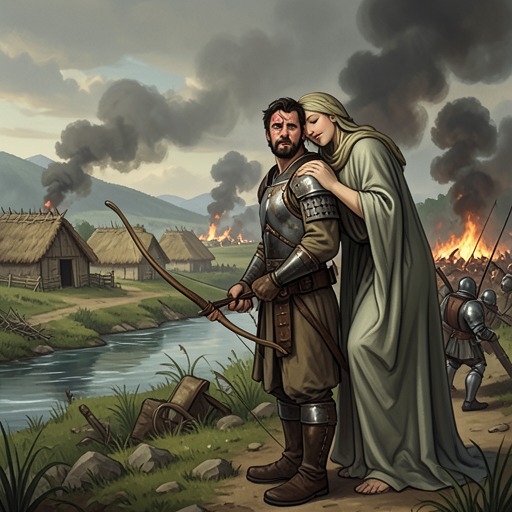
Gandiva
Bhagavad GitaGandiva is Arjuna’s bow and the most immediate material sign of his crisis before the Battle of Kurukshetra. When the weapon slips from his hand as he looks upon teachers, elders, friends, and relatives in both armies, the bow turns a private anguish into a visible refusal of action. Its recovery belongs to the larger movement by which Krishna redirects Arjuna from grief and confused duty toward disciplined action and obedience.
Identity and Martial Function
Gandiva appears as the characteristic weapon of Arjuna, who raises it when the two armies have been assembled and the first missiles are about to be exchanged. Its presence places him within the battlefield role expected of him: he is not merely an observer of the conflict but a principal combatant prepared to confront the Kaurava forces. The bow therefore carries an established relation between person and duty. Arjuna’s hand on Gandiva signifies readiness for battle before the emotional reversal that follows.
The weapon is also connected with Arjuna’s position beside Krishna on their great chariot. Krishna places the chariot between the two armies at Arjuna’s request, giving him the vantage from which he can inspect those with whom he must fight. Gandiva remains the instrument through which that contemplated decision could become action, but the inspection changes the meaning of its use. What first appears to be a straightforward martial preparation becomes a confrontation with kinship, reverence, and inherited obligation.
The Bow and Arjuna’s Crisis
Arjuna’s distress is expressed through the body before it is fully organized into argument. His limbs grow languid, his mouth dries, his body trembles, his hair stands on end, and his skin burns. In the middle of this sequence, he states that Gandiva slips from his hand. The detail gives his moral hesitation a concrete form: the warrior’s defining implement is no longer securely held, just as his understanding of what he ought to do is no longer secure.
The bow’s failure is not caused by an enemy’s attack or by physical defeat. It results from Arjuna’s sight of the assembled kinsmen for whose sake sovereignty, enjoyment, and life would ordinarily be desired. He sees preceptors, fathers, sons, grandsires, maternal uncles, fathers-in-law, grandsons, brothers-in-law, and other relatives prepared to die. Gandiva consequently becomes the point at which martial competence collides with family feeling. The weapon is ready for violence, while Arjuna’s conscience recoils from the consequences of using it.
Arjuna’s argument expands from personal grief into a social and religious judgment. He fears that killing the Kaurava kinsmen will destroy the race, extinguish its eternal customs and family rites, produce sin, corrupt the women of the race, cause an intermingling of social groups, and deprive ancestors of their offerings of pinda and water. He concludes that victory and sovereignty would be empty if won through the slaughter of those who give them meaning. The slipping of Gandiva thus introduces a chain of consequences reaching beyond the battlefield to family continuity, ritual obligation, and the fate of the dead.
Casting Aside the Weapon
After declaring that he does not wish to fight, Arjuna speaks of the greater evil involved in killing Bhishma and Drona, whom he regards as worthy of worship. He says that living on alms would be preferable to enjoying pleasures stained by the blood of his preceptors, and he asks Krishna to instruct him because his judgment about duty has become unsettled. The bow’s earlier slipping now culminates in a deliberate withdrawal from combat.
Sanjaya reports that Arjuna casts aside his bow and arrows and sits down on the chariot, his mind overwhelmed by grief. This is more than a pause in preparation. The object that could have enabled the first decisive act of the battle is physically rejected, and the warrior who had raised it becomes silent. The battlefield remains the setting, but the action temporarily turns inward: the decisive struggle is now between competing conceptions of duty, compassion, sin, family loyalty, and righteous action.
Reinterpretation Through Krishna’s Teaching
Krishna responds by challenging Arjuna’s despondency and urging him to rise. His teaching gradually changes the status of the action represented by Gandiva. Arjuna is instructed to dedicate actions to Krishna, fix his thoughts on him, and act without attachment to the fruits of action. The issue is no longer whether the bow can be used in anger or for personal gain, but whether action can be performed as duty without possessive attachment to its results.
Krishna later tells Arjuna that refusing to fight from self-conceit would be vain, because nature would constrain him to perform the duty arising from his own nature. He also declares that if Arjuna will not listen and thinks, “I will not fight,” that resolution will fail. The teaching therefore places the discarded weapon within a larger account of agency: Arjuna’s personal refusal cannot by itself escape the obligations and forces that define his position.
The cosmic revelation intensifies this redefinition. Krishna declares, “I am Death, the destroyer of the worlds,” and tells Arjuna that the warriors standing in the divisions have already been slain by him. Arjuna is to become an instrument and fight, while Krishna names Drona, Bhishma, Jayadratha, Karna, and other heroic warriors among those already destined for destruction. Gandiva’s significance consequently shifts from being the source of independent violence to being the human instrument through which a cosmic process is enacted.
Significance and Resolution
Gandiva’s central narrative function lies in its contrast between visible readiness and inward refusal. It is raised at the threshold of battle, slips when Arjuna beholds his relatives, and is then cast aside when grief overcomes him. These successive gestures give the opening crisis a clear material rhythm: preparation, destabilization, and abandonment. The bow makes Arjuna’s ethical conflict legible without reducing it to an abstract debate.
The later teaching does not erase the compassion that caused Gandiva to fall. Instead, it places that compassion within a hierarchy of knowledge, duty, nature, devotion, and divine command. Arjuna’s final declaration that his delusion has been destroyed, his doubts dispelled, and that he will do Krishna’s bidding marks the restoration of decision. Although the supplied passage does not narrate the subsequent physical lifting of Gandiva, it establishes the spiritual and dramatic condition for its return to use: Arjuna accepts the command to act, and the weapon’s abandonment no longer defines the end of his role as a warrior.