Kalpa
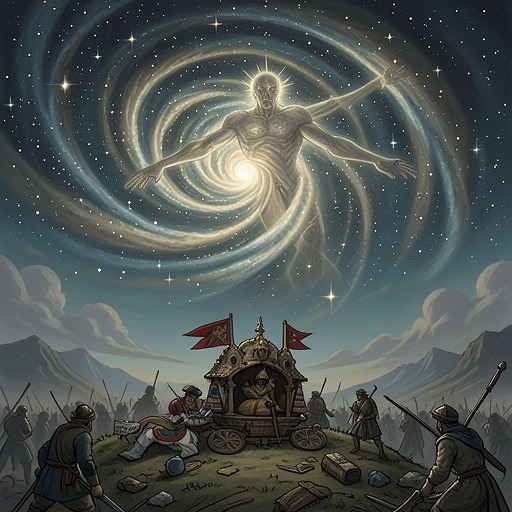
Bhagavad GitaKalpa is the immense cosmic period that gives the universe its rhythm of manifestation and dissolution. In Krishna’s teaching, it is not simply a measure of duration but a structure of recurring creation: beings arise, return to the unmanifest at the close of a Kalpa, and are brought forth again when the next Kalpa begins. Against this immense cycle, the highest goal is defined as that which does not perish and from which there is no return.
Cosmic Creation and Dissolution
At the close of a Kalpa, all entities attain to Krishna’s nature. At its beginning, he creates them again, regulating his own independent nature and setting the universe into manifestation once more. The world is therefore presented as plastic and subject to nature, not as a permanently fixed arrangement. Krishna remains unattached to these acts of creation; as the overlooker, he permits primal nature to produce the universe of moving and unmoving beings without becoming fettered by the work it performs.
This cycle also explains why the universe repeatedly passes through birth and destruction. Creation is not a single event followed by an irreversible historical progression. It is a recurrence governed by the relation between the manifest and the unmanifest, with the same assemblage of creatures appearing again and again and dissolving when the cosmic period ends. The ordinary world is thus placed within a rhythm larger than any individual life or earthly conflict.
The Day and Night of Brahma
The scale of the Kalpa is clarified through the imagery of the Day of Brahma and the Night of Brahma. A day of Brahma ends after a thousand Yugas, and a night lasts for another thousand Yugas. When the cosmic day arrives, everything manifest springs from the unmanifest; when the cosmic night comes, all things disappear into that same unmanifest condition. The alternation of day and night transforms cosmic time into a vast breathing movement of emergence and withdrawal.
The creatures that arise with the cosmic day do not escape the force of action. They are compelled to reappear when the next day begins, just as they dissolve when night arrives. Their recurrence is therefore not random: it is connected with action and its consequences. The imagery joins cosmology to moral causation, making the universe’s temporal rhythm also a framework for understanding repeated embodiment.
Beyond the Cosmic Cycle
Although the manifest universe dissolves at the end of each Kalpa, Krishna describes another unmanifest entity beyond the unmanifest state into which creatures disappear. This higher reality is eternal and indestructible; it is not destroyed when all other entities are destroyed. It is called the highest goal and Krishna’s Supreme seat, attained by those who do not return.
The contrast is decisive. Ordinary existence is cyclical, even on the scale of Brahma’s immense day and night, while the Supreme reality stands outside destruction and recurrence. All worlds, from the abode of Brahma downward, pass through rebirth, but reaching Krishna brings an end to rebirth. The Kalpa therefore marks both the grandeur and the limitation of cosmic existence: it is vast beyond human measure, yet still belongs to the transient order.
Paths Through Time and Return
Krishna further distinguishes two enduring paths by which devotees depart from life. The path of fire, light, day, the bright fortnight, and the six months of the northern solstice leads those who know Brahman to Brahman without return. The path of smoke, night, the dark fortnight, and the six months of the southern solstice leads to lunar light and then back to return.
These paths place individual death within the same cosmic order that governs the Kalpa. Departure is not treated as an isolated end but as a passage whose direction determines whether the soul returns to the cycle or reaches the imperishable goal. Knowing the two paths prevents delusion and strengthens the instruction that Arjuna should remain devoted at all times.
Significance for Human Action
The doctrine of the Kalpa enlarges the meaning of action without making action irrelevant. Arjuna’s immediate crisis occurs on the sacred plain of Kurukshetra, but Krishna frames his decision within a universe that repeatedly creates and dissolves worlds. The teaching does not tell him that temporal events are meaningless; instead, it directs him to act without attachment to the fruits of action and to orient his mind toward the reality beyond cyclical existence.
In this structure, Kalpa functions as a measure of cosmic recurrence and as a contrastive boundary. Creation returns, beings return, and worlds return, while the Supreme remains beyond return. The concept thus binds together cosmology, moral causation, devotion, and liberation: the universe turns through immense cycles, but disciplined knowledge and devotion offer a way beyond the turning.