Kaurava army
Bhagavad GitaThe Kaurava army is the assembled force of Dhritarashtra's sons at Kurukshetra, the military counterpart to the Pandava army and the immediate collective object of Arjuna's hesitation. Its presence turns a dynastic conflict into a crisis of kinship, duty, reputation, and cosmic order: the army is not merely an opposing formation but a gathering of teachers, elders, relatives, and renowned warriors whom Arjuna cannot regard as ordinary enemies.
Formation and Command Structure
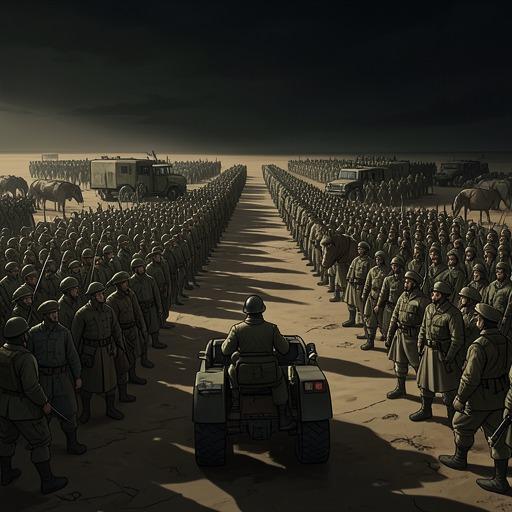
The army is first seen arrayed on the sacred plain of Kurukshetra, where Dhritarashtra asks Sanjaya what his sons and the Pandavas did after assembling with the desire to fight. Sanjaya's account places the Kaurava army within a formal battlefield hierarchy. Duryodhana approaches Drona after observing the opposing Pandava formation and names the principal figures on his own side: Drona himself, Bhishma, Karna, Kripa, Ashwatthaman, Vikarna, Saumadatta, and Jayadratha. Around these leaders stand many other heroic warriors, armed with varied weapons and prepared to lay down their lives for Duryodhana.
Duryodhana's assessment of the two forces is strategically revealing. He describes his own army as protected by Bhishma but insufficient, while judging the Pandava force, protected by Bhima, sufficient. His response is not complacency but an order to the assembled warriors: they must station themselves at the entrances of their assigned divisions and protect Bhishma alone. The command makes Bhishma the army's crucial defensive center and shows that the army's strength depends not only on numbers or individual prowess but on disciplined protection of its grandsire and leader.
The Army at the Opening of Battle
The Kaurava army's formation is answered by a ceremonial and martial uproar. Bhishma gives Duryodhana joy by uttering a leonine roar and blowing his conch; immediately, conches, drums, cymbals, and horns sound together. The noise establishes the scale of the confrontation before any individual combat is described. It is a public declaration of readiness, a collective assertion of power, and the acoustic threshold between deliberation and violence.
The Pandava response intensifies the contrast. Krishna and Arjuna, stationed on a great chariot drawn by white horses, blow the Panchajanya and Devadatta. Bhima, Yudhishthira, Nakula, Sahadeva, and numerous other Pandava champions sound their own conches. The reverberation through heaven and earth rends the hearts of the Dhritarashtra troops. Thus the Kaurava army is introduced not as an unshaken mass but as a force already affected by the opposing army's answer, with its collective confidence placed under pressure before the combat fully begins.
Kinship, Conflict, and Arjuna's Refusal
When Arjuna asks Krishna to place his chariot between the two armies, Krishna positions it before Bhishma, Drona, and the assembled kings. From there Arjuna looks across the battlefield and recognizes the people standing in both armies: sires and grandsons, friends, a father-in-law, well-wishers, teachers, sons, grandsires, maternal uncles, grandsons, brothers-in-law, and other kinsmen. The Kaurava army therefore becomes, in Arjuna's vision, a family network transformed into a battlefield formation.
This recognition produces his physical collapse. His limbs grow languid, his mouth dries, his body trembles, his hair stands on end, his skin burns, and Gandiva slips from his hand. He cannot stand steadily and believes his mind is wandering. The army's presence has changed the meaning of victory: sovereignty, pleasures, and even life appear useless if the people for whose sake they are desired are killed in the struggle.
Arjuna's objection extends beyond personal grief. He argues that killing the Kaurava forces would bring sin even if they are treated as enemies, because they remain his own kinsmen. He fears the extermination of a race, the loss of family customs, the corruption of women, the intermingling of castes, the abandonment of ancestral rites, and the fall of ancestors from heaven when offerings of pinda and water cease. In this argument, the army represents the threatened destruction of an entire social and ritual order, not simply the deaths of individual combatants.
Arjuna finally declares that it would be better for the sons of Dhritarashtra to kill him while he remains unarmed and unresisting than for him to slay his own relatives out of desire for sovereignty. Having spoken this way on the battlefield, he casts aside his bow and arrows and sits down on his chariot, leaving the Kaurava army temporarily opposed by a warrior who refuses to fight.
Krishna's Reframing of the Army
Krishna answers Arjuna's grief by separating the imperishable soul from the mortal body and by insisting that death and rebirth belong to an unavoidable condition of embodied existence. The body is compared to a worn-out robe that is cast off for a new one; weapons cannot cleave the soul, fire cannot consume it, water cannot drench it, and wind cannot dry it. From this perspective, the Kaurava warriors' bodies can perish, but the indestructible soul is not slain.
Krishna also reframes the army through Arjuna's social duty as a Kshatriya. A fair battle that arrives of itself is described as an open gate of heaven for a Kshatriya, while refusing such a just battle brings sin through abandonment of duty and lasting infamy. If Arjuna is slain, he will attain heaven; if victorious, he will enjoy the Earth. Krishna therefore directs him to regard pleasure and pain, gain and loss, victory and defeat as equal and to fight for the sake of battle itself, without attachment to its fruits.
The broader teaching of action makes the army part of a larger ethical problem. No person can remain without action even for a moment, and action is better than inaction. Work performed for sacrifice does not bind in the same way as work performed from attachment, while action undertaken for personal fruit creates bondage. The battlefield thus becomes the setting in which Arjuna must learn to act without treating victory, possession, or personal reward as his motive.
Cosmic Determination and Narrative Significance
The Kaurava army receives its most radical reinterpretation during Krishna's revelation of the Vishvarupa. Arjuna sees the sons of Dhritarashtra, the hosts of kings, Bhishma, Drona, Karna, and the leading warriors rushing into Krishna's terrible mouths. Some strike against the spaces between the deity's teeth with their heads crushed; others enter like rivers flowing toward the ocean or moths rushing into a blazing fire. The imagery changes the army from a political force into a multitude already moving toward destruction within a cosmic process.
Krishna then identifies himself as Death, the destroyer of worlds, fully developed, and says that he is engaged in slaying the human race. Without Arjuna, the warriors in the different divisions will cease to be; Arjuna is told to rise, gain glory, vanquish the foe, and become Krishna's instrument. Drona, Bhishma, Jayadratha, Karna, and other heroic warriors are declared already slain by Krishna, while Arjuna is commanded to fight rather than be dismayed.
The army consequently stands at the intersection of two explanations of war. At the human level, it is a force commanded by Duryodhana, protected by Bhishma, and composed of identifiable warriors bound by loyalty, training, and kinship. At the cosmic level, its destruction is presented as already encompassed by Krishna's power. This double status intensifies rather than erases Arjuna's responsibility: he must act, but he is instructed to understand himself as an instrument rather than the independent author of the outcome.
The army's final significance is therefore ethical and theological as much as military. It provokes Arjuna's refusal, supplies the concrete occasion for Krishna's teaching on the soul, duty, action, and detachment, and becomes one of the central images through which mortality is absorbed into cosmic inevitability. By the end of the dialogue, Arjuna's delusion has been destroyed, his doubts dispelled, and he declares that he will do Krishna's bidding. The Kaurava army remains the opposing force on the field, but its narrative function has expanded: it is the human face of a conflict that the teaching recasts as a test of duty within an ordered universe.