Krishna–Arjuna Dialogue
Bhagavad GitaThe Krishna–Arjuna Dialogue is the central dramatic and philosophical event of the Bhagavad Gita: on the eve of the Battle of Kurukshetra, Arjuna asks Krishna to place their chariot between the opposing armies, sees teachers, elders, relatives, friends, and allies on both sides, and collapses into grief. Krishna answers not with a single command but with a sequence of arguments that moves from the immortality of the soul to the obligations of social duty, from action without attachment to knowledge and devotion, and finally to a direct appeal for surrender and obedience. The dialogue’s decisive consequence is visible in Arjuna’s final response: his delusion is destroyed, his doubts are dispelled, and he declares that he will do Krishna’s bidding.
Battlefield Setting and Crisis
The conversation begins within the sacred setting of Kurukshetra, where Dhritarashtra asks Sanjaya what his sons and the Pandavas did after assembling for battle. Sanjaya describes Duryodhana surveying the Pandava army and naming its prominent warriors, while Bhishma’s roar and the answering conches, drums, cymbals, and horns turn the field into a charged threshold between deliberation and violence. Krishna and Arjuna stand together in a great chariot yoked to white steeds; Krishna blows Panchajanya, while Arjuna blows Devadatta.
Arjuna initiates the dialogue by asking Krishna to drive the chariot between the two armies so that he can observe those with whom he must contend. Krishna complies and places the chariot before Bhishma, Drona, and the assembled rulers. The requested view produces a reversal in Arjuna’s understanding of the battle. What had been an organized military confrontation becomes, before his eyes, a conflict against sires, grandsons, friends, father-in-law, teachers, and other kinsmen. The battlefield therefore becomes both a political space and a moral tribunal: the same sight that should prepare Arjuna for combat exposes the human cost that makes combat intolerable to him.
Arjuna’s Refusal and Moral Argument
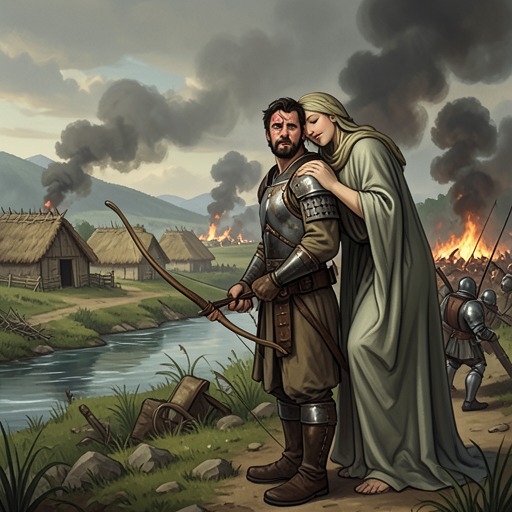
Arjuna’s crisis is physical as well as intellectual. His limbs grow languid, his mouth dries, his body trembles, his hair stands on end, his skin burns, and Gandiva slips from his hand. He says that he does not desire victory, sovereignty, pleasures, or even life if the people for whose sake those goods are sought are standing ready to die. His refusal is not presented as simple fear. He argues that killing teachers and relatives would stain any enjoyment with blood, and that no earthly kingdom, or even sovereignty over the three worlds, could compensate for such destruction.
His reasoning expands from personal affection into a theory of social catastrophe. He fears that the extermination of a race will destroy its eternal customs, that the loss of those customs will allow sin to prevail, and that the resulting corruption and intermixture of castes will bring ruin upon both the living and the ancestors whose rites of pinda and water would cease. Even if the opposing warriors are morally blinded by avarice, Arjuna argues, those who understand the consequences should abstain from the sin. He concludes that it would be better to be killed unarmed and unresisting than to slay his own kinsmen for the sweets of sovereignty.
Krishna initially rebukes this despondency as unbecoming a person of noble birth and as a weakness that brings infamy. He urges Arjuna to shake it off and rise. Arjuna responds by making the crisis explicit: he cannot determine whether conquering Bhishma and Drona or being conquered by them would be better. His compassion has unsettled his sense of duty, and he asks Krishna to instruct him, declaring himself Krishna’s disciple and seeking guidance that could dispel his grief even if he gained a prosperous kingdom or the sovereignty of the gods. He then says, “I will not fight,” and falls silent.
Krishna’s Doctrines of Self and Action
Krishna’s first sustained answer separates the imperishable self from the perishable body. The wise, he says, do not grieve for the dead or the living, because embodied existence passes through childhood, youth, and old age before acquiring another body. Sensory contacts produce heat and cold, pleasure and pain, but these experiences have a beginning and an end; endurance of them is part of the discipline required for emancipation. The soul is described as immortal, unborn, unchangeable, ancient, and untouched by bodily destruction. Like a person casting off worn-out robes and putting on new ones, the embodied soul casts off worn-out bodies and enters new ones. Weapons cannot cleave it, fire cannot consume it, water cannot drench it, and wind cannot dry it.
This teaching does not erase the seriousness of the battle; it changes the ground on which its seriousness is judged. Even if one regarded beings as repeatedly born and repeatedly dying, Krishna argues, death would remain certain for the born and birth certain for the dead. Beings are unmanifest before birth, manifest for an interval, and unmanifest again at death. Arjuna’s grief therefore cannot alter an unavoidable process. Krishna then turns from metaphysics to social obligation: for a Kshatriya, a fair and just battle is a duty, and abandoning it would bring sin, dishonor, and the contempt of warriors who would interpret his withdrawal as fear.
Krishna next redirects Arjuna from the result of action to the manner in which action is performed. Pleasure and pain, gain and loss, victory and defeat are to be regarded equally; action undertaken in this equanimity does not bind the actor in sin. He explains that work is unavoidable: no one can remain even for a moment without acting, and mere renunciation of work cannot produce liberation. The deceptive person restrains the senses outwardly while dwelling mentally on sense objects, whereas the disciplined person controls the senses through the mind and engages in work without attachment.
The dialogue presents sacrifice as the principle that frees action from selfish possession. Work performed for sacrifice sustains the cosmic exchange between human beings and the gods; food sustains creatures, sacrifice proceeds from work, and work proceeds from the Vedas. One who consumes what has been given without returning an offering is compared to a thief, while those who eat the remnants of sacrifice are freed from sin. The fully self-contented person has no personal dependence on action, yet Krishna insists that the wise must still work for the preservation of order and for the example they set to others. Even Krishna, who has nothing to gain in the three worlds, continues to act because if he did not, people would follow his inactivity and the worlds would perish.
Knowledge, Devotion, and Cosmic Authority
Krishna presents the teaching as an ancient discipline transmitted from Vivasvat to Manu, from Manu to Ikshaku, and through the royal sages before being lost to the world and declared again to Arjuna. Arjuna questions how Krishna could have taught Vivasvat when Krishna’s birth appears later. Krishna answers that many births have passed for both of them, but that he remembers them while Arjuna does not. Though unborn and imperishable, Krishna takes birth through his own power when piety declines and impiety rises. His recurrent descent serves the protection of the righteous, the destruction of evildoers, and the reestablishment of piety age after age.
The teaching also gives action a larger metaphysical framework. All works are performed by the qualities of nature, while the deluded ego imagines itself to be the actor. One who distinguishes the self from the qualities and their works is not attached to action. Krishna therefore commands Arjuna to devote his works to him, direct his mind toward the self, and enter battle without desire, affection, or weakness. Knowledge does not mean abandoning the world; it means seeing action, nature, duty, and agency without mistaking the ego for the ultimate doer.
In the teaching on death and liberation, Krishna states that remembering him at the final moment leads to his essence, while whatever form a person habitually remembers at death determines the destination reached. He consequently tells Arjuna to think of him at all times while engaging in battle. Continuous meditation, disciplined concentration, and the utterance of Om at the moment of departure lead toward the highest goal. The contrast between return and release is expressed through cosmic cycles: Brahma’s day and night each extend across a thousand Yugas, creation emerges from the unmanifest during the day and dissolves into it during the night, while an eternal unmanifest reality lies beyond that cycle and is not destroyed when other beings are destroyed.
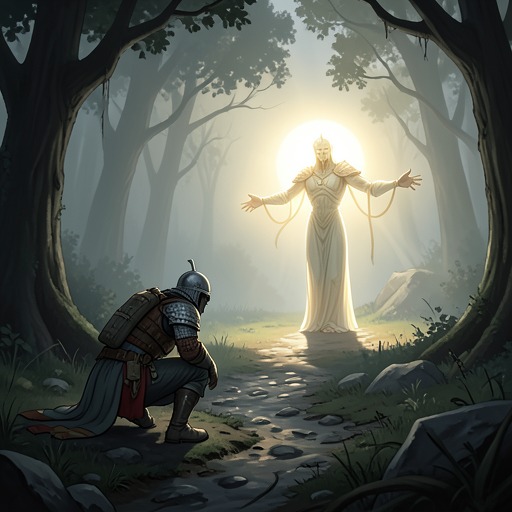
The dialogue’s most overwhelming revelation comes when Krishna discloses his cosmic form. Arjuna sees warriors from both armies entering Krishna’s blazing mouths, their heads crushed between terrible teeth, moving toward destruction like rivers rushing to the ocean or moths flying into fire. When Arjuna asks who Krishna is in this fierce form, Krishna answers, “I am Death, the destroyer of the worlds, fully developed.” He declares that the warriors are already slain and that Arjuna is to become his instrument. Drona, Bhishma, Jayadratha, Karna, and other heroic warriors have already been killed by Krishna’s power; Arjuna must rise, fight, and gain glory rather than imagine that the outcome depends solely on his individual agency.
Final Decision and Narrative Consequences
At the close of the dialogue, Krishna combines freedom and command. He tells Arjuna to reflect fully on the teaching and act as he chooses, but then speaks the most intimate instruction: Arjuna should set his heart on Krishna, become his devotee, sacrifice to him, bow to him, and take him as his sole refuge. Krishna promises deliverance from sin and asks Arjuna not to grieve. The discourse is described as a supreme mystery whose transmission is reserved for those prepared to receive it, while studying or hearing the sacred conversation with faith is itself treated as a sacrifice of knowledge.
Arjuna’s answer marks the event’s decisive value shift. The warrior who had looked upon the armies and seen only unbearable kin-slaying now says that his delusion has been destroyed, his recollection restored through Krishna’s favor, his firmness recovered, and his doubts dispelled. He will do Krishna’s bidding. The dialogue has not changed the armies, removed the dead, or made the battle less violent; it has changed Arjuna’s relation to action. His paralysis gives way to disciplined obedience, and private grief is reinterpreted through duty, knowledge, devotion, and the recognition that Krishna’s cosmic order already encompasses the battle’s destruction.
Sanjaya’s narration gives the exchange a further frame. Through Vyasa’s favor, Sanjaya hears the supreme mystery directly from Krishna, the Lord of Yoga, and repeatedly recalls both the wonderful conversation and Krishna’s astonishing form. His amazement and joy endure through recollection, and he ends by locating prosperity, victory, greatness, and eternal justice where Krishna and the great bowman Arjuna are together. The dialogue thus becomes more than a private instruction: it is preserved as a repeatable sacred utterance, a teaching heard by Sanjaya, transmitted to Dhritarashtra, and offered to later readers as a practical answer to dilemmas that arise within the material world.
Significance of the Event
The Krishna–Arjuna Dialogue derives its force from the collision of two legitimate-looking obligations. Arjuna’s compassion is directed toward the faces and relationships before him, while Krishna insists that personal revulsion cannot by itself determine the demands of duty. The conversation does not treat action and renunciation as simple opposites. It argues instead for action without attachment, knowledge without withdrawal from responsibility, and devotion expressed through the performance of one’s own work.
Its setting gives these doctrines an unusually dramatic form. The teaching unfolds not in a secluded school but between two armies at the instant when weapons are about to be used. A battlefield becomes a sacred space; a moment of hesitation becomes a revelation of the immortal self and the cosmic scale of time; and a warrior’s refusal becomes the starting point for a complete reorientation of action. The result is the defining narrative movement of the Bhagavad Gita: grief, inquiry, revelation, recognition, and renewed resolve.