Night of Brahma
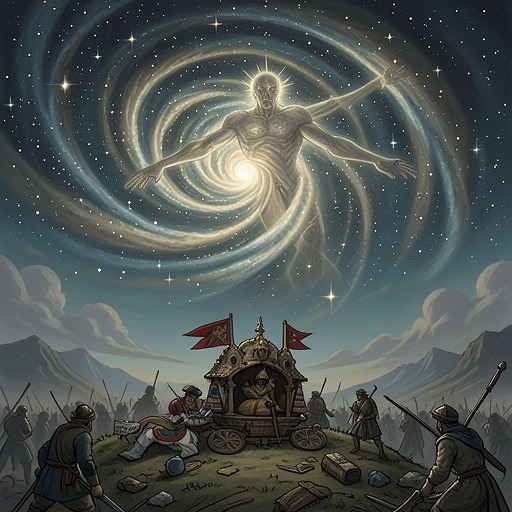
Bhagavad GitaNight of Brahma is the period of cosmic dissolution in the Bhagavad Gita’s account of time, when the manifest world withdraws into the unmanifest. It is not merely a metaphor for ordinary sleep or an individual death: it is a universe-scale interval in which creatures and forms disappear, while the cycle of manifestation remains governed by action. Against this recurring rhythm, the text places a higher, imperishable reality and presents devotion as the means of passing beyond return.
Definition and Cosmic Cycle
Night of Brahma is defined through its relation to Day of Brahma. A day of Brahma ends after a thousand Yugas, and a night likewise lasts for a thousand Yugas. When the day arrives, what is manifest proceeds from the unmanifest; when night comes, the whole manifest order disappears into that same unmanifest condition. The sequence therefore resembles an immense breathing of the cosmos: emergence is followed by withdrawal, and withdrawal prepares the conditions for another emergence.
The cycle is recurrent rather than final. The same assemblage of creatures arises again and again when day returns and dissolves again when night begins. Their reappearance is not presented as random renewal, since it occurs under the force of action and its consequences. Night of Brahma thus suspends visible existence without abolishing the causal structure that binds beings to recurrence.
Relation to Birth, Death, and Rebirth
The cosmic night extends the Gita’s distinction between visible bodies and the enduring principle associated with the soul. Beings are unmanifest before birth, manifest between birth and death, and unmanifest again when death arrives. This smaller rhythm of individual existence anticipates the larger rhythm of Brahma’s day and night. What appears to be an absolute ending is instead a return from manifestation to concealment.
That comparison changes the meaning of grief. The battlefield of Kurukshetra is introduced as a sacred plain where Dhritarashtra asks Sanjaya what his sons and the Pandavas did when assembled for battle. The immediate crisis concerns embodied warriors and the possibility of their destruction, but the teaching places their fate within a wider order in which manifestation and disappearance are unavoidable features of existence. The cosmic scale does not erase the battlefield’s moral stakes; it explains why death cannot be treated as the destruction of the imperishable self.
Beyond the Unmanifest
The Gita does not identify the unmanifest state associated with cosmic night with the highest reality. It speaks of another unmanifest and eternal entity beyond that unmanifest condition, one that is not destroyed when all other entities are destroyed. This reality is described as indestructible and as the supreme goal. Reaching it means that the individual does not return, unlike those who remain within the recurring cycle.
This distinction is the central limit placed on Night of Brahma. Cosmic dissolution may withdraw the universe, but it does not itself constitute liberation. The repeated alternation of day and night belongs to the order of return; the supreme seat lies beyond that order. The teaching therefore separates two kinds of transcendence: temporary release from manifestation during the cosmic night, and final passage beyond rebirth through attainment of the eternal.
Paths of Return and Non-Return
The Gita associates departure from embodied life with two enduring cosmic paths. The path of fire, light, day, the lighted fortnight, and the six months of the northern solstice leads those who know Brahman to Brahman, without return. The path of smoke, night, the dark fortnight, and the six months of the southern solstice leads a devotee to lunar light and then back again.
Night therefore has a double significance. As Night of Brahma, it is the vast dissolution into which the manifest universe disappears. As one element in the darker path after death, night belongs to a route that culminates in return. The contrast makes the text’s hierarchy of destinations precise: not every passage beyond ordinary visibility is liberation, and not every encounter with the unmanifest ends the cycle of rebirth.
Religious and Narrative Significance
The doctrine of Night of Brahma turns the battlefield dialogue into more than a response to one warrior’s hesitation. The Bhagavad Gita, meaning “the divine song,” is part of the Sanskrit Mahabharata and occupies the twenty-fifth through forty-second sections of its sixth book. Its immediate setting is the conflict at Kurukshetra, but its teaching repeatedly expands from that historical crisis into cosmic time.
That expansion gives the dialogue its characteristic tension. Krishna instructs Arjuna to remember him at the final moment, to meditate on him, and also to engage in battle. The proper response to impermanence is therefore not passive withdrawal from all activity. Action must be performed according to one’s own duty, without attachment to its fruits; even a person who has perfected knowledge continues to act without being bound by action. Night of Brahma supplies the cosmic background for this discipline, while the battlefield supplies its practical test.
The concept also clarifies the relation between duty and liberation. Every person reaches perfection by performing his or her own duty, and one’s own duty is better even when performed imperfectly than another’s duty performed well. Yet such action becomes spiritually decisive only when it is offered without attachment and directed toward the Supreme. The cosmic night reveals the instability of worlds; disciplined action and devotion answer that instability by seeking the imperishable reality beyond it.