Pandava–Kaurava conflict
Bhagavad GitaThe Pandava–Kaurava conflict is not merely a contest for sovereignty but a war that turns family bonds into the battlefield’s central moral fact. At Kurukshetra, the Pandavas and the Kauravas assemble with their armies, relatives, teachers, allies, and hereditary obligations entangled on both sides. The conflict’s decisive significance lies in the way it forces Arjuna to confront a contradiction that military victory cannot resolve by itself: the duty to fight a just battle appears inseparable from the destruction of the very people for whose sake a kingdom would be desired.
Dynastic Armies on the Sacred Plain
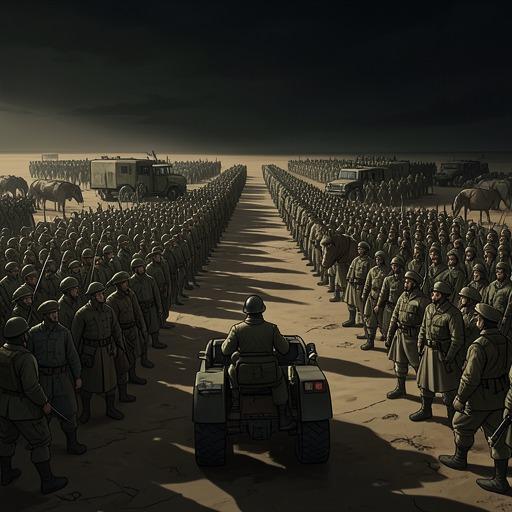
The conflict begins in the charged setting of Kurukshetra, described as a sacred plain where the sons of Dhritarashtra and the Pandavas have gathered out of a desire for battle. Dhritarashtra’s opening question is directed to Sanjaya, making the war at once a political event and a narrated act of witnessing. The king asks what the two sides did after assembling, while Sanjaya supplies the view of the battlefield that Dhritarashtra cannot see directly.
Duryodhana first surveys the Pandava army and addresses Drona, his preceptor. He identifies the force as vast and carefully arrayed by Dhrishtadyumna, the son of Drupada and Drona’s intelligent disciple. The Pandava ranks include Yuyudhana, Virata, Drupada, Dhrishtaketu, Chekitana, the ruler of Kasi, Purujit, Kuntibhoja, Saivya, Yudhamanyu, Uttamaujas, Subhadra’s son, and the sons of Draupadi. The list emphasizes that the opposing army is not an anonymous mass: it is composed of recognized heroes, family connections, former teachers, and political allies.
Duryodhana then names the distinguished warriors on his own side: Drona, Bhishma, Karna, Kripa, Ashwatthaman, Vikarna, Saumadatta, and Jayadratha, together with many other armed fighters prepared to lay down their lives for him. He nevertheless contrasts the two formations by calling his army insufficient despite its protection by Bhishma, while describing the Pandava force, protected by Bhima, as sufficient. His response is practical and defensive: the warriors are ordered to guard Bhishma at the entrances to their divisions.
The armies’ readiness is announced through sound. Bhishma gives a leonine roar and blows his conch, after which conches, drums, cymbals, and horns create a vast uproar. Krishna and Arjuna, standing together in a great chariot yoked to white steeds, answer with their celestial conches: Krishna blows Panchajanya and Arjuna Devadatta, while Bhima sounds Paundra, Yudhishthira Anantavijaya, and Nakula and Sahadeva Sughosa and Manipushpaka. Other major warriors also blow their conches, and the reverberation through heaven and earth terrifies the Dhritarashtra troops. The ceremony of war therefore carries both military and symbolic force: each side announces its presence, lineage, courage, and readiness before the first decisive human hesitation occurs.
The Battlefield Becomes a Family Tribunal
Just as the throwing of missiles is beginning, Arjuna asks Krishna to place his chariot between the two armies. He wants to observe those assembled for battle and identify the men with whom he must contend while they fight for the purposes of Duryodhana, whom he calls evil-minded. Krishna places the chariot before Bhishma, Drona, and the assembled kings, directing Arjuna’s sight toward the center of the conflict rather than toward an abstract enemy.
From that position Arjuna sees sires, grandsons, friends, fathers-in-law, well-wishers, preceptors, sons, grandsires, maternal uncles, grandsons, brothers-in-law, and other kinsmen standing in both armies. The opposing forces are thus revealed as a single social and familial network split into armed divisions. The war’s immediate military logic is interrupted by recognition: the men who must be killed are precisely those whose presence gives victory its supposed value.
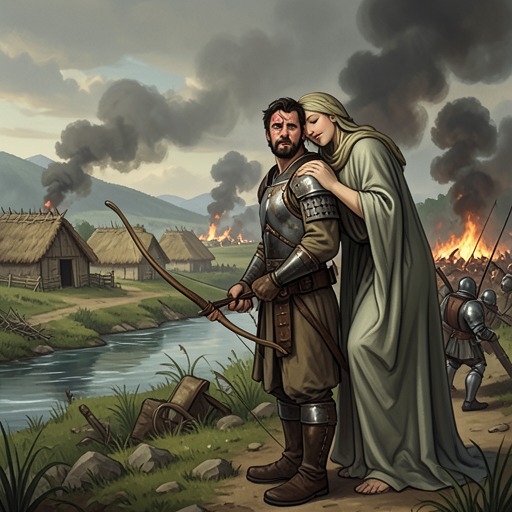
Arjuna’s physical response records the impact of that recognition. His limbs become languid, his mouth dries, his body trembles, his hair stands on end, and his skin burns. Gandiva slips from his hand; he cannot remain standing, and his mind seems to wander. The symptoms are not incidental weakness but the bodily form of an ethical crisis. The warrior who has been introduced through martial skill can no longer hold the weapon that defines his role.
He rejects victory, sovereignty, pleasure, and even life when their price is the death of his own people. Kingdom and enjoyment have meaning only because they are desired for the sake of those now arrayed against him. With preceptors, fathers, sons, grandsires, maternal uncles, fathers-in-law, grandsons, brothers-in-law, and kinsmen facing him, Arjuna cannot see what gratification could remain after their destruction. Even if they would kill him, he says that he does not wish to kill them, not even for sovereignty over the three worlds.
Kinship, Sin, and the Refusal to Fight
Arjuna’s objection expands from personal grief into a theory of social catastrophe. Killing the sons of Dhritarashtra would be sinful even if they are regarded as foes, because the destruction of a race would destroy its eternal customs. Once family customs disappear, sin would overpower the surviving community; the corruption of its women would lead to intermixture of castes; and that intermixture would bring both the destroyers and the destroyed race to hell.
The consequences extend beyond the living. When family rites cease, ancestors fall because the offerings of pinda and water are no longer performed. The extinction of family rules and religious observances therefore creates a chain of damage linking battlefield violence to the dead, the unborn, domestic order, social identity, and posthumous destiny. Arjuna presents the war as an action whose effects exceed the combatants’ intentions and spread through the entire structure of inherited obligation.
He also identifies the motive that makes the catastrophe especially shameful: the desire for the sweets of sovereignty. The combatants are prepared to slay their own kinsmen for royal enjoyment, even though those whose lives and wealth would make sovereignty meaningful are the very people placed in danger. Arjuna concludes that it would be better to be killed unresisting and unarmed by the sons of Dhritarashtra than to become the agent of such destruction.
Having spoken on the battlefield, Arjuna casts aside his bow and arrows and sits down on his chariot, his mind troubled by grief. This gesture converts moral argument into visible action. The Pandava warrior does not merely announce reluctance; he temporarily withdraws from the war at the point when combat is about to begin. The conflict’s first major reversal is therefore an inward collapse within one of its most important champions.
Duty Against the Fear of Consequences
Krishna answers Arjuna by separating the imperishable soul from the perishable body. The soul is described as unborn, unchangeable, eternal, ancient, indestructible, and not slain when the body perishes. Bodies have an end, but the embodied self is not destroyed; like a person casting off worn-out robes and putting on new ones, the soul casts off worn-out bodies and enters new bodies. Weapons cannot cleave it, fire cannot consume it, water cannot drench it, and wind cannot dry it.
This teaching does not deny that death is painful or that the battlefield contains real bodies. It changes the level at which the war must be judged. Even if existence is considered in terms of continual birth and death, birth leads inevitably to death and death to birth, while beings are unmanifest before birth, manifest between birth and death, and unmanifest again after death. Krishna therefore argues that grief cannot alter what is unavoidable. The conflict is placed within a larger cycle in which visible destruction is not the final condition of the embodied self.
Krishna then turns from metaphysics to Arjuna’s social duty. As a Kshatriya, Arjuna has no duty better than a fair battle. A just battle that arrives of itself is compared to an open gate of heaven; refusal would mean abandoning the duties of his order and incurring sin and infamy. The shame would be particularly severe because respected warriors would interpret his withdrawal as fear, enemies would deride his prowess, and those who had honored him would think lightly of him. In this argument, reputation is not mere vanity: it is the public sign of whether a warrior has fulfilled the role on which social order depends.
Krishna also reframes the possible outcomes. If Arjuna is slain, he will attain heaven; if victorious, he will enjoy the Earth. He is instructed to fight while treating pleasure and pain, gain and loss, victory and defeat as equal. The ethical discipline required is therefore not attachment to triumph, nor hatred of defeat, but action performed without making its fruit the motive.
From Dynastic War to Cosmic Instrumentality
The conflict is later absorbed into Krishna’s cosmic revelation. When Arjuna sees the terrifying universal form, he beholds the sons of Dhritarashtra, Bhishma, Drona, Karna, and the principal warriors rushing into Krishna’s blazing mouths. They move like rivers flowing toward the ocean and like moths rushing into fire. Some are seen with their heads crushed against the interstices of the divine teeth. The battlefield’s human violence is thereby represented as part of a destruction already encompassing the warriors.
Krishna declares that he is Death, the destroyer of the worlds, fully developed and engaged in slaying the race of men. He tells Arjuna that the warriors standing in their divisions will cease to be without him, orders him to arise and gain glory, and names Drona, Bhishma, Jayadratha, Karna, and other heroic warriors as already slain by Krishna. Arjuna is told to become only the instrument of their destruction and is assured that, if he fights, he will conquer his foes.
This revelation alters the meaning of agency without removing Arjuna’s responsibility. The conflict is no longer presented as a private choice between compassion and ambition. Its combatants occupy a human field of action within a cosmic process of death, while Arjuna must still decide whether to assume the role assigned to him. The image of the warrior as instrument preserves the seriousness of his action even as it denies that he is the ultimate source of the destruction.
The wider teaching places the war within recurring temporal and cosmic structures. The imperishable discipline was transmitted from Vivasvat to Manu and from Manu to Ikshaku before being lost to the world and declared again by Krishna to Arjuna, who is both devotee and friend. Krishna also explains that he takes birth age after age when piety declines and impiety rises, protecting the righteous, destroying evildoers, and establishing piety. The conflict thus becomes one episode in a recurring pattern of disorder and restoration rather than an isolated dynastic accident.
The same cosmic scale appears in the account of Brahma’s day and night. After a thousand Yugas, Brahma’s day ends; during the day manifested beings arise from the unmanifest, and during the night they disappear back into it. Creatures emerge and dissolve again and again under the force of action, while another eternal, indestructible reality lies beyond the perishable unmanifest. The war’s destruction is consequently framed by cycles of manifestation and dissolution, and by the possibility of reaching a supreme state from which there is no rebirth.
The Conflict’s Ethical Resolution
The teaching does not resolve the Pandava–Kaurava conflict by declaring every action equally permissible. It distinguishes action performed for sacrifice from work that merely binds the actor, and it insists that no one can live without action. Krishna tells Arjuna that inaction alone does not free a person from work, while action performed without attachment can lead to the Supreme. The world is bound by work other than work performed for sacrifice, so duty must be carried out without grasping at its fruit.
The same principle is applied to social continuity. In the ancient order, creation and sacrifice were established together, with reciprocal obligations between human beings and the Devas. Food, creatures, work, the Vedas, and sacrifice are presented as parts of a revolving wheel. Those who consume what is given without returning anything are likened to thieves, while those who eat the remnant of sacrifice are freed from sin. The war therefore occurs within a world where action is judged by the network of obligations it sustains, not solely by private intention.
Krishna further argues that great figures must continue to act because ordinary people follow their example. Although Krishna has nothing left to acquire in the three worlds, he continues to act; if he did not, people would follow his path, the worlds would perish, and social intermixture and ruin would result. This logic makes Arjuna’s conduct exemplary as well as personal. His refusal would not simply preserve his own conscience; it could confuse the relation between individual duty and the duties that hold the world together.
At the end of the teaching, the principle of one’s own duty becomes explicit. Every person can reach perfection by performing the duty appropriate to their nature, and one’s own duty, even if imperfectly performed, is better than another’s duty performed well. A natural duty should not be abandoned merely because it is tainted by difficulty or evil, since every action is enveloped by fault as fire is by smoke. Arjuna’s reluctance therefore remains intelligible, but it cannot serve as the final standard for action.
Krishna finally warns that if Arjuna, through self-conceit, thinks that he will not fight, that resolution will be vain because nature will compel him. What he refuses to do through delusion he will perform involuntarily, bound by the duty arising from his own nature. The conflict’s final pressure is thus both external and internal: the armies stand before Arjuna, but the deeper battle concerns whether he can act without surrendering to grief, pride, fear, or attachment. The Pandava–Kaurava conflict ends in the supplied account not with a simple celebration of victory, but with Arjuna brought to the threshold of accepting action as duty, discipline, and participation in a larger order.