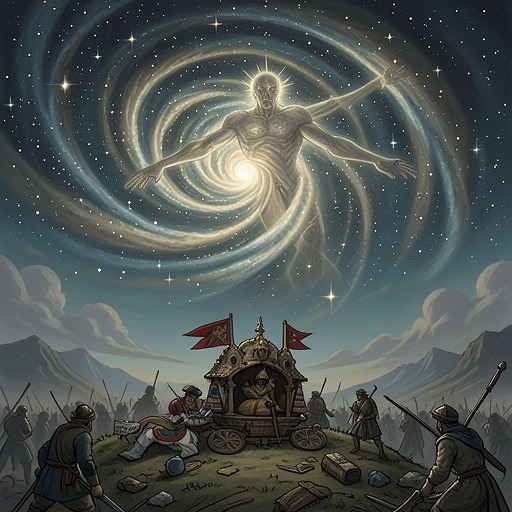
Vishvarupa Revelation
Bhagavad GitaThe Vishvarupa Revelation is the climactic disclosure of Krishna's cosmic identity to Arjuna. Requested by Arjuna after Krishna's teachings have dispelled his earlier confusion, the vision makes the invisible structure of reality visible at once: gods, creatures, worlds, time, and destruction appear gathered within Krishna's body. Its decisive consequence is not merely wonder but a redefinition of Arjuna's agency. Krishna declares that the warriors are already slain and commands Arjuna to become the instrument of a destruction already embraced by the divine order.
Request and Preparation
Arjuna asks to see Krishna's sovereign form after hearing about the creation and dissolution of beings and Krishna's greatness. He accepts Krishna's account of his divine nature and seeks direct confirmation, asking to behold the eternal Self if he is capable of receiving it. The request marks a movement from instruction to vision: Arjuna no longer wants only a doctrine about the supreme reality but an encounter with the reality itself. Krishna answers that Arjuna cannot behold him with ordinary human sight. He therefore grants him celestial sight and announces that the coming revelation will display hundreds and thousands of divine forms, diverse in color and shape, together with innumerable marvels. The entire universe of moving and unmoving things will be collected within Krishna's body, including whatever Arjuna might wish to see. The vision is thus prepared as an alteration of perception, not as an ordinary appearance that an unaided observer could simply inspect.
The Universal Form Appears
Sanjaya narrates the manifestation to Dhritarashtra. Krishna reveals a form with many mouths and eyes, innumerable aspects, celestial ornaments, raised weapons, garlands, robes, and fragrances. It is filled with every wonder, resplendent, infinite, and turned toward every direction. Its radiance is compared with the simultaneous bursting forth of a thousand suns, while Arjuna sees the entire universe, divided and subdivided into many parts, gathered within the body of the God of gods. Arjuna's first response is astonished recognition. He sees the gods, hosts of creatures, Brahma seated on his lotus seat, the Rishis, and celestial serpents. Krishna has innumerable arms, stomachs, mouths, and eyes; Arjuna can find neither beginning, middle, nor end. The diadem, mace, and discus appear within a mass of energy, while the Sun and Moon serve as his eyes and blazing fire as his mouth. Heaven and earth and all points of the horizon are pervaded by him, so that the vision abolishes any stable boundary between deity, world, and space. The form is not simply an enlarged human figure. It is a totality in which the varied orders of existence coexist: gods, Rishis, Siddhas, Rudras, Adityas, Vasus, Aswins, Maruts, Ushmapas, Gandharvas, Yakshas, Asuras, and other beings behold Krishna in amazement. Some pray with joined hands, while the wider triple world trembles. The scene turns cosmic vision into a collective reaction, establishing that the revelation exceeds not only Arjuna's private experience but ordinary divine spectatorship as well.
Terror, War, and the Devouring Mouths
Wonder gives way to fear when Arjuna sees the terrible mouths of the universal form. Their tusks, blazing radiance, innumerable limbs, and wide-open faces make the vision fierce rather than consoling. Arjuna can no longer recognize the directions or command peace of mind. His fear is intensified because the cosmic form does not stand apart from the battle: the sons of Dhritarashtra, the assembled kings, Bhishma, Drona, Karna, and the leading warriors of Arjuna's own side are already entering Krishna's mouths. The warriors move toward destruction in two extended comparisons. They rush into the flaming mouths like currents of water flowing through many channels toward the ocean, and they hasten toward the blazing fire like moths moving toward their own ruin. Krishna swallows them from every side and licks them with flaming mouths, while his energy fills and heats the universe. The battle is therefore presented not as an isolated human decision but as an episode within a vast process of consumption and dissolution. Arjuna asks who Krishna is in this fierce form and admits that he does not understand the action he is witnessing. Krishna gives the revelation its starkest name: he is Death, the destroyer of worlds, fully developed, engaged in destroying the race of men. The warriors will cease to be even without Arjuna. Drona, Bhishma, Jayadratha, Karna, and other heroic fighters have already been slain by Krishna; Arjuna is told to rise, gain glory, vanquish the foe, and become only the instrument. The command does not erase Arjuna's action, but relocates its meaning within a destruction that Krishna presents as already accomplished.
Submission and Return to Human Form
After hearing Krishna's declaration, Arjuna trembles, bows with joined hands, and speaks with a voice choked by fear. His address now abandons the casual intimacy of their earlier relationship. He praises Krishna as the indestructible refuge of the universe, the first and ancient Being, the Knower and the object to be known, the highest abode, and the power identified with Vayu, Yama, Agni, Varuna, the Moon, Prajapati, and the Grandsire. Arjuna also confesses that he had treated Krishna as a friend, using familiar names and showing careless disrespect during play, meals, solitude, and public company. The cosmic vision forces him to reinterpret that friendship in light of Krishna's immeasurable greatness. He asks forgiveness as a son asks a father, a friend asks a friend, and a lover asks the beloved, then begs to see Krishna's gentler, familiar form with diadem, mace, and discus. The request shows that revelation produces both recognition and a need for restored proportion: Arjuna can acknowledge the universal form, but cannot remain psychologically composed before it. Krishna responds by saying that this supreme, universal, infinite, primeval form has been shown to Arjuna through mystic power and has been seen by none other in the human world. Neither study of the Vedas, sacrifices, gifts, actions, nor the severest austerities can produce this sight. Krishna then tells Arjuna not to fear and resumes his other form. Sanjaya reports that the gentle form comforts the afflicted warrior, and Arjuna says that, seeing Krishna's human form again, he has recovered his right mind and normal state.
Meaning and Consequences
The return to the human form does not cancel the terror of the vision; it makes the vision actionable. Krishna explains that the universal form is difficult to see even for the gods, while the form Arjuna has seen is truly known and attained through exclusive reverence. The required response is therefore not passive fascination but a disciplined relation to action: one who performs everything for Krishna, makes Krishna the supreme object, abandons attachment, and bears no enmity toward beings comes to him. The revelation also completes the movement begun when Arjuna confronted his kinsmen on the battlefield. His grief had centered on the apparent contradiction between victory and the death of preceptors, fathers, sons, grandfathers, and friends. Krishna's cosmic form does not deny that death is terrible; it displays death as already active within the divine totality. The battlefield remains a scene of kinship, ethical danger, and human responsibility, but it is simultaneously absorbed into a universal process whose temporal scale exceeds Arjuna's perspective. The episode's structure is consequently one of passage through a sacred threshold. The battlefield of Kurukshetra, initially a human and political setting, becomes the place where ordinary sight is suspended and the cosmic order is disclosed. Earlier teaching had described an imperishable reality, recurring creation and dissolution, and paths by which beings return or do not return. The Vishvarupa Revelation turns those propositions into an overwhelming image: the worlds are contained in Krishna, the warriors are carried toward destruction, and the divine reality exceeds the opposition between a merely personal deity and an impersonal universe. The event changes Arjuna's position without making him the ultimate author of the battle's outcome. He has moved from physical collapse and refusal to a vision in which his action is required, yet his victory is represented as dependent on Krishna's prior destruction of the opposing warriors. The resulting doctrine is neither simple passivity nor ordinary self-assertion. Arjuna must act, but he must understand himself as an instrument of a higher order, with personal fear, attachment, and pride displaced by obedience to Krishna's command.