
Adrian Crain’s Possessive Design
Bimbo Suite: A Dark Ex Lovers Erotic Thriller (The Institute Protocols)This arc traces Crain’s transformation of romantic rejection into an institutional project and his eventual defeat by the subject he intended to possess.
increasing Bearing strength in each event
 decreasing
Bearing strength in each eventdecreasingThe Former Fiancé

The Former Fiancé
A buried relationship
Crain reveals that he and Marla were once engaged and that she ended the relationship because she feared being treated as a possession. Their shared past changes the meaning of his authority over the tower.
Rejection reinterpreted
He describes her decision as a refusal of truth rather than a boundary she set for herself. This interpretation turns his private grievance into a justification for controlling her.
The revelation makes his project intimate, but intimacy does not soften its coercive character. He treats knowledge of Marla as permission to define her.
The Architect’s Explanation
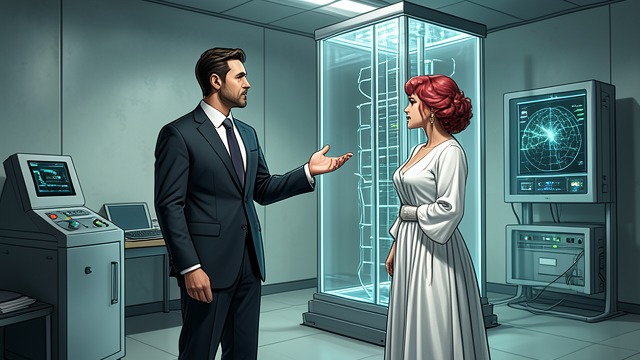
The Architect’s Explanation
Authority in therapeutic language
Crain calls himself a behavioral architect and presents Marla’s transformation as a path toward wholeness. His calm explanation recasts the facility’s violations as a gift offered by someone who supposedly understands her.
Control disguised as care
He claims that Marla was already breaking and that the tower merely allows her to fracture in an orderly way. His language avoids accountability while granting him ownership of the process.
The scene establishes that Crain’s power depends partly on a therapeutic vocabulary that makes domination sound benevolent.
The Ring of Ownership

The Ring of Ownership
A symbol reclaimed by Crain
Crain brings Marla’s old engagement ring into the pod chamber and places it on her finger. He uses a shared object to connect their past to his present claim over her.
Sentiment as leverage
The gesture mixes memory, longing, and rage without changing the fact that Marla is restrained. Crain interprets their former relationship as proof that she belongs to him.
The ring becomes a symbol of his refusal to recognize her earlier choice. Personal history serves his control rather than establishing mutual consent.
The Controller Exposed

The Controller Exposed
A confidence misplaced
Crain expects Marla to appear as the completed identity he designed. Her approach briefly reinforces his belief that the process has succeeded.
Authority disrupted
Marla reveals that she remembers and activates the countermeasure. Crain’s personal certainty cannot protect him once the system he commands begins to fail.
His defeat comes from the same dependence that supported his power: he trusts the tower’s predictions more than Marla’s capacity to act outside them.
The Defeated Founder

The Defeated Founder
Loss of command
Crain is found slumped in the control area after the overload. Marla tells him that she has killed his authority, not merely interrupted the machine.
A narrow ending
The novel shows his immediate defeat but does not describe a trial, public accountability, or lasting containment. His personal arc closes while the institution he created remains operational under someone else.
Crain’s loss is therefore not a complete resolution of the harm he caused. His ideas and machinery survive as risks beyond his own control.
when Crain confronts Marla in the pod chamber
during Crain’s first suite visit
during their reunion in the Black Room sequence
during the Final Release Ceremony
hours after the tower shuts down
