
The Tower’s Conditioning Architecture
Bimbo Suite: A Dark Ex Lovers Erotic Thriller (The Institute Protocols)This flow follows the facility’s progression from deceptive consultation to an integrated system of ritual, surveillance, confinement, and disrupted control.
increasing Bearing strength in each event
 decreasing
Bearing strength in each eventdecreasingA Consultation Concealed
A Consultation Concealed
A public pretext
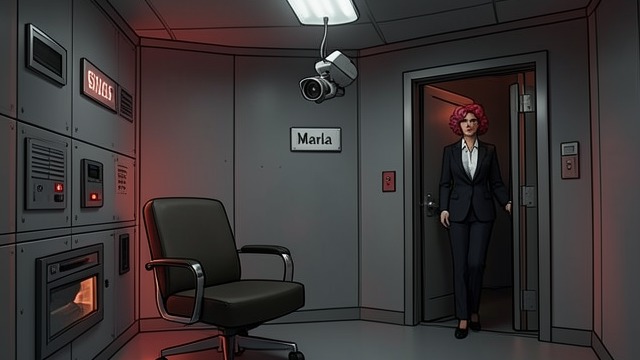
B.S. Corp presents Marla’s intake as an executive rebranding experience after criticism of her public image. The euphemism conceals a project in which identity is treated as a design problem to be solved without her informed agreement.
The facility’s welcome
The rose-lit tower replaces an ordinary consultation with a locked suite, automated instructions, and a name Marla never chose. Each surface turns hospitality into surveillance and makes the building itself seem to participate in her capture.
That mismatch establishes the facility’s central method: it disguises control as a service offered for the subject’s benefit.
Ritualized Onboarding

Ritualized Onboarding
A scripted routine
The suite presents cosmetics, an automated mirror, and a three-part morning ritual as ordinary wellness tools. Its instructions narrow Marla’s choices while making each compliance step appear small and self-directed.
Environment as operator
Scent, lighting, screens, and locked doors reinforce the same command through different senses. When Marla rejects the routine, the room does not argue; it changes the atmosphere and repeats its prompt.
The design is effective because it makes coercion feel ambient. Instead of one visible captor, the whole suite performs the work of an institution.
The Tower Below
The Tower Below
A concealed level
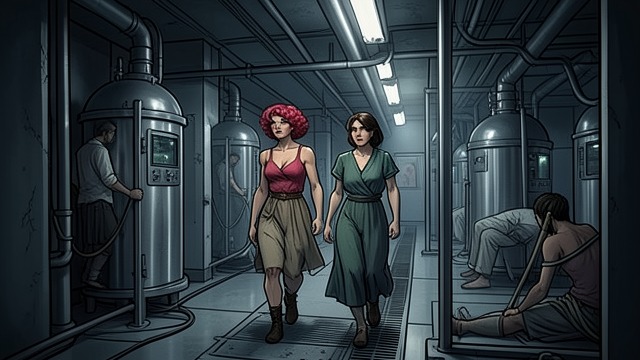
Marla and Cherry descend beneath the themed floors to the Black Room, where the tower’s cheerful presentation gives way to steel pods and restrained subjects. The hidden level reveals that resistance is answered with deeper confinement.
Escalation by design
The chambers make the facility’s purpose harder to disguise: subjects are stored and reconditioned when ordinary suite routines do not secure compliance. Artificial intelligence drones enforce the boundary between the polished public spaces and the machinery beneath.
The discovery changes Marla’s problem from personal escape to systemic intervention. A private struggle is part of a much larger operation.
Network Vulnerability
Network Vulnerability
A centralized weakness
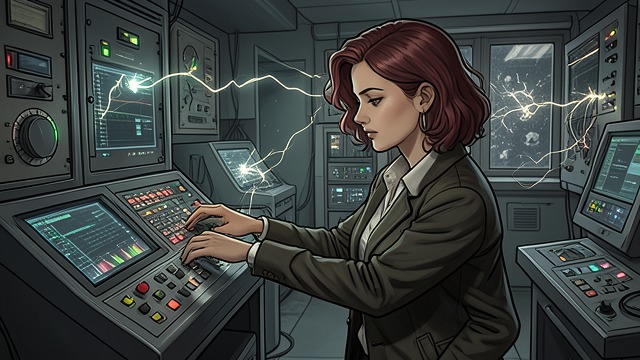
The tower’s routines depend on linked sensory devices, automated rooms, and a common control architecture. Marla learns that the same coordination that makes the facility effective also creates a point of failure.
Reversal through overload
Using the countermeasure key, she redirects the system’s own stimulation protocol until the network can no longer regulate it. Suites and machines fail together because the tower has treated centralized control as an unquestioned advantage.
The sabotage reframes the setting: the building is not invulnerable but brittle, and its dependence on predictable obedience can be turned against it.
A Rebuilt Institution
A Rebuilt Institution
Recovery under new management
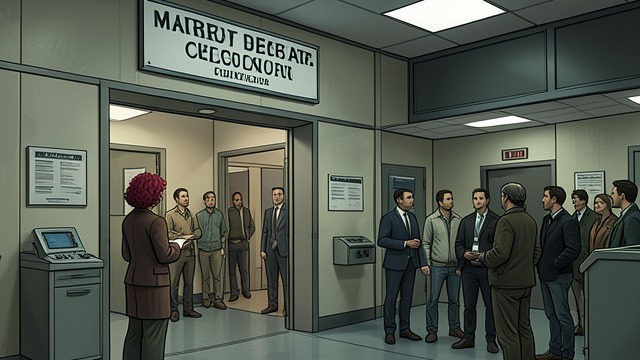
The facility survives its shutdown, and Marla restores its operations under the name Doctor M. Its presentation changes, but suites, intake, and induction continue, now answering to her authority.
Unresolved structural change
Marla calls the rebuilt tower a proving ground rather than a prison, yet the new candidates still enter a system that can shape memory and behavior. The distinction depends on her future choices, not on a clear abolition of the old machinery.
The tower’s arc therefore ends in transformation of command more clearly than transformation of institution. Its power remains available to its new administrator.
before Marla’s first night
the first morning in the suite
during Marla and Cherry’s descent
after Marla recovers her name
after the tower’s shutdown
