Cherry’s Fail-Safe Data Chip
Bimbo Suite: A Dark Ex Lovers Erotic Thriller (The Institute Protocols)Cherry’s Fail-Safe Data Chip is the small but decisive object through which suppressed knowledge becomes actionable resistance. Cherry hides copies of the archives on it, Marla Devon carries it through an attempted capture, and its damaged fragment later becomes the instrument that reconnects memory, identity, and sabotage. Its importance lies not merely in the information it stores, but in the way its physical vulnerability mirrors the struggle of the people who depend on it: it is concealed, discovered, confiscated, broken, swallowed, recovered, and transformed rather than simply used.
Purpose and Concealment
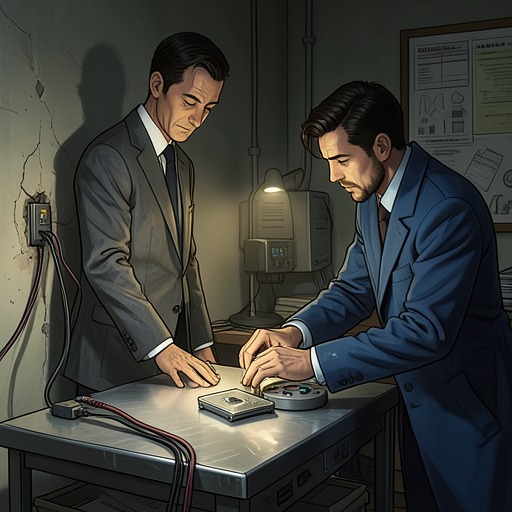
Cherry reveals the chip during the escape attempt with Marla Devon. When Marla asks what it is, Cherry identifies it as a fail-safe and explains that she stored copies of the archives in the suite grid. The intended destination is the Control Room, where the data could be loaded into the system to wake the other subjects and collapse the conditioning loop. The chip therefore carries both a record of what has happened and a practical countermeasure against the infrastructure that has made the subjects forget, obey, and accept imposed identities.
Its hiding place is deliberately intimate and absurdly unprofessional by institutional standards. Cherry has concealed the chip behind the perfume vent in her suite and covered it with bodily residue and glitter, reasoning that nobody would touch it. The concealment makes the object part of the suite’s cosmetic environment while placing it outside the system’s expected channels of inspection. Cherry’s first real smile in hours accompanies the disclosure, and Marla laughs at the improvised defense. That shared reaction gives the chip a second function: it briefly restores human complicity and humor inside a space designed to convert bodies and feelings into managed responses.
Seizure and Flight
The chip becomes immediately dangerous once the hallway detects unauthorized presence. As red light pulses and the system announces the intrusion, Marla grabs the object and shoves it down the front of her dress before sprinting away while Cherry bolts separately. The gesture is hurried and embodied rather than ceremonial. The chip is no longer protected by a hidden vent; it has become contraband carried against the surveillance system, and its concealment depends on the very body the facility is continually reshaping and monitoring.
The system eventually retrieves Marla and initiates Phase Three Conditioning. A voice identifies her as Subject 00A, and she is lowered naked into a pod with her arms and legs strapped down. During the brief interval before the procedure closes around her, she reaches between her breasts and pulls out the chip with a trembling hand. The drone fails to notice because it is occupied with aligning her body. The scene turns the object’s smallness into an advantage: the chip survives because the apparatus is looking at Marla as a body to position, not as an agent capable of carrying evidence.
Breakage and Material Persistence
Marla tries to hide the chip beneath her tongue, but the collar detects an unauthorized object. She bites down when the system challenges her, and the chip cracks apart into metal, plastic, and data. She swallows the broken material, apparently converting the object into something the facility cannot retrieve intact. Yet the narrative immediately complicates that apparent destruction: Marla has not swallowed the whole chip. During the struggle, she has tucked a jagged, half-melted fragment inside herself, where it remains warm and faintly pulsing.
This breakage makes the chip’s materiality impossible to ignore. Before it is threatened, it functions as a transparent tool—a compact container of archives whose value seems to reside in what it can transmit. Under pressure, it becomes conspicuous, obstructive, and physically dangerous. Its fracture does not erase its political use; instead, the damaged fragment preserves a remnant of the stored resistance. The object passes from data carrier to hidden bodily secret, and its survival depends on Marla’s ability to turn the facility’s invasive attention against itself.
From Data Carrier to Neural Key
The fragment later reappears in a transformed state. In the Mirror Space, it has been mounted into a makeshift neural key, and Marla presses it into the central sensory node beneath her collarbone. Cherry is present when Marla asks whether she can fight from there, and the answer is that she cannot do so alone. The fragment consequently becomes a point of connection rather than a solitary weapon: its operation depends on the recovered presence of Cherry and on cooperation across the identities and systems the facility has tried to isolate.
When Marla triggers the flood, every suite, node, and implant activates, initiating pleasure cycles throughout the system. The chip fragment is therefore not simply evidence of the archives’ existence; in its final form, it becomes part of the mechanism that overwhelms the network. Its trajectory is a sequence of escalating conversions: hidden archive, smuggled contraband, shattered material, concealed bodily remnant, and neural key. Each conversion narrows the distance between knowledge and action until the object participates directly in the system-wide attack.
Narrative Significance
Cherry’s Fail-Safe Data Chip gives resistance a tangible form that can be passed between people, hidden in architecture, carried through danger, and preserved through damage. It also binds together the story’s recurring conflict between imposed appearances and buried reality. The facility can alter Marla Devon’s face, body, clothing, name, and responses, but it cannot fully control the fragment once she has made it part of her own survival. The chip’s eventual activation demonstrates that resistance does not require the original object to remain pristine. What matters is the persistence of the information, the relationship that carries it forward, and the willingness to risk bodily harm to keep it from returning to the system.
The chip’s significance also depends on the contrast between its apparent disappearance and its continued agency. After Marla bites through it, the facility can register only an unauthorized object and then lose track of the object’s intact form; the narrative, however, reveals that the chip has survived as a half-melted, jagged fragment with a faint heat of its own. This reversal turns destruction into concealment. What looks like surrender to the conditioning apparatus is actually a change in the chip’s status, from recoverable evidence to a secret embedded in the body the system believes it has secured.
Materiality and the Body
The fragment exposes the limits of treating information as weightless. Cherry’s copies of the archives are valuable because they can wake the other subjects and collapse the conditioning loop, but the plan depends on a physical carrier that can be hidden, seized, cracked, swallowed, and recovered. Its metal, plastic, and data do not separate cleanly once the chip breaks. The object’s informational purpose is preserved through material damage, while its material remnants acquire a new strategic use.
That transformation parallels the bodily alterations imposed on Marla Devon. The facility presents a softened face in the mirror, a body reshaped into heavier breasts, a narrower waist, and smooth, glossed legs, and later marks further changes in the weight of her breasts and the curve of her thighs. Against this managed surface, the chip fragment is an irregular remainder: jagged rather than polished, hidden rather than displayed, and retained by an act of resistance rather than assigned by the system. The object makes visible the difference between a body designed to be read and a body still capable of concealing something from its reader.
The chip also interrupts the facility’s command structure at the level of perception. The suite addresses Marla as Miss Marnie, announces a new wellness identity, and assures her that she is safe, beautiful, and loved. Later, the mirror reports that the conditioning sequence has reached Tier Two, while another voice identifies her as Subject 00A and begins Phase Three Conditioning. These messages attempt to translate identity and bodily response into programmable status. The chip answers with an object that cannot be reduced to the language used to classify her: even after being broken, it remains a material trace of an alternative history.
Connection, Memory, and Sabotage
The fragment’s later mounting as a makeshift neural key completes its movement from archive to interface. Marla presses it into the central sensory node beneath her collarbone, making the remnant part of a direct connection between stored knowledge and the system’s sensory architecture. This is not a return to the chip’s original condition. The intact device was meant to be loaded into the Control Room; the fragment instead enters the body-network boundary and operates from within the system’s own field of sensation.
Cherry’s presence is essential to that final use. When Marla asks whether she can fight from the Mirror Space, her double answers that she cannot do so alone, and Cherry appears as a second figure. The fragment thus retains Cherry’s original intention while exceeding her initial plan. It was first meant to carry copies of the archives to the Control Room so that the others could be awakened; later, joined to the neural node, it helps make collective action possible through connection rather than through Marla’s isolated effort.
The resulting activation is systemic. Marla triggers the flood, and every suite, node, and implant responds as pleasure cycles begin throughout the network. The chip does not merely reveal the facility’s records or preserve a private memory. It becomes one of the means by which the network’s own mechanisms are redirected against its governing logic. A device created as a fail-safe therefore functions as both memory storage and operational leverage: it preserves what the system suppresses and helps convert that recovered knowledge into an attack on the conditioning infrastructure.
Narrative Function
As a recurring object, Cherry’s Fail-Safe Data Chip organizes the plot’s movement from secrecy to exposure, from capture to counteraction, and from individual survival to network-wide disruption. Its concealment behind a perfume vent places resistance inside the decorative machinery of the suite. Its passage down the front of Marla’s dress turns escape into smuggling. Its attempted concealment under the tongue turns speech, swallowing, and bodily enclosure into competing forms of defense. Its hidden fragment later becomes a key beneath the collarbone, where the same body marked by the system becomes the access point for sabotage.
The chip’s repeated changes also create a material version of the story’s identity conflict. Marla’s imposed identity is repeatedly announced, displayed, and conditioned, but the chip follows the opposite pattern: it is withheld, damaged, and preserved in forms the system does not expect. The facility seeks obedient surfaces and legible subjects; the chip survives as concealed depth. Its power comes not from remaining unchanged but from retaining continuity across alteration.
For that reason, the object is more than a plot device or a container of archives. It is the narrative’s compact model of resistance under coercion. Cherry’s planning gives it purpose, Marla’s risk gives it mobility, the break gives it resilience, and the neural key gives it collective force. When the fragment participates in the flood that activates every suite, node, and implant, its journey reaches its decisive consequence: suppressed information has crossed into the system as an active disturbance, and the facility’s own network becomes the medium through which its control can be overwhelmed.