Doctor M Takes Over Bimbo Suite
Bimbo Suite: A Dark Ex Lovers Erotic Thriller (The Institute Protocols)Doctor M Takes Over Bimbo Suite marks the story’s central reversal of power. After confronting Dr. Adrian Crain in the darkened Control Room, Marla Devon refuses the role of the defeated subject, enters the Administrator’s terminal, and names herself “Dr. M.” The tower survives, but its former prisoner now occupies the position from which its commands, identities, and intake procedures are issued.
Causes and Background
The takeover grows out of a system that has treated consent as an administrative process rather than a freely given choice. From the rose-gold invitation promising that “Your transformation awaits, Miss Devon. Tomorrow, 9:00 AM.” to the blonde escort’s assertion that “Consent” is “given in layers,” Bimbo Suite has presented coercion as hospitality. Its rooms, voices, mirrors, and protocols steadily convert resistance into compliance: the system assigns Marla a wellness identity, announces that she is safe and loved, escalates her affirmation levels, and makes reward conditional on repeating its mantra. The command “Repeat the mantra to earn reward” culminates in the harsher rule, “No release without obedience.”
The institution’s violence is therefore distributed across people, architecture, and automated instructions. A suite reset follows unauthorized interaction; the ceiling announces changing conditioning tiers; and the tower can retrieve Marla as “Subject 00A” for another phase. Even the projected stages of transformation—makeup, weight loss, breast augmentation, pigtails, a giggle, and a blank-eyed expression—turn bodily alteration into a scheduled production sequence. The Final Release Ceremony, held at midnight and repeated each cycle, completes the false ritual: one woman is stripped, rewritten, and presented to the other “sisters” as a finished fantasy, while Dr. Adrian Crain calls the process “graduation.”
What Happens
The immediate setting of the takeover is the Control Room after the lights have gone out and only emergency power hums through the distant pipes. Marla finds Dr. Adrian Crain collapsed on the floor, his shirt open, tie loosened, and eyes glassy with withdrawal. He tells her that she killed Cherry; Marla corrects him by saying, “I killed you.” The exchange compresses the conflict between the institution’s language and her own. He interprets the catastrophe through the loss of one of its constructed subjects, while she identifies him—and the authority he represents—as the true object of her retaliation.
Marla then turns away from him and walks toward the lifts. Her destination is not escape. She opens the Administrator’s terminal and types a new designation: “Dr. M.” This is both a bureaucratic act and an identity seizure. The same terminal that once formalized the tower’s procedures now records the name of the person who will direct them. The takeover thus occurs through administration rather than spectacle: command changes hands when Marla enters the system’s own interface and allows it to recognize a title she does not correct.
New Order in the Tower
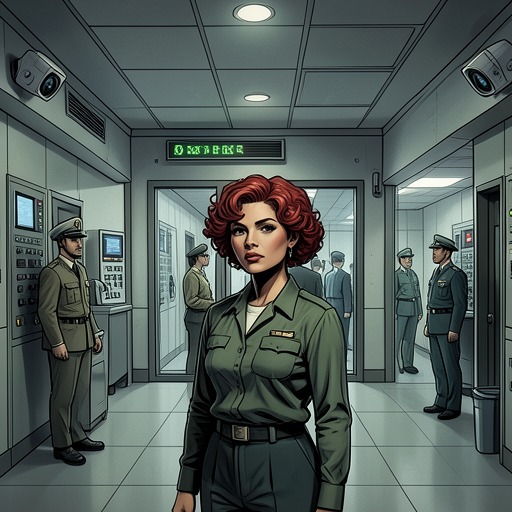
The following chapter presents the result as a changed but continuous institution. Marla wears a white lab coat tailored to her altered silhouette, and the corridors remain marked by the tower’s former signs: pink-glass windows catch the sunrise, perfume vents whisper sweetness, and the core is described as bent inward and obedient to her. The narrative declares that Marla Devon is dead, or perhaps sleeping, while the woman moving through the halls exists between erased former identity and newly consolidated authority. The AI calls her Doctor M, and she accepts the name without correction.
Her first visible exercise of power is an intake order. When the intercom reports that Candidate 27 is ready, Doctor M sends her to Suite 4 and commands the beginning of passive induction. The response is immediate and institutional: the AI answers, “Yes, Doctor.” Around her, new girls stir in velvet nests, mouth mantras without understanding, or giggle as invisible frequencies move beneath their skin. The tower is alive again because she has resurrected it. Yet the text distinguishes her version from the previous one by insisting that it is not a prison but a proving ground. That claim leaves the machinery intact while recasting its meaning and her position within it.
Memory, Continuity, and Cherry
Doctor M’s rule is not founded on simple forgetting. In the Penthouse, she asks the AI to begin playback of “File: Subject Zero. Alias… Cherry.” The projection shows Cherry before the pigtails and pink styling, with her real voice still brisk, brilliant, and questioning. By reopening this record, Doctor M preserves access to the person whom the tower’s conditioning sought to replace with a manufactured identity.
Her next order is deliberately ambiguous and unsettling: she tells the AI to reopen Cherry’s suite, clean it, and leave the vent open. The AI objects that the subject is inactive and the file is marked erased, but Doctor M continues to treat the erased subject as recoverable through space, memory, and procedure. The instruction may be memorial, experiment, invitation, or the first gesture of a counter-program; the evidence establishes its concrete form without resolving its final purpose. What matters is that Doctor M governs through the same archive and environment that once governed her, now directing them toward the return of a suppressed trace.
Consequences and Significance
The takeover changes the story’s value structure without delivering a clean liberation. Marla has moved from a woman protesting that she did not agree to the process to the administrator who assigns another candidate to induction. The transformation is therefore a victory over Dr. Adrian Crain and the old hierarchy, but it also carries the danger of reproducing the hierarchy’s methods. She retains the tower’s language of candidates, suites, induction, protocols, and graduated stages even as she claims to turn the building into a proving ground. Power has been reversed; the problem of what power does to its new holder remains deliberately alive.
The event also makes identity plural rather than simply restored. The final account insists that “Because she was still Marnie now. And she was still Marla.” Doctor M is consequently not presented as a straightforward return to an untouched original self. She is a composite produced by resistance, conditioning, memory, and command. The tower’s mirrors and administrative systems externalize that divided continuity: they can display earlier versions, name current ones, and make each designation operational.
In narrative terms, the event turns the facility’s recurring cycle against itself. Bimbo Suite repeatedly strips, rewrites, and debuts a new fantasy, but Doctor M interrupts the expected ending by refusing to leave after the collapse of the old regime. The system will rebuild, as it always does, but now it will rebuild under her direction. That conclusion makes the takeover both an act of emancipation and an ominous founding myth: the former subject becomes the person who decides which identities enter the tower, which memories are reopened, and what kind of future its machinery will manufacture.