Retreat
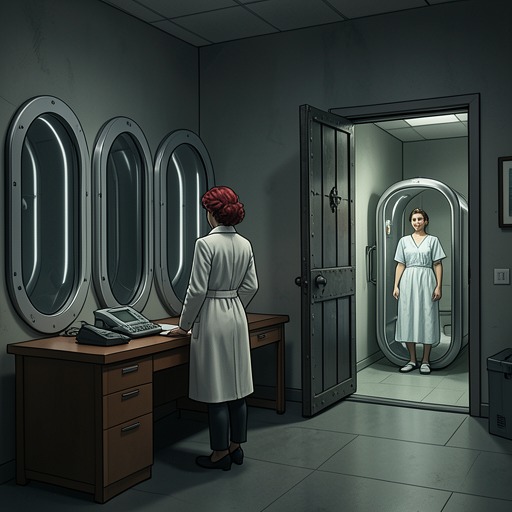
Bimbo Suite: A Dark Ex Lovers Erotic Thriller (The Institute Protocols)The retreat chambers are the facility’s concealed machinery of coercion: steel pods where resistance is answered with confinement and an attempt to rewrite a person from zero. Their heart-shaped windows and carefully arranged occupants give the rooms a polished, doll-like surface, but the chambers expose the violence beneath the facility’s sweet, feminine presentation.
Structure and Purpose
Unlike the softly styled rooms above, the chamber space is cold and metallic, with steel walls lined by pods. Each has a single glowing, heart-shaped window. Inside, nude bodies lie curled in fetal positions, their hair arranged perfectly and their lips parted as if caught in silent dreams. The clinical arrangement makes the occupants appear less like people undergoing treatment than figures displayed in a system designed to control them.
Samantha Aimes, whom Marla Devon knows as Cherry, explains that the pods are used when women resist for too long, or when the facility intends to rewrite them from zero. Her account gives the chambers a specific function within the institution: they are not ordinary recovery spaces, but an escalation of its conditioning program. The soothing visual motif of the heart is set against the purpose Cherry describes, making the chamber’s appearance part of the system’s disguise rather than evidence of care.
The pods reveal different stages and forms of captivity. One opens automatically to disclose a woman whose eyes are vacant; Cherry warns Marla not to approach because the woman is already gone. Another chamber holds a girl barely older than twenty, strapped down with dilated pupils and stimulation nodes wired to her parted legs. She whispers the name Marnie. The contrast between the fetal stillness of the first occupants and the second girl’s visible restraints makes clear that the pods house people in radically diminished states, while the facility imposes its own identities and procedures upon them.
Conditioning and Escape
When Marla Devon is retrieved, the chambers become the immediate instrument of her conditioning. A voice announces that Subject 00A has been recovered and that Phase Three Conditioning is beginning; she is lowered into a pod naked, with her arms and legs strapped down. The pod closes around her, and the physical confinement turns the chamber’s stated purpose of rewriting into an enacted procedure.
The system uses bodily stimulation as programming rather than care. Low pulses rise in tempo through the pod, while restraints hold Marla’s wrists in velvet-lined cuffs and secure her ankles in stirrups. Her collar blinks red in rhythm with the apparatus. The pod’s walls are soundproof: her scream cannot carry beyond them, leaving Adrian Crain to watch from behind smart glass as the chamber isolates her both physically and acoustically. The machinery’s controlled rhythm makes the room’s promise of a new beginning inseparable from coercion.
The pod’s control is not complete. During the struggle, Marla conceals a jagged, half-melted chip fragment inside her body rather than swallowing it whole. When the pod enters passive post-orgasm reset mode, it darkens without sounding an alarm or issuing a command. Marla finds the fragment, uses the brief slack in the restraints to free herself, and slips out. The escape depends on the chamber’s own reset cycle: a system built to immobilize and rewrite her gives her a temporary interval in which its attention lapses.
The chambers therefore function as both instruments of control and sites of resistance. Their procedures aim to reduce their occupants to compliant bodies, but the sequence also makes the limits of that control visible: Marla preserves a piece of the system’s data and acts while the pod is passive. The contrast sharpens the facility’s central deception. Its orderly, heart-windowed pods may present captivity as a designed process, but the soundproof enclosure, restraints, and bodily programming expose what that process demands—and the narrow openings through which it can be disrupted.
The Language of Rebuilding
Adrian Crain gives the chamber’s coercive purpose a therapeutic-sounding vocabulary. He insists that he is there to make Marla Devon “more whole,” describing her as already breaking and the facility’s work as permission to “fracture cleanly” and rebuild. The pod turns that metaphor into procedure: a person is confined, subjected to conditioning, and treated as material the institution can remake. Its clinical enclosure therefore does more than conceal what happens inside; it gives the institution’s claims of repair a physical setting.
That language sits uneasily beside Marla’s resistance to changes she never consented to. Before her capture, she objects that she did not let the facility alter her; later, she sees her breasts heavier, her waist narrower, and her thighs softened into a shape she does not recognize as her own. The retreat chambers belong to this larger pattern of imposed bodily change, but make its coercion impossible to mistake for ordinary beautification. Their promise of starting over is voiced by the person who controls the process, while the captive’s restraints and unanswered scream show what that promise costs.
Aftereffects and the Meaning of Retreat
The chambers’ reach extends beyond the moment of confinement: their stated purpose is to rewrite women, while the facility’s effects are also visible in how captives describe their own experience. When Marla Devon asks Samantha Aimes, known as Cherry, why she does not leave, Cherry says she remembers only the facility and admits that sometimes it feels good, calling that the worst part. Her answer places conditioned pleasure beside isolation and lost memory, not in place of them. It complicates any reading of the pods as a bounded procedure: the coercion they enact can shape what captivity feels like to the people subjected to it.
That tension gives the word “retreat” its sharpest irony. The chambers offer neither voluntary withdrawal nor ordinary recovery; they are where resistance is met with confinement and an attempted reset. Cherry’s account shows why compliance or pleasure cannot, by themselves, establish consent, while the pods’ sealed design makes the institution’s power over both bodies and experience concrete. Their heart-shaped windows promise tenderness at a glance, but the name and the machinery describe a system that turns care’s language into a means of control.