Abolition of check-reins
Black BeautyAbolition of check-reins is the reform advocated in Black Beauty against bearing reins that hold horses’ heads unnaturally high. The book makes the case through both human argument and the horse’s own account of pain, restricted movement, and diminished working strength. Its decisive qualification is that opposing the practice is not the same as abolishing it: even after years of local effort and a humane upbringing at Birtwick, Black Beauty and Ginger are subjected to the rein again when fashion governs their new household.
The Reform and Its Humane Basis
At Birtwick, Squire Gordon and Farmer Grey have worked together for more than twenty years to get bearing reins removed from cart horses. Their effort has changed local practice: such reins are seldom seen in the surrounding area. The campaign is therefore presented as sustained work by people with influence, not simply a private preference about how one horse should be handled.
Squire Gordon’s objection is grounded in how a horse moves and works. He compares horses forced to hold their heads up with soldiers whose heads are tied back: an appearance of smartness may be gained, but the body is made less able to act freely and effectively. A horse needs to throw its weight into the work; fixing the head shifts strain onto its joints and muscles and wears it out more quickly. If it stumbles, a restrained head and neck also make recovery harder. The argument treats freedom of movement as a practical condition of strength and safety, not an indulgence.
The contrast between a naturally raised head and one held up by a rein is central to the reform. In conversation with a military visitor who likes the appearance of horses carrying their heads high, Squire Gordon accepts the appeal of a good-looking carriage team but rejects the means used to produce that look. Fashion, in his account, makes an animal seem more stylish by restricting the very freedom that allows it to work well. The visitor concedes the force of the analogy, but only says that he will think about changing his practice; persuasion does not amount to a commitment.
Local Advocacy and Intervention
The reform belongs to a wider ethic of active protection at Birtwick. Black Beauty describes Squire Gordon and his wife as respected for kindness to people and animals, with the servants following their example. Children known to mistreat animals hear of it from the Hall. In one instance, Squire Gordon and Black Beauty catch up with a driver who has sharply wrenched a pony’s head and then whipped it. The intervention turns concern for a horse’s mouth and comfort into a public rebuke of cruelty.
Squire Gordon’s wife also intervenes when she sees a heavily laden horse with its head strained upward. She stops the carriage, gets out, and tries to explain to the driver that the practice is both foolish and cruel. Her conduct shows the reform working through repeated encounters: the aim is not only to set an example within the household, but to challenge the custom wherever it is visible.
The book extends this ethic beyond reins. When Joe Green reports a man flogging two horses at a brick-yard, John Manly praises him for refusing to treat the abuse as somebody else’s business. Joe agrees to give evidence if the case goes before a magistrate. Later, Jerry Barker hears a gentleman explain that people share responsibility when they see cruelty they have the power to stop. These episodes do not establish that bearing reins were legally prohibited; they show the moral principle on which the book’s campaign depends: witnessing preventable harm calls for action.
Fashion, Commerce, and Reversal
The story also explains why the practice survives despite knowledge of its costs. Black Beauty hears of a dealer who raises horses’ heads progressively because buyers in London want them to carry their heads high and step high. The dealer acknowledges that the treatment is bad for horses but says it is good for trade: animals wear out or become diseased, and buyers return for another pair. The account connects the rein not only to individual taste but to a market that profits from repeatedly replacing damaged working animals.
The limits of reform become personal after Black Beauty and Ginger leave Birtwick for Earlshall. John Manly tells York that the black horse has never worn a bearing rein and that Ginger’s temper was spoiled by a gag-bit. York replies that the horses will have to wear the rein at their new home. He prefers a loose rein and says the master is reasonable, but the lady insists on style and will not accept carriage horses whose heads are not held high.
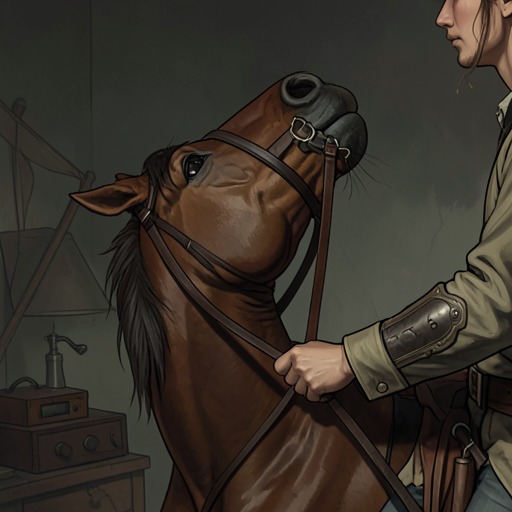
At first, the rein is not shortened beyond the height Black Beauty is accustomed to carry his head, but the lady soon orders York to raise both horses’ heads further. York shortens the rein by a hole before they have to pull a carriage up a steep hill. Black Beauty can no longer put his head forward to draw the load as before; the strain falls on his back and legs, and work that had once been a pleasure begins to feel like a burden. Day by day, the reins are shortened. The gradual adjustment makes the coercion of fashion visible as an accumulating change rather than a single dramatic act.
The Horse’s Testimony and the Reform’s Stakes
For four months in the lady’s carriage, Black Beauty suffers the effects of the rein. The sharp bit and constrained position cause him to foam at the mouth; pressure on his windpipe makes breathing uncomfortable, while his neck, chest, mouth, and tongue become strained, tender, or painful. The book explicitly challenges observers who mistake foaming for spirit: the visible sign of distress is not proof of a fine appearance or good performance, but a reason to attend to the horse’s discomfort.
The contrast with Birtwick sharpens the point. There, John Manly and Squire Gordon are identified as Black Beauty’s friends; at Earlshall, although he is treated well in other respects, he has no one who relieves the rein. York may understand that it harasses the horses, but regards the practice as something that cannot be helped. The problem is thus not only whether an individual knows better. It is whether anyone with the ability to act will oppose a fashion backed by household authority and commercial custom.
Abolition of check-reins, as the book presents it, is therefore both a practical reform and a test of humane responsibility. The campaign at Birtwick demonstrates that sustained advocacy can change local practice; the later reversal shows that such change remains vulnerable when appearance takes precedence over a horse’s freedom and safety. Through Black Beauty’s first-person account, an argument often made by human observers becomes testimony from the body subjected to the restraint.