Alcohol dependence and abstinence
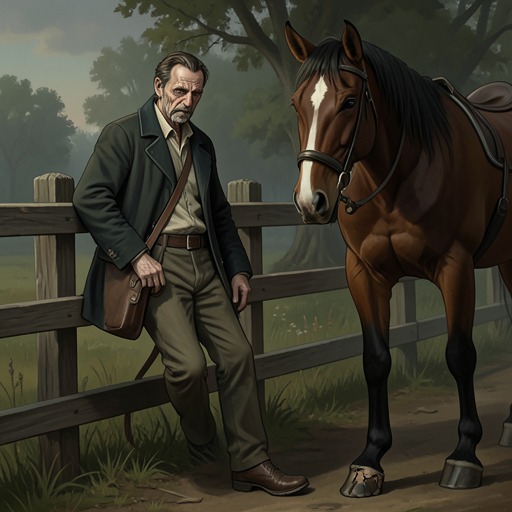
Black BeautyAlcohol dependence and abstinence are presented through Jerry Barker’s account of a difficult, sustained effort to stop drinking. Although Jerry says he never became drunk, he recognizes that craving could overrule his intentions; his recovery depends on persistence, support from Polly Barker, and practical ways of getting through moments of temptation. When he recounts this history to Governor Grant, personal testimony becomes an invitation to change, though the governor’s eventual outcome is left open.
The Conversation’s Setting
The subject arises after Captain is injured in a collision caused by a drunken driver. Jerry condemns the harm caused by drink and objects that compensation cannot restore the time, security, and companionship lost when a trusted horse is injured. His anger gives the conversation an immediate context: alcohol is not treated merely as a private habit, but as something that can expose other people and animals to serious consequences.
Governor Grant responds personally rather than dismissing Jerry’s criticism. He admits that Jerry’s words touch a weakness of his own and says he has tried to stop drinking once, but managed only two days before finding the effort extremely difficult. The exchange shifts from judgment of the drunken driver to an examination of how hard it can be to refuse drink. Jerry does not present abstinence as effortless or claim that good intentions alone are enough.
Jerry’s Recognition of Dependence
Jerry distinguishes his experience from drunkenness. He explains that he had never actually got drunk, yet came to understand that he was not fully his own master: when the craving arrived, saying no required a sustained effort. His account therefore locates dependence not only in visible intoxication but in the pressure of wanting something he had decided to refuse. The decisive struggle, as he describes it, was to prevent the habit from ruling his choices.
He frames that struggle as a contest in which one side would have to yield: either the drink or Jerry Barker. His resolve was to ensure that he, rather than his own agency, would not be defeated. He also describes the stakes in intimate and spiritual terms, reminding himself that giving in could mean losing his soul and breaking Polly’s heart. These concerns make abstinence more than a matter of avoiding a drink; it is bound up with his sense of self-command, faith, and responsibility within his marriage.
Support and Practical Methods
Jerry acknowledges that he needed help. Polly took care to ensure that he had good food, providing a concrete form of support during his effort to change. When cravings came, he reached for coffee or peppermint, or read from his book. These modest alternatives gave him something to do at the moments when refusal was hardest, while the repeated self-reminder about his soul and Polly’s heartbreak helped him hold to his decision.
The account presents recovery as both an exertion of will and a supported practice. Jerry does not attribute the outcome to resolve alone: he recalls the difficulty of resisting, the usefulness of specific substitutes, and Polly’s care. Nor does he suggest that the struggle vanished at once. It lasted several weeks, and his description makes the work of abstinence visible as a repeated response to craving rather than a single declaration.
Governor Grant’s Response
Jerry tells this history because Governor Grant asks how he managed to stop. The contrast between them is carefully drawn: Grant has tried for two days and found it hard to continue, while Jerry speaks from an experience of getting through a longer struggle. Jerry encourages him to try again and argues that doing so would help other men at the cab rank who would also like to stay away from the tavern but find it difficult.
Grant says he has a strong inclination to make the attempt, recognizing that it is a poor state to be unable to govern oneself. The conversation records intention, not completion: it does not confirm that Grant stops drinking or establish what happens afterward. Jerry’s testimony nevertheless offers him a possible path and connects private abstinence with example. A change in one man’s conduct, Jerry suggests, could make change more imaginable to others.
Duration and Significance
Jerry reports that he has not tasted drink for ten years and no longer wishes for it. That duration gives his account an outcome beyond the initial struggle, while the lack of desire marks a change from the cravings he once had to resist. His story moves from recognition of dependence, through weeks of effort and reliance on support, to a long period of abstinence.
The episode does not treat the struggle as proof that every person can stop in the same way, nor does it provide a general account of treatment. Its focus remains Jerry’s own experience and his response to Grant. Through Black Beauty’s report of the exchange, the narrative lets a cabman’s account carry moral force without reducing the subject to condemnation: Jerry holds a drunken driver responsible for harm, but also speaks honestly about the difficulty of resisting drink. His ten years of abstinence make that testimony a source of encouragement, while Grant’s unresolved intention preserves the difference between hearing the possibility of change and achieving it.