Black Beauty Collapses on Ludgate Hill
Black BeautyBlack Beauty’s collapse on Ludgate Hill is the breaking point of a period of relentless cab work: exhaustion and an excessive load bring him down, while his driver continues to urge him onward. The immediate rescue keeps the episode from ending in his death, but the farrier’s diagnosis makes its larger cause plain. Black Beauty has not simply fallen ill; he has been worked beyond his strength in a system that treats rest as a cost and a worn horse as something to sell.
Causes and Background
By this stage, Black Beauty’s working life has become miserable. On some Sundays, parties hire the cab for long journeys into the country and back, with no passenger willing to get out and walk even on steep hills or in hot weather. Black Beauty can become so fevered and worn that he can hardly eat. This contrasts with his earlier routine under Jerry Barker, when a Saturday-night bran mash and a long, unbroken rest gave the horses time to recover before work resumed. Under Skinner’s management, that restorative pause is gone.
The daily strain is compounded by the driver’s treatment. He uses a cruel whip, sometimes striking Black Beauty under the belly or directing the lash toward his head. Black Beauty continues to do his best, but remembers Ginger’s warning that resistance is futile because people are stronger. His wish to collapse and escape his misery therefore does not arise from a single bad journey; it follows from the accumulated pressure of work, inadequate recovery, and harsh handling.
The Journey and Collapse
The decisive journey begins after Black Beauty has been working since eight in the morning. At the railway station, a party of four needs transport with a substantial quantity of luggage. The young girl, Grace, notices that Black Beauty looks too weak for the fare and the bags, and urges her father to hire a second cab. The driver assures the man that Black Beauty can manage and helps haul a heavy box aboard. Grace’s concern is overridden, and the family’s luggage is loaded onto the cab.
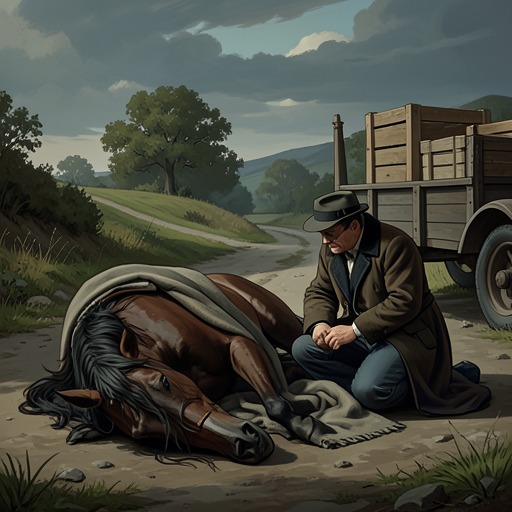
Black Beauty has had neither food nor rest since morning. He manages to continue for a time, but at Ludgate Hill the load and his exhaustion prove too much. His driver keeps tugging at the reins and using the whip as Black Beauty struggles forward. His feet slip, and he falls heavily onto his side, unable to move. Around him, people unload the luggage and voices rise in confusion. Grace recognizes that the party’s decision has contributed to what happened. Her response offers a human acknowledgment of responsibility, but it comes only after the horse has already been pushed to collapse.
Rescue and Diagnosis
A policeman gives orders, and people loosen Black Beauty’s throat strap and traces so that the tack no longer holds him tightly. Someone throws cold water over his head and gives him cordial. He gradually regains enough strength to stand after several attempts, then is led to nearby stables, where he receives a well-littered stall and warm gruel. By evening he has recovered sufficiently to be returned to Skinner’s stables.
The farrier’s examination the next morning clarifies the nature of the crisis: Black Beauty has no strength left, and overwork, rather than disease, is the chief problem. The farrier estimates that six months of freedom from work could enable him to work again. Skinner resists the prospect of nursing a sick horse, explaining that he has no meadows for that purpose and prefers to work horses as long as they can go, then sell them for whatever they will fetch. The farrier proposes a shorter immediate course of rest and feeding before an upcoming sale, offering Skinner a possible financial return. Skinner agrees reluctantly; the stableman, more willing than his employer, carries out the care properly.
Recovery and Significance
For ten days Black Beauty receives complete rest, plenty of oats and hay, bran mashes, and boiled linseed mixed into the food. His condition improves enough for him to be taken to a sale on the twelfth day after the accident. The recovery is real but limited: the care is given to prepare him for sale, not as a commitment to the lengthy convalescence the farrier believes would restore his working capacity. The episode thus turns on a sharp difference between what the horse needs and what his owner considers worthwhile.
The contrast recalls the humane principles practiced at Birtwick, where care extended to animals and the household opposed cruel treatment, and the broader lesson that witnesses should intervene rather than treat cruelty as someone else’s concern. Joe Green acts on that principle when he reports a man abusing horses and agrees to give evidence; Jerry likewise hears an argument that failing to expose cruelty makes a bystander complicit. On Ludgate Hill, Grace speaks up before the journey, but her warning is dismissed. The collapse makes the consequence of that dismissal unavoidable: concern without the power to change the decision cannot protect the animal. Black Beauty’s rescue saves his life, while the diagnosis and Skinner’s response expose the economic logic that brought him to the ground.