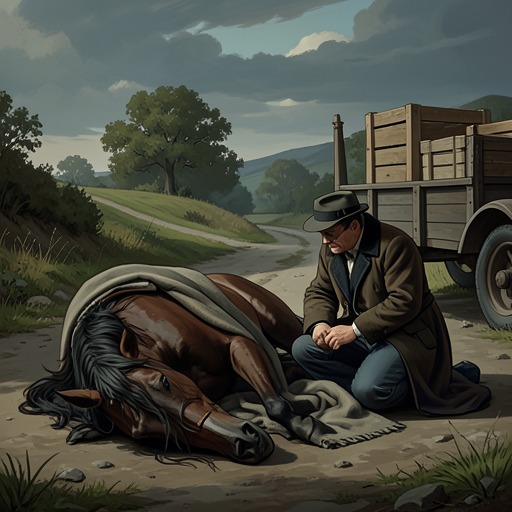
Black Beauty Is Rescued and Recovers After Collapsing on Ludgate Hill
Black BeautyBlack Beauty’s collapse on Ludgate Hill marks the turning point from a punishing period in Nicholas Skinner’s cab service to recovery, recognition, and a secure home. The immediate crisis grows out of exhaustion rather than an illness: after the horse falls beneath a heavy load, a farrier judges that rest and feeding may restore him. His subsequent sale brings him to Mr. Thoroughgood, whose care gradually returns him to useful work and ultimately reunites him with Joe Green.
Conditions Before the Collapse
Black Beauty had once been better off as a cab horse working for Jerry Barker, who owned the cab and his horse. That arrangement gave Jerry a direct interest in avoiding overwork, and he also provided rest and a bran mash on Saturday nights in hot weather. Under Nicholas Skinner, the conditions were different. Skinner’s cabs and drivers were poorly treated, and the pressure passed from the employer to the men and then to the horses. There was no Sunday rest, even in summer.
The contrast had already been made plain by Seedy Sam, a driver who described the costs and hours imposed on men who rented cabs and horses. He said that some paid eighteen shillings a day for the use of a cab and two horses, leaving nine shillings to be earned from each horse before the driver could make a living. His account included fourteen- or sixteen-hour days, weeks without a Sunday off, and fares that could require a horse to travel long distances for little return. Black Beauty’s experience under Skinner gives that economic pressure a bodily consequence: he was driven without the rest that had previously helped him recover between working periods.
On the day he fell, Black Beauty had been working since eight in the morning and had already done a substantial amount of work. At the railway station, the driver waited for passengers arriving on a heavy train. A party of four hired the cab, with luggage as well as passengers. The young girl, Grace, noticed that Black Beauty looked weak and urged her father to take a second cab. Her concern was dismissed; the driver assured the party that the horse could manage, and more luggage was loaded.
Collapse and Immediate Rescue
The journey continued until the cab reached Ludgate Hill. Black Beauty had had neither food nor rest since morning, and the load was heavy. As he struggled onward under repeated use of the reins and whip, his feet slipped and he fell. He could not move at first and believed he might die. In the confusion that followed, the luggage was removed and someone loosened the throat strap and traces, relieving the pressure of the harness.
A policeman gave directions while people tried to help. Cold water and cordial were given to Black Beauty, and he was covered. After some time, a man encouraged him to stand. With further assistance, he managed to get to his feet and was led to nearby stables. There he was placed in a well-littered stall and given warm gruel. The rescue did not immediately end his ordeal: that evening, once sufficiently recovered to be moved, he was taken back to Skinner’s stables.
Diagnosis, Rest, and Sale
The following morning, Skinner brought a farrier to examine Black Beauty. The farrier judged that the case resulted more from overwork than disease, and said that six months’ rest could allow him to work again, though he had no strength left at that point. Skinner was unwilling to keep an unproductive horse for such a long recovery. The farrier’s practical suggestion—that a rested and fed horse might sell for more than he would as a carcass—persuaded Skinner to order his care.
For ten days Black Beauty had complete rest, plenty of oats and hay, bran mashes, and boiled linseed mixed into the feed. The stableman carried out the instructions more willingly than Skinner had given them. The improvement was sufficient for Black Beauty to be taken to a horse sale on the twelfth day after the fall, a few miles outside London. The man who brought him explained that he was not old, that overwork in the cabs had reduced his condition, and that a longer period of rest might restore him. He recommended giving the horse a chance rather than judging him only by his current weakness.
Mr. Thoroughgood bought Black Beauty and had him led to an inn, where he received a good feed. A servant then took him gently to his new home, a large meadow with a shed. Mr. Thoroughgood arranged for hay and oats morning and night, with access to the meadow during the day, and placed his grandson Willie in charge of him. Willie visited daily, brought him treats, and spoke and behaved toward him kindly. The horse came to follow the boy around the field and was called Old Crony.
Recovery and Recognition
Rest, nourishing food, soft ground, and gentle exercise gradually improved Black Beauty’s condition and spirits. During the winter his legs improved, and by March Mr. Thoroughgood felt able to try him in a phaeton. Black Beauty drove a few miles with Mr. Thoroughgood and Willie; his legs were no longer stiff, and he managed the work with ease. Mr. Thoroughgood planned to introduce gentle work gradually rather than return him at once to the demands that had exhausted him.
The family later offered Black Beauty to Miss Blomefield and her sisters on trial. Mr. Thoroughgood acknowledged that a horse who had once fallen might make a prospective rider nervous, while also observing that a horse’s knees could be damaged through a driver’s carelessness and without fault of his own. After Black Beauty had been driven daily for about a week and seemed safe, Miss Lavinia tried him in a small close carriage. The sisters decided to keep him and restore his old name, Black Beauty.
Joe Green, now a grown young man, recognized him by the white star on his forehead, one white foot, a small knot on his neck, and the patch of white hair on his back that John Manly had called Beauty’s three-penny bit. Joe had once feared that his own mistake had nearly killed the horse, but now he was able to greet him again and promise, in effect, that the horse would be well treated. The recognition reconnects Black Beauty’s present safe life with his earlier home at Birtwick.
A year later, Black Beauty’s work was easy and pleasant, his strength and spirits were returning, and Joe was his groom. Willie continued to treat him as a special friend, and the ladies promised he would never be sold. The episode therefore ends not merely with recovery sufficient for work, but with security against another forced transfer: after the collapse brought on by overwork, Black Beauty is again at home.