Black Beauty and Captain’s relationship
Black BeautyBlack Beauty and Captain’s relationship is a friendship between two working horses, built through daily company and the conversations made possible by rest. Captain gives Black Beauty a personal account of his earlier life as an army horse; later, when Captain is gravely injured in a street accident, Black Beauty is absent but learns what happened and feels the loss when his friend is gone. Their bond makes Captain’s history more than background: it reaches Black Beauty as testimony, then becomes part of his own experience of bereavement.
Friendship in the Stable
Captain and Black Beauty live together while working in Jerry Barker’s cab business. Black Beauty remembers Captain as a noble old horse and good company, and says plainly that they were great friends. The stable relationship is not presented as a formal hierarchy between them but as shared life: they work, rest, and spend time in one another’s company.
Sunday rest matters especially to this companionship. The horses work hard during the week, and the day off allows them to enjoy each other’s company. It is on these Sundays that Black Beauty learns Captain’s history. Their friendship therefore includes attentive listening: Captain can make his past known to another horse, and Black Beauty preserves that account within his own autobiography.
Captain’s Recollections
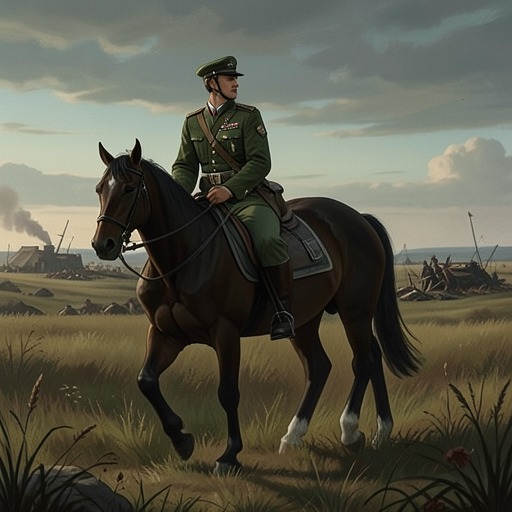
Captain tells Black Beauty that he was trained as an army horse. His first owner was a cavalry officer going to the Crimean War, and Captain recalls the coordinated exercises with the other horses: trotting and turning together, halting at command, and moving at speed in response to a trumpet or signal. As a young dark, dappled iron-gray horse, he was considered handsome, and his young owner treated him with care and kindness. Captain remembered the training as pleasant, a contrast to the ordeal of being transported overseas.
The sea passage altered that experience. Since the horses could not simply walk aboard, they were lifted onto the ship in straps; once there, Captain and the others were confined in small stalls, unable for a long time to see the sky or stretch their legs. The rolling ship made the journey difficult. Captain’s account gives Black Beauty a horse’s perspective on military transport: the organized work of training is followed by a voyage in which the animals’ movement and surroundings are tightly restricted. The story reaches the reader through one friend’s recollection to another, rather than through Black Beauty’s direct presence at those earlier events.
The Accident and Its Consequences
Captain’s later misfortune comes when he and Jerry Barker have taken passengers to the great railway station over London Bridge. On their return, Jerry sees a brewer’s empty dray coming rapidly through the traffic. Its driver is whipping the two horses and has lost control of them. A young girl is knocked down, and the dray then crashes into Jerry’s cab. Captain is dragged down and badly hurt; Jerry is thrown but survives with bruises. Black Beauty was not there and explicitly identifies his knowledge as something he heard afterward, so the account is both a report of the accident and a measure of how closely he follows his friend’s fate.
The driver is shown to have been very drunk. He is fined, and the brewer has to pay damages to Jerry’s employer, but no compensation can restore Captain’s health. Captain is too old and too badly affected to return to cab work. The farrier believes he might recover enough to be sold for a small amount, but Jerry refuses to sell him into the risk of hard work and misery. He concludes that, since he cannot find a reliably kind home for the old horse, the kindest course is to end Captain’s suffering. This decision belongs to Jerry, but its emotional force is sharpened by Black Beauty’s understanding that Captain is not merely a fellow worker: he is a trusted companion.
Loss and Narrative Significance
The day after Jerry decides what to do, Harry takes Black Beauty to the forge for new shoes. When Black Beauty returns, Captain is gone, and the whole family feels his absence. The narrative does not give the friends a final conversation; instead, their separation is conveyed through Black Beauty’s return to an empty place and his recognition of the household’s shared grief. That restraint keeps the focus on the consequence of the decision rather than inventing a farewell.
Their relationship joins two distinct forms of knowledge. Captain’s recollections let Black Beauty—and, through him, the reader—hear about the life of an army horse, while Black Beauty’s later account records the dangers facing an old cab horse in crowded streets. Captain’s fate also exposes the limits of monetary redress: the brewer pays damages, but the horse who bears the injury cannot be restored by a fine. Against that public reckoning, the friendship between the horses and Jerry’s refusal to sell Captain into further hardship offer a more personal measure of care. Black Beauty’s account preserves Captain as a friend whose story was heard, remembered, and mourned.