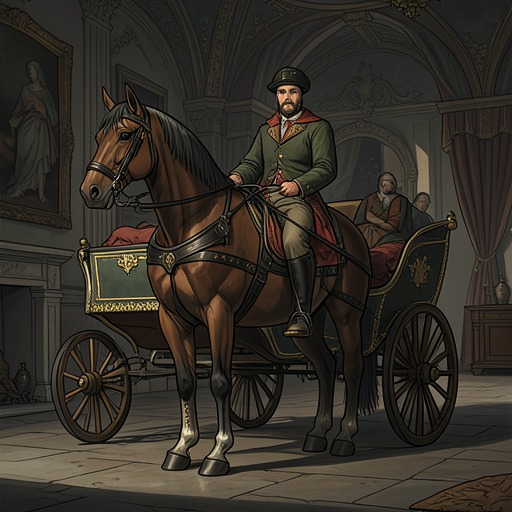
Blinkers
Black BeautyBlinkers are pieces fixed to a horse’s bridle that block much of its view to either side, leaving it able to see mainly straight ahead. Introduced as part of Black Beauty’s harness training, they become the subject of a stable-yard debate about whether limiting a horse’s sight makes it safer or more vulnerable. The discussion sets their practical reputation against the horses’ firsthand knowledge of seeing, learning, and responding to the world around them.
Design and Use
During Black Beauty’s training to harness, the bridle comes with large side-pieces called Blinkers. Their effect is direct: he cannot see on either side and can look only forward. The account places them among several unfamiliar items of harness, including a stiff collar and a crupper. Unlike the saddle, which Black Beauty gradually accepts through repeated gentle handling, the restricted vision of Blinkers is described as a feature of the equipment itself, not as a skill the horse learns.
The object’s purpose is later explained by Justice, a roan cob. He says Blinkers are supposed to prevent horses from shying, starting, and becoming so frightened that they cause accidents. That reasoning assumes that what a horse cannot see cannot alarm it. The other horses’ discussion tests that assumption against a different possibility: an animal may be more unsettled when it can see only fragments of a situation and cannot turn to identify what is there.
The Case Against Restricted Vision
Justice questions why riding horses, especially ladies’ horses, are not similarly fitted with Blinkers. He argues that the supposed danger of seeing the wheels of one’s own carriage is inconsistent with horses being expected to encounter wheels in crowded streets when ridden. Horses, he says, can become accustomed to such surroundings and understand them. In his account, unrestricted sight would let a horse see what is present and make sense of it, while a restricted view can leave it confused by partial glimpses. He allows that a nervous horse, particularly one frightened or hurt when young, might benefit from Blinkers, but presents that as a qualification rather than a general case for fitting them to every horse.
Sir Oliver advances a related objection from nighttime driving. Horses can see better in the dark than people, he says, so blocking their vision may deprive them of information that could help them avoid hazards. He recalls a hearse whose two horses and driver went too near a pond on a dark road; the horses drowned, and a visible white rail was put up afterward. Sir Oliver reasons that horses with their full sight could have kept farther from the edge. His account makes the rail a telling contrast: the response to danger was to mark the hazard, while the horses’ restricted vision had prevented them from judging it for themselves.
He also recalls an earlier carriage accident involving Black Beauty’s master. A lamp had gone out beside a large hole left by road-makers, and the old horse Colin, who wore Blinkers, was badly hurt when the carriage went into it. Sir Oliver concedes that the missing lamp was blamed, but argues that Colin might have seen the hole even without it if his eyes had not been restricted. The episode does not establish that Blinkers alone caused the accident; it gives the horses grounds to question whether reduced vision can remove a horse’s chance to respond to danger.
Fear, Familiarity, and Training
The debate extends beyond accidents to the way horses are taught to handle unfamiliar sights. A young horse later tells Black Beauty that it was already timid and had been frightened several times. Wearing Blinkers, it could not understand a strange object unless it turned to look at it. Its master responded to that movement with a whipping, which made the horse start forward rather than allowing it to inspect what had frightened it. The horse believes that calm time to look might have helped it discover there was nothing dangerous and become accustomed to such sights.
One incident makes the pattern concrete: a large piece of white paper or rag blew past on one side. The horse shied and moved forward; its master whipped it again, while an older rider objected that punishment would intensify the fear and make the habit worse. The young horse’s account links restricted sight and harsh correction without claiming that either guarantees a particular reaction. Its central point is that a horse cannot learn what is harmless if it is not allowed to see and assess it. The contrast with Black Beauty’s early training is instructive: he had been introduced to startling railway trains while turned out among sheep and cows, where he could encounter them repeatedly and observe the other animals remaining calm.
Disputed Protection and Animal Knowledge
The arguments about Blinkers turn on competing ideas of protection. Their conventional rationale treats the horse’s sight as a possible source of alarm; the horses’ counterargument treats sight as a means of understanding and avoiding danger. Justice’s qualification leaves room for individual cases, while Sir Oliver’s examples and the young horse’s experience challenge the assumption that restriction is automatically safer. The discussion also distinguishes an animal’s first startle from deliberate misconduct: in the young horse’s account, the fear precedes the punishment, and punishment worsens rather than resolves the problem.
Ginger makes the dispute’s broader criticism explicit through irony. She mocks the presumption that people can improve on nature, suggesting that those who distrust horses’ side-set eyes might prefer all foals to be born with eyes in the middle of their foreheads. Her remark does not supply another practical test of Blinkers; it sharpens the debate into a criticism of treating human preference as proof that an animal’s natural capacities need correction. Across Black Beauty’s training, the stable discussion, and the young horse’s recollection, Blinkers thus serve as more than harness equipment: they expose the consequences of managing fear by limiting perception instead of allowing a horse to become familiar with what it sees.