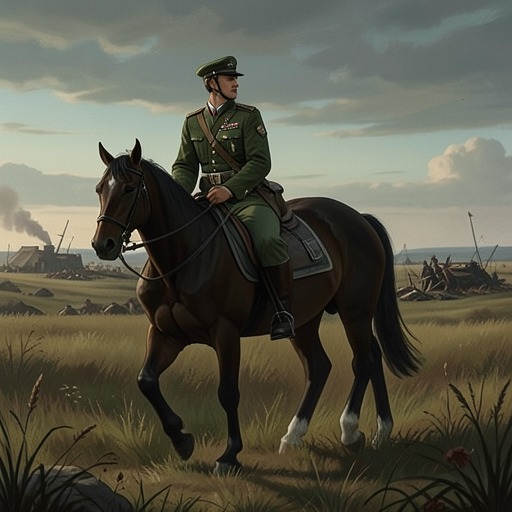
British Army
Black BeautyThe British Army is presented in Black Beauty chiefly through the military life of Captain, an old war horse who recounts his experiences to Black Beauty. His story follows a cavalry horse from training and a caring relationship with his officer to overseas service, repeated engagements, and the destruction of most of the horses that went out with his unit. The account distinguishes the order and shared purpose of military drill from the reality of war, where confidence in a rider could not prevent mass loss.
Identity and Scope
Captain had been trained as an army horse, and his first owner was a cavalry officer setting out for the Crimean War. The account offers no broad description of the British Army’s command structure or policies; its view is grounded in the work and experience of the cavalry and the horses serving alongside its soldiers. Military life is therefore shown from the horse’s level: as training, movement under command, dependence on a rider, and the consequences of a campaign.
Captain recalls that he initially enjoyed training with the other horses. They learned to trot and turn together, halt at an order, or move forward at a signal from the officer’s trumpet. The coordinated drills gave him a sense of shared activity and readiness. His account presents the army horse not as an instrument without feeling, but as a trained participant whose understanding of commands and trust in a rider shaped his experience of service.
Training and the Officer-Horse Bond
Captain describes his first officer as young, high-spirited, fond of him, and consistently kind. That relationship is central to his account of military service. In action, Captain says that a firm rider and a steady hand on the bridle gave him confidence; his trust in his master made him willing to advance even when the danger was severe. Military discipline thus appears not only as the ability to respond to signals, but as a bond between horse and rider.
On the morning of a major engagement, the cavalry was ready before daybreak, with horses and men prepared while they waited for orders. As the firing began, the officer mounted and the line remained controlled and watchful. Before they moved, Captain’s master noticed a lock of mane out of place, smoothed it over, and patted Captain’s neck. Captain remembered the small act because it joined personal affection to the formal readiness of the regiment: the officer’s attention did not disappear when duty called.
Overseas Service and Campaign Conditions
The journey across the sea was Captain’s first severe test of army life. Since the horses could not walk aboard, strong straps were placed beneath their bodies and they were lifted over the water onto the ship. They were confined in close stalls, unable for a long time to see the sky or stretch their legs, and were knocked about when the ship rolled in high winds. After landing, Captain and the other horses faced a country unlike their own and further hardships, including snow and wet weather.
Captain’s account also records efforts by soldiers to make conditions more bearable. He recalls that many men were so attached to their horses that they did what they could to keep them comfortable despite the weather and disorder. This care is not presented as removing the hardships of a campaign: it is a human response within circumstances the men and animals could not simply avoid. The contrast between the cramped crossing and the soldiers’ attention to their horses gives the army setting both its material difficulty and its capacity for individual kindness.
Combat and Losses
Captain says that he and his master took part in many engagements. At the sound of the trumpet, the horses were eager to advance, even when they had to wait for orders. He recalls seeing horses and soldiers killed or gravely wounded, and describes the strain of moving through a battlefield while avoiding those who had fallen. His own confidence rested on his master’s voice and guidance; the attachment that had formed during training continued to shape his conduct under fire.
After the engagement, army farriers went over the field and shot horses whose injuries were too severe for them to recover. Some with comparatively slight wounds were brought back and cared for, but most of the horses that had gone out that morning did not return. Captain gives the scale of the loss plainly: only about one horse in four was left in his stables. The figure makes the cost of the action concrete, and shows that the army’s care for surviving horses existed alongside the practical decision to end the suffering of those considered ruined.
Return and Narrative Significance
Captain believes that his beloved master fell dead from the saddle, though he did not witness what happened to him afterward. He continued into other engagements, was wounded once without serious consequence, and returned to England when the war ended, described as sound and strong. The distinction between what Captain knows and what he can only believe leaves his master’s fate as a personal loss rather than a confirmed scene of death.
Captain tells this history to Black Beauty during the time the two horses have to enjoy one another’s company. His testimony complicates any idealized view of military glory: he distinguishes the appeal of exercise, parade, and sham fighting from a war in which thousands of men and horses may be killed or permanently injured. Through the British Army as Captain experienced it, the novel holds together courage, discipline, loyalty, care, and the severe cost borne by animals as well as people.