Captain
Black BeautyCaptain is an elderly cab horse whose life joins military service, working life in London, and a final act of protection by Jerry Barker. His history, related to Black Beauty during their companionship, moves from the disciplined excitement of cavalry training to the loss of his first master in battle, then to the quieter labor of a cab and the question of what a good owner owes an old, failing horse.
Identity and Introduction
Captain is Jerry Barker’s other horse when Black Beauty joins the family. He is tall, white, and rather large-boned; though old, he still holds his head proudly and arches his neck. Black Beauty regards him as noble and fine-mannered, and the two become good friends. Captain is not simply a companion in the stable: his bearing and recollections preserve a past that Black Beauty has not known.
The name Captain belongs to his later life. In the cavalry, his first owner called him Bayard, and he was once a dark, dappled iron-gray considered handsome. His change from that younger horse to the white, worn veteran in Jerry’s cab makes age visible in the contrast between his remembered appearance and his present condition, without erasing the dignity that Black Beauty sees in him.
Cavalry Service and the Crimean War
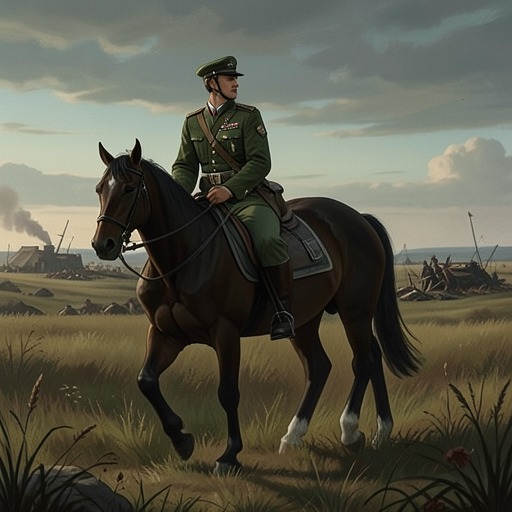
Captain was trained as an army horse for a cavalry officer going to the Crimean War. He remembers the coordinated routines of training with other horses: trotting and turning together, halting at command, and moving at speed in response to a signal. His first master treated him with care and affection from the beginning. Captain consequently describes military life, before the journey overseas, as pleasant and purposeful.
The passage by ship unsettled that expectation. Horses could not walk aboard, so they were lifted in straps and kept in close stalls during the voyage; for a long period Captain could neither see the sky nor stretch his legs. He was relieved when the transport ended and the horses were set on land again. The episode marks a limit to his otherwise positive account of training: service depended on human arrangements that could be frightening and confining even before the danger of battle began.
Captain’s most consequential memory is a cavalry charge across a valley toward the enemy’s guns. Before it began, his master noticed a lock of mane lying the wrong way, smoothed it into place, and patted his neck. Captain understood the familiar gesture as a sign of their closeness; he stayed still because he knew his master’s moods. In the charge, gunfire struck the officer, who fell from the saddle as the other riders swept onward. Captain tried to remain beside him but was carried away by the movement of the charge. Alone, he attempted to rejoin the ranks, was driven off, and was then mounted by a soldier whose own horse had been killed. The cavalry was overpowered, and the account leaves Captain among the survivors of a battle in which many men and horses fell.
Life with Jerry Barker and Black Beauty
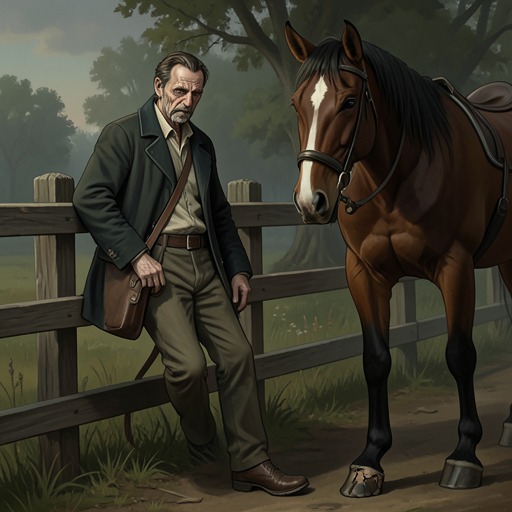
By the time Black Beauty meets him, Captain belongs to Jerry Barker, who owns and drives a cab with two horses. Jerry attends to the horses himself. His attention to fit and comfort is also evident when Black Beauty is first put into harness: Jerry adjusts the crupper and uses a plain ring snaffle, without a check-rein or curb. That care provides a practical contrast to the strain horses can face in work, while Captain’s presence gives the stable a living connection to an earlier working life.
Captain and Black Beauty share companionship during the days when they have time together. It is then that Black Beauty learns Captain’s history, including his training, the sea journey, and the battle. The structure of the recollection matters: Captain speaks as a witness to his own life, while Black Beauty, who was not present for the events, carries that testimony into the larger story. Captain’s war memories are therefore not an ornamental past; they disclose the long service and personal attachments behind the old horse standing in the cab stable.
Accident, Retirement, and Death
Captain’s cab work ends after Jerry has taken a party to the railway station over London Bridge. On the return journey, a brewer’s empty dray, drawn by two powerful horses, races into the busy street. Its driver is whipping the horses and cannot control them. A young girl is knocked down, and the dray then collides with Jerry’s cab. The wheels are torn off, the cab overturns, and Captain is badly hurt; Jerry is thrown but survives with bruises. Jerry leads Captain home gently.
The driver is found to have been very drunk and is fined, while the brewer pays damages to Jerry. No one, however, can compensate Captain for what has happened to him. At first he seems to do well, but his age and the demands of cab work soon tell. The farrier believes he may recover enough to be sold for a few pounds. Jerry refuses: selling a faithful old servant into hard work and misery, he judges, would stain the money earned from the sale. He considers a sure, painless death kinder because he cannot find a trustworthy master who will care for Captain for the rest of his life.
Captain is gone while Black Beauty is away with Harry Barker at the forge for new shoes. His absence is felt by Black Beauty and the family. Jerry then has to seek another horse, so Captain’s departure changes the cab stable as well as ending a friendship. His story closes not with a return to the cavalry world of his youth, but with Jerry’s refusal to turn an old servant into a commodity once his working value has diminished.
Character and Narrative Significance
Captain’s life brings together two forms of dependence on human beings: the disciplined partnership of a cavalry horse and the everyday labor of a city cab horse. His fondness for his first officer is conveyed through a small act of grooming before the charge, while his later fate rests on Jerry’s judgment of what care requires when work can no longer continue. The contrast is especially sharp because Captain has served under radically different conditions, yet his life is not reduced to the battlefield or to his usefulness in harness.
As an older friend to Black Beauty, Captain also broadens the novel’s testimony beyond the narrator’s own experience. His remembered journey and battle give a horse the authority to recount military history through the relationship between horse and rider; his final decline then brings attention back to ordinary responsibility. Jerry cannot undo the accident or restore Captain’s youth, but he can refuse a sale that might expose him to further hardship. Captain’s ending makes that choice a defining measure of humane ownership.