Check-Reins and Their Restraint of Horses
Black BeautyThe bearing rein, central to Black Beauty’s criticism of fashionable horse management, is presented as a device that trades a horse’s freedom of movement for an imposed appearance. Through Ginger’s account and Black Beauty’s own experience, the narrative traces how that constraint can cause distress, alter a horse’s behavior, and make ordinary work more difficult. The debate is not merely about equipment: it concerns whether people will judge horses by their comfort and capacity, or by a fashionable posture that serves human display.
Purpose and Physical Effects
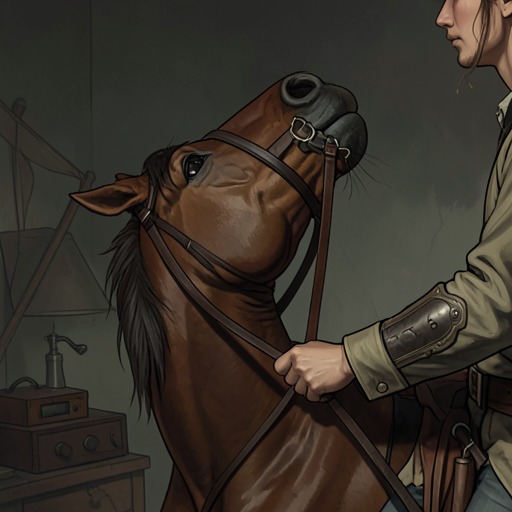
The rein holds a horse’s head in a raised position, restricting the ordinary movement of the head and neck. Ginger explains that a horse may naturally toss its head high, but that is different from being compelled to maintain the position for hours. In her experience, the enforced posture made her neck painful and left her unable to move her head freely. She also had to work with two bits, one of them sharp, which made her mouth uncomfortable. When she fretted while waiting for her mistress at parties or other entertainments, the whip followed; the arrangement offered no relief for the horse required to endure it.
Ginger connects these physical constraints to changes in her conduct. She was willing to work hard, but came to resent being made uncomfortable for the sake of appearance. Her breathing also felt affected by the pressure around her throat. As her restlessness increased, she began snapping and kicking when people came to harness her. The narrative thus presents resistance not as evidence that the horse is naturally vicious, but as behavior arising in a situation that repeatedly frustrates and pains her.
Fashion, Knowledge, and Responsibility
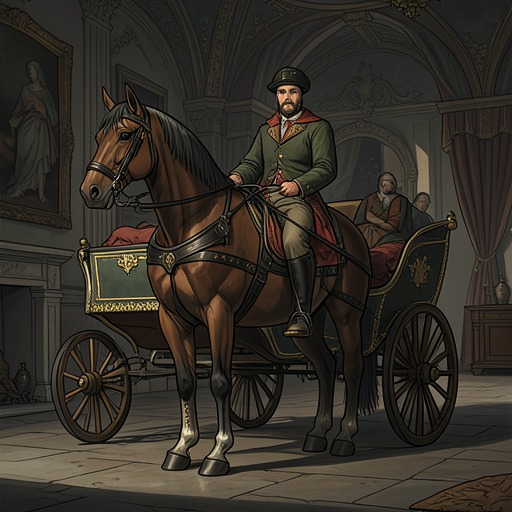
Ginger’s first experience of the rein followed a series of sales and changes of ownership. After breaking-in, she was bought by a dealer to be matched with another chestnut horse. They were later sold to a fashionable gentleman and taken to London, where the rein was made tighter than it had been at the dealer’s. Ginger’s account distinguishes the horse’s experience from the owner’s concern: her owner wanted a stylish turnout, while the coachman described her as irritable and expected her to get used to the restraint. Rather than respond to her distress with patient handling, the groom treated her harshly. The appearance valued by the household was therefore maintained by overlooking the discomfort it produced.
Her response eventually made her unsuitable for that establishment. When the horses were being harnessed for a carriage, Ginger struggled so forcefully that she broke harness and freed herself. She was then sent to Tattersall’s for sale. A later dealer tried different bits and methods, discovered that she could not tolerate the rein, and drove her without one before selling her as a quiet horse to a country gentleman. The contrast matters: her conduct was not fixed, but changed with the conditions imposed on her. Yet a new groom at the country home was also rough and impatient, showing that changing owners alone did not guarantee kind treatment.
The book sets these experiences against the reform efforts of Squire Gordon and Farmer Grey, who had worked for more than twenty years to remove bearing reins from cart horses. In their district, the device had become uncommon. Squire Gordon’s mistress also sometimes stopped when she met a heavily laden horse with its head strained up, got out of the carriage, and reasoned with the driver about the practice. These interventions turn private sympathy into public action: people who recognize the horse’s difficulty use their position to challenge the custom.
Squire Gordon makes the case directly to a Captain who admires a handsome pair of horses but still uses the reins. He compares the imposed posture with soldiers whose heads were tied back: looking smart on parade would not prove that they retained the strength and freedom of movement needed in a bayonet charge. For horses, he argues, holding the head back can fret their temper, diminish their power, and force more strain onto their joints and muscles. It can also leave them less able to recover if they make a false step. His argument opposes visible polish to practical ability: an animal made to look stylish may be less able to work safely and effectively.
The Rein at a New Household
Black Beauty encounters the restraint after leaving his earlier home, where he had known John Manly and Squire Gordon as friends. Before the new household’s first drive, York admits that the horses may have to wear a rein because his mistress wants the carriage horses’ heads raised. At first, the adjustment is limited, and Black Beauty can manage it. The change becomes more consequential when the mistress orders York to raise the horses’ heads because they are not fit to be seen. York shortens the reins, initially by one hole, on a day when the horses must pull the carriage up a steep hill.
Black Beauty notices the difference in the work itself. Instead of reaching forward and pulling with his usual willingness, he has to work with his head held up; the effort no longer feels natural, and the strain shifts onto his back and legs. Ginger recognizes the first adjustment as a warning. She says little while the reins are shortened gradually, but becomes restless. After several days without another change, Black Beauty hopes the worst has passed. The pause proves temporary: the reins continue to be shortened, and putting on the harness, once a pleasure, becomes something he dreads.
When the mistress demands a still higher carriage posture, York tightens Black Beauty’s rein and then turns to Ginger. She anticipates another adjustment and erupts into a struggle, knocking York’s hat away and disrupting the carriage team. She falls over the carriage pole, and Black Beauty is struck on his near quarter. The people present have to separate the horses and free them from the carriage. The episode makes the consequences of repeated restraint visible not as a problem of appearance, but as a breakdown in the working arrangement created by insisting on it.
Cumulative Harm and Narrative Significance
Black Beauty describes the effects of four months in the carriage as increasingly wearing. The sharp bit and constrained position left him foaming at the mouth, uncomfortable in his breathing, and strained and painful in the neck and chest; his mouth and tongue were tender, and he felt depressed. The narrative specifically challenges the interpretation of foaming as a sign of fine spirit, presenting it instead as a warning of discomfort that should prompt attention. This contrast exposes how an observer can mistake a sign of distress for a pleasing feature when appearance has already become the standard of judgment.
The absence of a trusted advocate intensifies the contrast with Black Beauty’s earlier life. He had known that John Manly and Squire Gordon were his friends; in the new household, although he was treated well in other respects, nobody relieved the pressure of the rein. York may have understood how it troubled him, but treated the practice as unavoidable. The account therefore distinguishes personal kindness from effective protection: sympathy that does not interrupt a harmful custom leaves the animal’s circumstances unchanged.
Across Ginger’s changing behavior, Squire Gordon’s reasoning, and Black Beauty’s symptoms, the bearing rein becomes a test of what human care means. The book does not treat a horse’s resistance as proof that the horse needs greater force. Instead, it asks readers to trace that conduct back to the conditions imposed on the animal. The recurring opposition between free movement and fashionable display turns a piece of harness into a critique of ignorance and convention: what looks elegant to a carriage owner may restrict the horse’s comfort, strength, and capacity to work.