Check-rein
Black BeautyThe Check-rein is a restraint that limits a horse’s ability to lower its head, and Black Beauty’s experiences show how a device treated as customary can obstruct rather than assist work. Its effects emerge in two contrasting episodes: a groom’s explanation of a runaway horse’s accident, and an intervention that allows Black Beauty to pull a heavy load more effectively. Together, these episodes connect bodily restriction with fashion, mistaken judgments about a horse’s behavior, and the difficulty of changing accepted practice.
Function and Effects
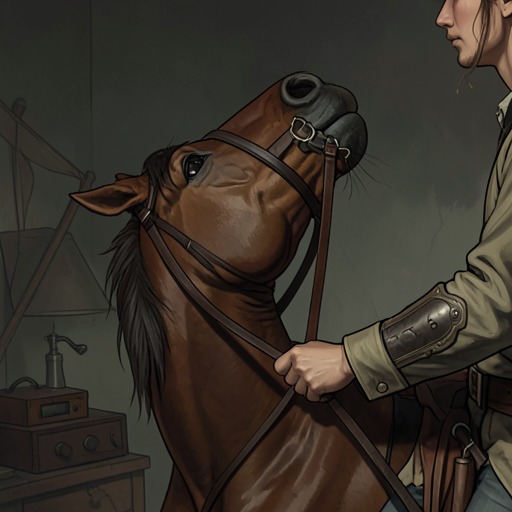
The Check-rein holds a horse’s head back. In the account of Black Beauty’s work as a carter, the rein is kept up as a matter of routine, and the narrator identifies it as an impediment to drawing easily. This restriction matters most when the horse must exert himself: the ability to move his head and position his body is connected directly to how effectively he can put his weight into the collar.
The book also presents the Check-rein as one element in a larger arrangement of restraints. A groom describes Hotspur, a young horse formerly kept in a nobleman’s stables, as having a tender mouth and a great deal of energy. Before the accident that made him unsuitable for those stables, Hotspur had been clipped, had not received enough exercise, and went out in bad weather. The coachman had harnessed him tightly, with a sharp curb and the reins attached at the bottom bar, as well as a Check-rein. The groom believes that this combination, imposed on a horse with a tender mouth and abundant spirit, contributed to the accident. His account does not isolate the Check-rein as the sole cause; it places it among several conditions that made the equipment particularly restrictive for Hotspur.
Black Beauty Under the Rein
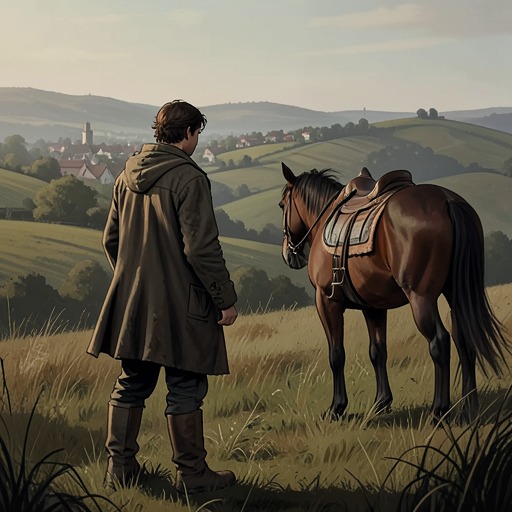
At the corn dealer’s, Black Beauty faces a different consequence of the same practice. Jakes, his carter, keeps the Check-rein raised, while a foreman repeatedly adds to Black Beauty’s loads even when Jakes considers them too heavy. After several months, the strain of the work is already telling on the horse’s strength. On a steep uphill road, Black Beauty cannot continue without stopping, and Jakes responds by whipping him, treating difficulty as unwillingness rather than recognizing the combined burden of the load and restraint.
A passing woman identifies the problem with the rein: with his head held back, Black Beauty cannot use all his power. She persuades Jakes to release it altogether. Black Beauty immediately lowers his head to his knees and moves it up and down to ease the stiffness in his neck. When Jakes takes the rein and speaks to him kindly, Black Beauty puts his head down, throws his weight against the collar, and pulls the load steadily uphill before stopping for breath. The sequence makes the point through a visible change in performance: the same horse and load, but with his head freed, can make progress without being driven by the whip.
The woman’s intervention also changes how Jakes understands the moment. She pats Black Beauty and asks Jakes not to put the rein back in its former position. Jakes acknowledges that giving the horse his head helped him up the hill. He nevertheless fears that working without a Check-rein would make him a laughing-stock among the other carters. He lets it out several holes and gives Black Beauty his head when going uphill, but does not abandon the restraint completely. The change is real yet limited: practical evidence persuades Jakes in a particular circumstance, while the expectations of his trade continue to shape his choices.
Fashion, Work, and Responsibility
The woman challenges the assumption that a customary practice is therefore a necessary one. She points out that many gentlemen no longer use Check-reins and that the horses in her own carriage have gone without them for fifteen years, working with less fatigue. Her argument turns the episode from a simple adjustment in harness into a comparison between established fashion and observed consequences. Jakes has just seen Black Beauty pull better when released, but worries that other carters will judge him for departing from convention.
The Check-rein also sits within a wider pattern of excessive demands on Black Beauty. Jakes’s partial adjustment does not stop the foreman from ordering additional goods onto already full loads. The narrator explicitly distinguishes the relief provided by fair food and rest from the limits of endurance: overloading can exhaust a horse despite such support. Black Beauty is eventually replaced by a younger horse because the heavy work has worn him down. The narrative therefore does not present release of the rein as a complete remedy for mistreatment; it improves the horse’s ability to pull, but cannot make excessive labor harmless.
By placing Hotspur’s restrictive harness beside Black Beauty’s uphill struggle, the book shows the Check-rein as more than an isolated piece of equipment. In one case it forms part of a tightly controlled setup that a groom believes contributed to an accident; in the other, loosening it allows a working horse to use his strength more effectively. The contrast gives the device a clear practical and ethical significance: a human preference for control or conformity can constrain a horse, while careful observation of what helps the animal work offers grounds for changing the practice.