Crimean War
Black BeautyThe Crimean War is recounted in Black Beauty not as a history of campaigns or causes, but as Captain’s testimony about life as a cavalry horse: the closeness of a trusted partnership, the ordeals of transport and battle, and the destruction that makes war look very different from parade. His account is embedded in a conversation with Black Beauty, so the war reaches the reader through an old horse’s recollection of what he experienced and what he could not understand.
Captain’s Service and the Journey Abroad
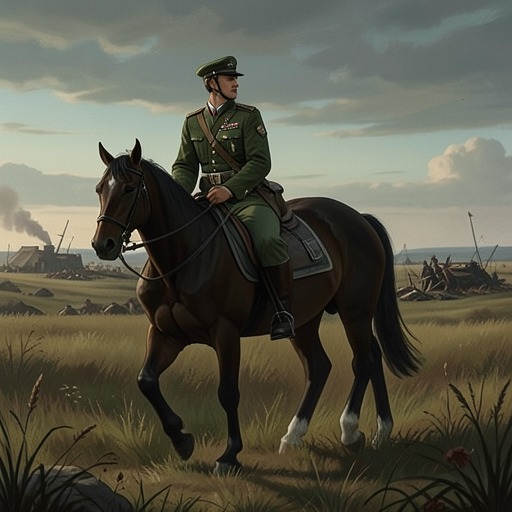
Captain had been trained as an army horse and belonged to a cavalry officer who went to the war. As a young horse he was a dark, dappled iron-gray, considered handsome, and treated with great care by his high-spirited owner. His early military training was, in his recollection, exhilarating: the horses moved together, wheeled in formation, halted at commands, and surged forward at a trumpet or signal. The training made war service seem like an extension of disciplined exercise, with Captain leading the regiment. The passage overseas changed that expectation. Horses could not simply walk aboard the ship; straps were placed beneath their bodies and they were lifted off their feet, swung over the water, and lowered onto the vessel. The crossing confined them in small stalls, where for a long time they could not see the sky or stretch their legs. In high winds, the ship rolled and the horses were knocked about. Their relief on reaching land was expressed in their excited snorting and neighing as they stood on firm ground again. Arrival brought further hardship. Captain remembered a country unlike his own and difficult conditions that extended beyond the fighting, including snow, wet weather, and general disorder. The care of individual soldiers mattered within these circumstances: many were fond of their horses and tried to keep them comfortable despite the conditions. The account thus distinguishes the privations of the campaign from the conduct of the people who shared them; hardship was widespread, but some riders continued to attend to the animals in their charge.
Battle and the Bond Between Horse and Rider
Captain recalled that the cavalry horses responded eagerly to the trumpet and the order to move, even when they had first waited for hours. He understood their confidence through the rider they felt in the saddle: a firm seat and steady hand helped keep them from fear as the force advanced. For Captain, trust in his officer was not an abstract loyalty. He believed that while his master guided him, they could not be killed, and he was prepared to charge toward the enemy’s guns. That confidence existed beside constant evidence of danger. Captain saw horses shot, pierced by lances, or struck by saber cuts; he also witnessed men fall mortally wounded. The cavalry passed over ground marked by blood, and Captain and his rider sometimes had to turn aside to avoid trampling wounded men or horses. He had not felt terror for himself through many engagements, despite these losses. His recollection singles out one day as a moment of exceptional fear, but the significance of that turning point is conveyed here without the circumstances that caused it. The aftermath makes the scale of loss plain. Army farriers went over the field and shot horses whose injuries left them ruined; horses with slight wounds were brought back and treated. Of the horses from Captain’s stables that went out that morning, only about one in four returned. The figure belongs to the group he describes, not to a general accounting of the whole war, but within his story it gives a stark measure of how many willing animals failed to come back from a single day’s action.
Loss, Return, and Captain’s Judgment
Captain never saw his beloved officer again. He believed that the young man had fallen dead from the saddle, though he had not witnessed what happened to him. The loss remained personal: Captain says he never loved another master so well. His memory of the officer’s care and encouraging presence gives the account’s military scenes their emotional center, while the officer’s absence leaves the horse without confirmation of his fate beyond what he believes. Captain went into further engagements after losing him. He was wounded once, but not seriously, and when the war ended he returned to England as sound and strong as when he had left. His survival does not cancel the losses he has witnessed. Rather, his return sets one horse’s continued life against the dead and injured horses, the fallen men, and the absent rider who had made him feel safe. The conversation with Black Beauty turns Captain’s recollection into a criticism of romantic ideas about war. He distinguishes the apparent fineness of exercise, parade, and sham fighting from the reality of thousands of men and horses killed or crippled. Asked what the fighting was about, he admits that a horse cannot understand its cause; he can only reason that the enemy must have been wicked if crossing the sea to kill them was justified. The uncertainty is central to his testimony: he knows the bodily costs and the bonds formed in service, but not the political purpose that demanded them. By giving that judgment to a horse who has experienced the campaign, the narrative makes military spectacle answerable to the lives and losses it leaves behind.