Earl of W——
Black BeautyThe Earl of W—— is Squire Gordon’s old friend and the aristocratic owner of Earlshall Park, where Black Beauty and Ginger are sent after the Gordon household breaks up. He buys them in the belief that they will find a good home, but their experience exposes the limits of that intention: his concern for their welfare does not prevent harmful treatment, and when he finally sees what has become of them, he can offer Ginger time to recover but sells Black Beauty because his injured knees make him unsuitable for the Earl’s stables.
Identity and Background
The Earl enters Black Beauty’s story through the changes caused by the illness of Squire Gordon’s wife. As the family prepares to leave England for a warmer country, Squire Gordon sells Black Beauty and Ginger to his old friend, trusting that they will be well placed. The Earl is therefore introduced not as a stranger seeking horses, but as someone whose friendship carries a promise of care. The stable hears of the sale as part of the household’s departure, alongside the arrangements for Merrylegs, whom Squire Gordon gives to the vicar on the condition that he will never be sold and will be put down and buried when past work.
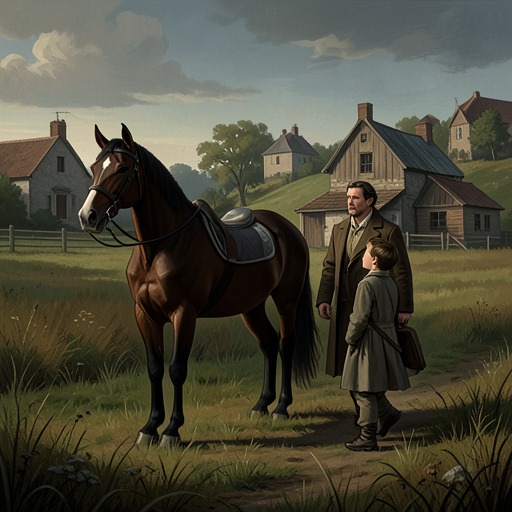
The Earl’s estate is Earlshall Park. Black Beauty and Ginger travel there with John Manly, who brings them about fifteen miles across the country. Their arrival establishes both the difference in scale and the difference in feeling between the new home and Birtwick Park: Earlshall has a very fine house and extensive stabling, but Black Beauty finds it less pleasant than the place they have left. The first reception is conducted by York, the new coachman, who examines the horses and receives John’s account of their particular needs.
A Good Home and Its Limits
The Earl’s first stated purpose is to use the horses in his country carriage. When he comes to inspect them the day after their arrival, he says he has confidence in them because of Squire Gordon’s recommendation. Although they do not match in color, he thinks they can work together in the carriage while the family is in the country. He also considers Black Beauty suitable for riding and plans to find a matching partner before the move to London.
The Earl is not wholly indifferent to differences between the horses. After York reports what John has said, he instructs him to watch Ginger and to keep her check-rein easy, anticipating that both horses may need some accommodation at first. That instruction reflects some awareness that the animals have individual needs, but the arrangement is quickly tested. When the horses are harnessed for the carriage, Black Beauty wears a check-rein for the first time. He finds it inconvenient to be prevented from lowering his head, though the rein does not initially force his head higher than he is accustomed to carry. He is especially anxious about Ginger, who appears quiet and content at that point.
The subsequent trouble reveals the gap between the Earl’s initial direction and what happens under his household’s authority. After an incident leaves Black Beauty injured, the Earl is much put out and blames York for yielding to his mistress. York says he would prefer to receive orders from the Earl alone, but Black Beauty observes that nothing seems to come of the disagreement: matters continue as before. The Earl’s remonstrance therefore shows that he objects to York’s decision, while the unchanged arrangements show that his objection does not produce an effective alteration in the horses’ treatment.
The Horses’ Ruin and His Decision
By the time the Earl returns to the meadow with York, Black Beauty and Ginger have both been damaged by their later work. Black Beauty has lasting trouble with his knees; Ginger has been strained by a steeplechase under Lord George, despite a groom’s warning that she was not fit to race. The Earl examines both animals and is visibly annoyed. He names the wasted purchase price of three hundred pounds, but identifies the deeper loss as the ruin of horses entrusted to him by an old friend who expected them to find a good home.
His response differs for each horse. He decides that Ginger will have twelve months at grass, after which her condition can be reassessed. For Black Beauty, however, the injured knees make continued residence in the Earl’s stables unacceptable to him. He says the horse must be sold. York proposes a livery-stable owner in Bath who often needs a good horse at a low price and, York believes, looks after his horses. He adds that the inquest cleared Black Beauty’s character and that a recommendation from either himself or the Earl would vouch for him. The Earl’s decision thus ends Black Beauty’s place at Earlshall, while York’s proposed reference offers a route to another home.
Character and Narrative Significance
The Earl is defined by a tension between humane intention and incomplete control. His friendship with Squire Gordon leads him to accept responsibility for two horses whose welfare matters to their former owner; his instruction about Ginger’s check-rein and his anger at York’s yielding show that he does not simply approve every choice made in his household. Yet Black Beauty’s account also records the practical limit of his intervention: after his protest, the conditions continue, and the horses’ later ruin forces a reckoning rather than being prevented by his good intentions.
His final inspection makes that failure explicit without erasing the care he can still provide. He acknowledges that the horses have not received the good home Squire Gordon expected, gives Ginger a year of rest, and allows Black Beauty to leave for a possible position in Bath rather than keeping an animal whose knees he considers unsuitable for his stables. The Earl is consequently neither the source of every hardship the horses endure nor a figure whose benevolence guarantees their safety. Through him, the narrative distinguishes a humane expectation from the sustained action needed to protect animals within a household.