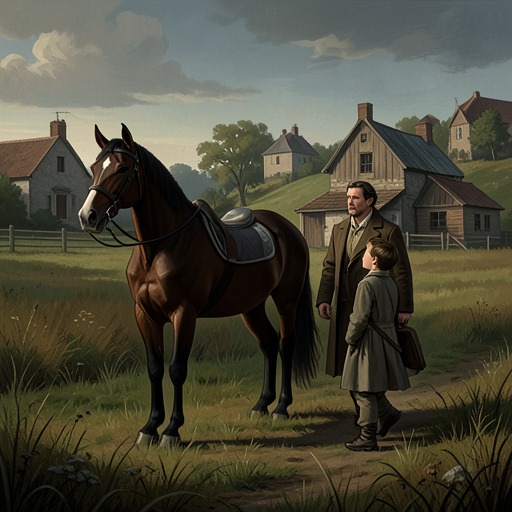
Earlshall Park
Black BeautyEarlshall Park is the estate of the Earl of W——, a grand country house with extensive stabling and the setting for a decisive change in Black Beauty and Ginger’s lives. Its scale and appearance initially suggest comfort, but the horses’ experience there is shaped by the demands of fashionable carriage display and by the gradual tightening of their bearing reins. The estate thus becomes more than a new home: it is where the contrast between attentive care and disregard for a horse’s needs is made visible, and where the consequences of their altered circumstances emerge.
Setting and arrival
Black Beauty and Ginger reach Earlshall Park after a journey of about fifteen miles from Birtwick Park. Before they leave, Joe Green takes Merrylegs to the vicarage in the mistress’s low chaise, and Merrylegs neighs goodbye from the yard. John Manly then saddles Ginger and leads Black Beauty across the country. The departure establishes Earlshall as a new household and a separation from the familiar people and stable life at Birtwick.
The estate is entered through a stone gateway. Black Beauty describes a fine house and a great deal of stabling; the house is three or four times the size of the one at Birtwick, though, in his judgment, it is not nearly as pleasant. The horses are led to airy, adjoining boxes, where they are rubbed down and fed. Their first accommodation is therefore comfortable in practical terms, even as the narrator’s comparison distinguishes the grandeur of the property from the warmth of their former home.
Household and stable management
John introduces the horses to Mr. York, who is to be their new coachman. York looks them over and asks whether either has particular needs, recognizing that horses can require different treatment. John explains that Ginger needs watching and that her check-rein should be left easy. York says he will keep an eye on her and raise the matter with his mistress. His first response suggests some awareness that adjustment should be made with care.
That caution is tested when the horses are harnessed for the carriage. At three o’clock they are brought to the front of the house, where two footmen in formal livery wait. The lady of the house comes down the stone steps and examines them before taking her place in the carriage. On the first outing, Black Beauty finds the check-rein inconvenient but not yet much higher than he is used to carrying his head. He is concerned about Ginger, although she initially appears quiet.
The next day the lady orders York to raise the horses’ heads because she considers their appearance unsuitable. York replies that they have not been reined up for three years and that the Earl had preferred bringing them to it gradually. He nevertheless shortens the rein by one hole. This alteration matters on a steep hill: Black Beauty cannot extend his head forward as he normally would to pull, and the changed position takes the spirit out of his effort and shifts strain onto his back and legs. Ginger recognizes the discomfort, but at first believes it may remain bearable if it does not worsen.
The bearing reins and the horses’ experience
The adjustment does not stop at one hole. The reins are shortened little by little, and Black Beauty’s former anticipation of being harnessed gives way to dread. Ginger becomes restless, though she says little. For a time, the shortening pauses, leading Black Beauty to hope that the worst is over; instead, the restriction has become a persistent burden. The gradual progression is important: the change is not presented as one abrupt decision but as a series of small adjustments that cumulatively alter the horses’ work and their response to it.
Black Beauty also contrasts Earlshall with his earlier home in his account of companionship. At Birtwick, he had known John and his master as friends. At Earlshall, although he is treated well in several respects, he feels that he has no friend. He thinks York may understand how the rein troubles him, but nothing is done to ease it. The contrast does not erase the care shown in the horses’ initial accommodation; rather, it shows how comfortable surroundings and polite management can coexist with a failure to address a working animal’s distress.
Departure, injury, and significance
Early in spring, the Earl and part of his family go to London, taking York with them. Black Beauty, Ginger, and other horses remain at Earlshall Park for use, with the head groom left in charge. Lady Anne, who prefers riding to carriage outings, chooses Black Beauty as her mount and gives him the name Black Auster. He enjoys rides with her, sometimes accompanied by Ginger and sometimes by Lizzie, a lively bay mare whom Ginger considers nervous. This episode shows that Earlshall’s horses have uses beyond the carriage, while also introducing a more pleasurable aspect of Black Beauty’s life at the estate.
After a later absence, the Earl comes into the meadow with York and examines Black Beauty and Ginger. He is annoyed to find that horses entrusted to his care have been ruined. Ginger is given a twelve-month run to see whether it will help her; Black Beauty is to be sold because the condition of his knees makes him unsuitable for the Earl’s stable. The decision marks the end of their time at Earlshall and makes the horses’ damaged condition a matter of practical consequence: Ginger is granted time away from work, while Black Beauty’s appearance and injuries determine his removal. Across these episodes, Earlshall Park is defined by a tension between the promise of a fine, well-appointed home and the standards of use and appearance imposed on the horses who live and work there.