Economic Exploitation of Cabmen and Horses
Black BeautyEconomic Exploitation of Cabmen and Horses is the system of costs, fares, and working conditions that makes cab drivers’ survival depend on extracting work from horses already under pressure. The narrative presents the cabman’s poverty and the horse’s exhaustion not as separate misfortunes, but as linked effects of arrangements in which owners control the terms, drivers bear the daily costs, and horses carry the physical burden. Seedy Sam’s account gives that system its arithmetic; Black Beauty’s changing treatment under different employers shows what those pressures mean in practice.
How the Cab Trade Distributes Costs
Black Beauty contrasts his own position with that of horses belonging to large cab-owners. His driver, Jerry Barker, owns his horse, so the horse’s welfare and the driver’s livelihood are directly connected. Jerry has reason not to overwork him, even apart from his kindness. By contrast, large owners rent cabs and horses to drivers for a fixed daily payment. The driver must first earn enough to pay the owner and then provide for himself and his family. Because the horse does not belong to the driver, the arrangement separates ownership from the consequences of daily work: the owner claims the fee, while the driver and horse face the immediate pressure to keep earning.
The story also shows that rules do not by themselves remove financial pressure. Jerry has a six-day cab license and refuses a regular Sunday fare because carrying a passenger that day would not be legal under his license. A customer offers to arrange a change, but the episode makes clear that Jerry’s decision is governed by the conditions of his license, not merely by whether an opportunity to earn is available. His position contrasts with drivers whose working arrangements leave them with little practical control over rest.
Seedy Sam’s Account of the Arithmetic
At the cab stand, the Governor challenges Seedy Sam after Sam arrives with a badly worn horse. Sam replies that the pressure should be traced to the owners who charge for the cab and horses and to fares set too low to make the work sustainable. In the busy season, he says, some drivers pay eighteen shillings a day for a cab and two horses. Before they can earn anything for themselves, they must bring in nine shillings for each horse. His account turns an abstract claim about hardship into a daily threshold: the horses’ work must first meet the rental cost, whether or not the driver has yet earned a living.
Sam describes the hours and family obligations behind that threshold. He has six children, only one of whom earns; he says he may spend fourteen or sixteen hours a day on the stand and has gone ten or twelve weeks without a Sunday. He wants warm clothing and a waterproof coat but cannot afford them while feeding his family and meeting the cab payment. He has pawned his clock to pay the owner and expects not to get it back. His circumstances do not excuse the horse’s suffering, but they explain why the driver experiences rest as a threat to already precarious income.
His examples of fares make the pressure concrete. Within the four-mile radius, the fare after the first mile cannot exceed sixpence per mile. On one morning Sam takes a passenger six miles and receives three shillings, then returns without a fare, leaving the horse to cover twelve miles for that payment. A subsequent three-mile journey earns one shilling and sixpence, with a shilling from the return trip. Bags and boxes add to the horse’s burden, while the permitted charge for the luggage described is only sixpence. Sam calculates that, even after this work, one horse still has three shillings to earn and the afternoon horse nine shillings before he can take anything for himself. The distances travelled and the money received do not translate into income freely available to the driver: much of the day is spent meeting costs set in advance.
Pressure Passed from Driver to Horse
Sam acknowledges that when a horse is thoroughly tired, a driver may resort to the whip to keep it moving. He says he does not ill-use his horse for its own sake, yet the conditions he describes leave both of them caught in the same demand to continue working. Other drivers at the stand agree that the system is desperately hard and suggest that drink, too, may follow from the strain. Jerry says nothing during the exchange, but the Governor changes his position: he accepts that Sam’s account is true and recognizes the hardship on both man and animal. The horse’s worn appearance has first drawn his attention; the explanation makes visible the economic conditions behind it.
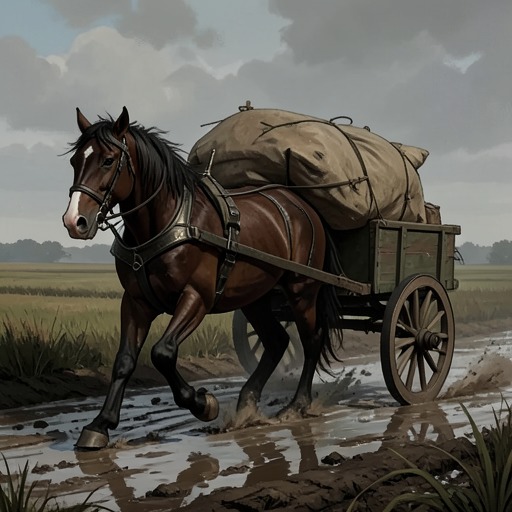
Black Beauty’s own work under a later employer shows how the pressure can also pass through workplace authority. After Jerry sells him to a corn dealer and baker, a foreman repeatedly orders more cargo onto an already full load, overruling Jakes, the carter, when Jakes says it is too much. Jakes also keeps the check-rein raised, making it harder for Black Beauty to draw, and after three or four months the work has substantially weakened him. On a steep uphill road with a heavier-than-usual load, Black Beauty has to stop repeatedly despite using his strength. Jakes responds by whipping him. The scene distinguishes the driver’s immediate action from the larger organization of work: Jakes applies the punishment, but the foreman determines the excessive load and dismisses the carter’s warning.
Skinner’s Stable and the Cost of No Rest
After a period of further changes in ownership, Black Beauty enters the large cab business of Nicholas Skinner, whom the narrative identifies as the man Seedy Sam may have driven for. Skinner’s operation is described as harsh toward drivers, while the drivers are harsh toward horses. There is no Sunday rest. On some Sundays, a party of passengers hires the cab for long trips into the country and back; they do not get down to walk up steep hills, even in hot weather. Black Beauty contrasts this work with the rest and Saturday-night bran mash he received with Jerry. Under Skinner, he is sometimes fevered and so worn that he can hardly eat, while his driver uses a whip that can draw blood and strikes him beneath the belly and toward the head.
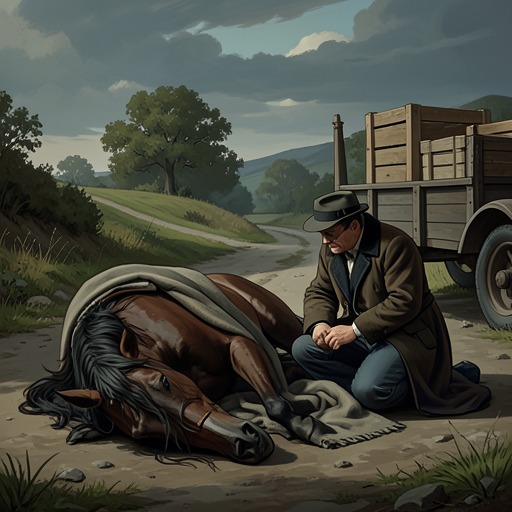
Black Beauty eventually collapses at Ludgate Hill under a heavy load and continuous pressure from the rein and whip. After he is taken to nearby stables and receives food and care, a farrier identifies overwork, rather than disease, as the main problem and says that six months’ rest could enable him to work again. Skinner initially regards a sick horse as unsuitable for his business and says he would sell horses once they could no longer work. The farrier points out that rest and feeding before an approaching sale might improve the horse’s value. Skinner then orders care, which the stableman carries out conscientiously: ten days of rest and nourishing food help Black Beauty regain some condition before the sale.
Consequences and Meaning
The account does not treat cabmen as uniformly cruel or horses’ suffering as the result of individual character alone. Sam’s explanation sets low fares, fixed rental payments, long hours, and family need beside the pressure on horses to keep moving. Black Beauty’s experiences add other points in the chain: a foreman can increase the load, a driver can punish a horse for failing under it, and an owner can see rest chiefly as a means of recovering sale value. By contrast, Jerry’s ownership and care show how a different arrangement can give the horse more protection from overwork.
The concept’s force lies in this connection between economic dependence and animal treatment. The horses bear costs in exertion and lost rest; the drivers bear long hours, debt, and difficulty supporting their families. The Governor’s response recognizes both sides without resolving the system that binds them. Through figures such as eighteen shillings in daily rental, fourteen or sixteen hours at work, and fares that may not cover the day’s obligations, the narrative makes exploitation legible as a structure of ordinary transactions rather than a single isolated act of cruelty.