Gentle, Knowledgeable Horse Training
Black BeautyGentle, Knowledgeable Horse Training is the humane method of preparing a horse for work that Black Beauty’s early life illustrates and the novel’s later contrasts make more urgent. It treats training as a responsibility to understand the animal: introduce equipment gradually, teach through repetition and reassurance, and prepare a young horse for real conditions rather than demand instant submission. The difference is consequential. Black Beauty becomes accustomed to work through patient instruction, while Ginger’s account shows how force and exhaustion can turn training into a struggle against the horse.
What Training Requires
In the book, breaking in means more than teaching a horse to carry a rider. A working horse is expected to wear a saddle and bridle, respond to a rider, and stand for the collar, crupper, and breeching that connect it to a vehicle. It must learn to pull a cart or chaise and adjust its pace to the driver. These tasks place the horse in unfamiliar equipment and make it responsible for work directed by people. The account also makes clear how much the customary ideal of obedience can demand: the horse is expected not to start at what it sees, to speak to other horses, or to act on its own wishes, even when tired or hungry.
That definition gives humane training a practical as well as moral purpose. A horse must learn what people expect, but people must give it the opportunity to learn without avoidable fear. Black Beauty’s experience links good preparation to time, repeated exposure, and the trainer’s attention to his responses. The method is not a denial that the horse will work; it is an argument that work can be taught without treating the animal’s alarm or confusion as defiance.
Black Beauty’s Gradual Education
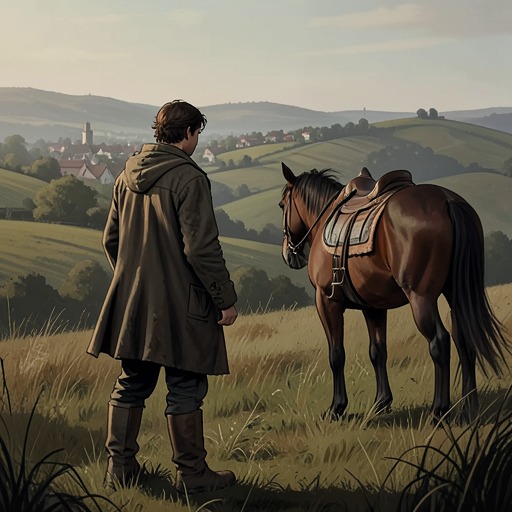
When Black Beauty is four, Squire Gordon examines his eyes, mouth, and legs, and watches him walk, trot, and gallop. He considers the young horse promising but expects him to be properly trained before taking up work. Black Beauty’s master undertakes the task himself, explaining the care behind that choice: he does not want the colt frightened or hurt. The sequence that follows turns this intention into practice.
Black Beauty already knows a halter and headstall, but the bit and bridle are new. His master uses oats, patience, and gentle handling until he accepts them. The saddle is introduced separately: the master places it carefully, while old Daniel holds the horse’s head, and Black Beauty receives oats and is led about. This is repeated daily. Only after he has become accustomed to the saddle does the master ride him, first around the meadow on soft grass and then for short rides on following days. Black Beauty recalls feeling strange at first, then taking pride in carrying his master. The change is produced by a progression from standing for the equipment to carrying a rider, not by making one startling demand.
The same care extends to preparation for road work. Black Beauty goes with his master to the blacksmith, who fits his shoes while the master stays nearby to prevent fear or harm. He is then introduced to harness, including a heavy collar, blinkers that restrict his view to the front, and a crupper beneath his tail. He finds the unfamiliar equipment uncomfortable, but becomes used to it over time. The narrative does not pretend that every part of training feels pleasant to the horse; instead, it emphasizes the difference made by patient introduction and steady care.
A fortnight spent in a neighboring farmer’s meadow prepares Black Beauty for another kind of challenge: passing trains. At first the noise and movement alarm him, and he runs to the other side of the field. The trains continue to pass, sometimes stopping at a nearby station, while he remains at a safe distance among sheep and cows. Over several days he learns that the trains do not enter the meadow or harm him. Later, he is calm at railway stations, a result the narrative attributes to his master’s thoughtful preparation. This example makes training an education in the world the horse will encounter, not merely a set of commands to obey.
Ginger’s Different Experience
Ginger’s history provides a counterexample to Black Beauty’s early training. She describes being separated from her mother when young and raised without the attentive human relationship Black Beauty experienced. When men begin to train her, they rely on force rather than giving her time to understand what is wanted. The contrast is not that Ginger lacks spirit or capacity; her account presents her distress as a response to the conditions imposed on her.
The difference between the older Mr. Ryder and his son, Samson, clarifies the book’s criticism. Mr. Ryder, who oversees the work only occasionally, recognizes that Ginger needs fair treatment. Samson, to whom the difficult training has been delegated, uses prolonged exertion and harsh handling. When Ginger resists a painful new bit, he responds with further force, and she fights to throw him. The episode ends not with successful instruction but with Ginger left exhausted and unattended in the field. This account presents resistance as information about how training is being conducted, not proof that the horse is naturally bad-tempered.
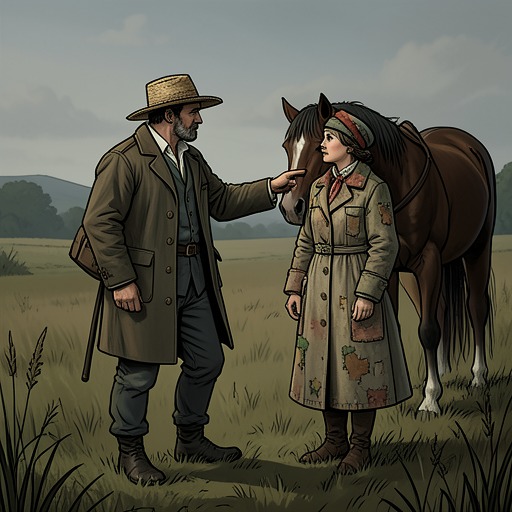
At sunset, Mr. Ryder approaches with oats and speaks to Ginger gently. She allows him near and follows him back to the stable. He removes her saddle and bridle, tends to her soreness, and arranges soft food while her mouth recovers. He then entrusts the continued training to Job, whom Ginger describes as steady and thoughtful; she soon learns what he wants. The change in outcome follows a change in method and handler. Mr. Ryder’s intervention also makes humane training a matter of judgment and accountability: he explicitly challenges Samson’s approach rather than treating the horse’s reaction as the only problem.
Principles and Wider Consequences
The novel connects competent training to a wider culture of humane treatment at Birtwick Park. Black Beauty describes Squire Gordon and his household as concerned for animals as well as people, and notes that their servants follow the same example. Squire Gordon and Farmer Grey have worked for years to end the use of check-reins on cart horses in their district; when the mistress sees a horse forced to hold its head up under a heavy load, she may stop and try to explain the cruelty and impracticality of the practice. This setting broadens the lesson beyond a single colt: a horse’s treatment depends not only on the trainer’s conduct but also on the equipment and expectations built into its work.
The book also distinguishes kindness from knowledge. Black Beauty’s early training succeeds because its patience is paired with specific preparation: equipment is introduced in stages, rides begin on soft ground, and exposure to trains lasts long enough for him to learn that they pose no danger. Ginger’s experience, by contrast, shows the consequences of a handler who mistakes force for skill. Good intentions matter, but effective humane treatment also requires attention to the horse’s condition and a willingness to change course when the animal is frightened or struggling.
The principle carries into John Manly’s plans after the Gordons leave. Rather than immediately accept other employment, he hopes to work with a first-rate colt-breaker and horse-trainer, because many young animals are frightened and spoiled through incorrect treatment and could receive a fairer start with the right person. Squire Gordon considers him well suited to the work, citing his understanding of horses and their responsiveness to him, and offers to recommend him through his agent in London. John’s ambition gives the practice a future beyond one household: humane training can be a skilled occupation directed toward preventing avoidable harm.
Narrative Significance
Because Black Beauty tells his life as an autobiography, the account makes training available through the horse’s own experience. The reader learns not just what equipment a young horse wears, but how the sequence feels to the animal and how repetition, familiar company, and human conduct shape its response. Ginger’s story extends that testimony: two horses can meet the demands of training under sharply different conditions, and their reactions reveal the difference between teaching and coercion.
Gentle, Knowledgeable Horse Training therefore joins practical competence to ethical responsibility. It does not suggest that horses need no instruction or that work can be separated from human direction. Rather, it argues through contrasting outcomes that responsible training makes the horse’s understanding and welfare part of the task. In Black Beauty’s gradual progress, preparation enables trust; in Ginger’s story, the arrival of a patient and perceptive handler interrupts a cycle of force. The book’s standard is simple but demanding: the person who trains a horse must learn to read the horse as carefully as the horse is expected to learn the work.