Ginger's Rebellion at Earlshall
Black BeautyGinger’s rebellion at Earlshall Park is the decisive collision between a horse’s resistance and a household’s insistence on the bearing rein. As the rein is tightened to force the horses’ heads higher, Ginger rears and struggles, bringing the carriage arrangement down and injuring Black Beauty. The episode changes Ginger’s place in the household but leaves the coercive practice in use, making the accident both a personal rupture and a revealing measure of how little a recognized danger can alter established authority.
Background and Setting
The incident takes place after Black Beauty and Ginger have entered service at Earlshall Park, where the carriage horses’ bearing reins are shortened repeatedly, hole by hole. Black Beauty recalls that he had once looked forward to being harnessed; now he dreads it. After several days without another adjustment, he tries to accept the discomfort as part of his duty. Ginger is restless too, though she says little. The apparent pause proves temporary: the worsening restraint is not an isolated adjustment but a developing condition that shapes what follows.
The contrast with Black Beauty’s earlier home at Birtwick gives this change particular force. There, the household’s kindness extended to animals, and the Squire and Farmer Grey had worked for more than twenty years to do away with bearing reins on cart horses. The mistress would sometimes stop to reason with a driver whose horse’s head was strained upward. Earlshall’s carriage scene presents the opposite pattern: a command from above reinforces the very restraint that the earlier household had tried to discourage. The contrast is not between ignorance and knowledge alone, but between concern expressed through intervention and authority exercised in the name of appearance and control.
The Command and Ginger’s Resistance
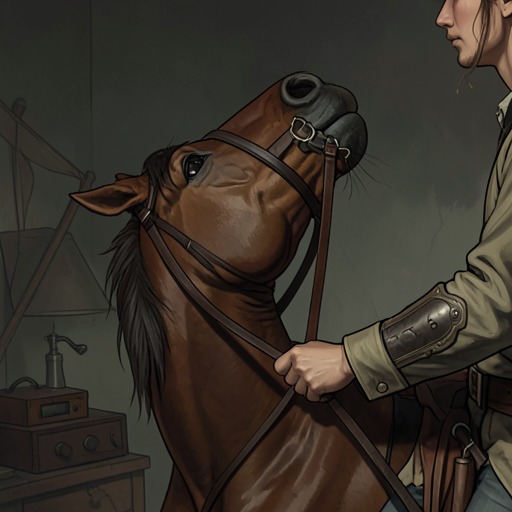
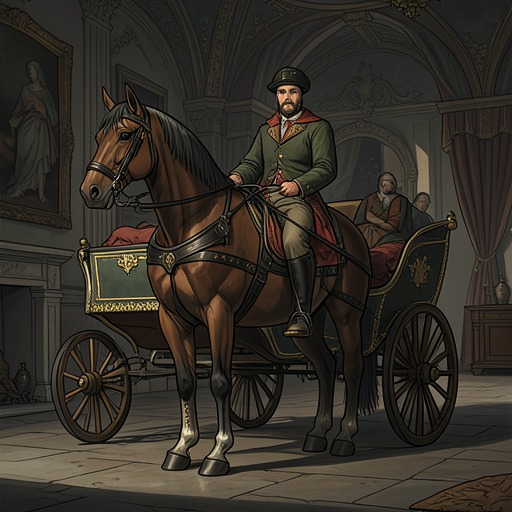
On the day of the accident, the mistress arrives later than usual and orders the horses’ heads to be raised, rejecting what she calls the indulgence shown to them. York begins with Black Beauty, drawing his head back and fastening the rein so tightly that it is nearly intolerable. A groom stands at Ginger’s head. Ginger jerks her head against the bit, and the account makes clear that she anticipates what is about to happen.
When York takes the rein off the terre t in order to shorten it, Ginger seizes the opening. She rears suddenly, knocking York’s hat off and nearly unbalancing the groom. The two men rush to control her, but she continues plunging and kicking. She kicks over the carriage pole and falls, striking Black Beauty on his near quarter. The journey to the garden party is interrupted before it can begin; the tightly controlled arrangement has become an immediate danger to both horses.
The men respond by trying to separate Black Beauty from Ginger and the carriage. York calls for the black horse to be unbuckled and for the carriage pole to be unscrewed or cut free. A footman fetches a winch and another brings a knife; the groom gets Black Beauty clear and takes him to his stall. The disruption leaves him excited, sore in the leg, and still held with his head raised by the rein. Ginger, meanwhile, is led in by two grooms, bruised from the struggle. The rebellion is not presented as a clean escape: it interrupts the imposed restraint, but both horses bear consequences.
York’s Recognition and the Household’s Response
After the horses are brought back, York releases Black Beauty’s head and discovers the swelling above his hock where Ginger struck him. He orders the place sponged with hot water and treated with lotion. His care for Black Beauty is practical, but his private reaction goes further: he blames the bearing reins and admits to himself that he had expected trouble. He also attributes his submission to the mistress’s orders, while anticipating that the Earl of W—— will be angry. His recognition is significant precisely because it does not prevent the event. York understands the risk, yet has allowed the rein to be tightened under pressure from someone with greater authority.
The Earl of W—— does blame York for yielding to the mistress. York replies that in future he would prefer to receive orders only from the Earl. That exchange suggests a dispute over who directs the stable, not a settled decision to stop using the reins. Black Beauty observes that little seems to change afterward: things continue as before. York may have identified the danger, and the Earl may have rebuked him for his compliance, but neither response removes the practice that produced the crisis.
Consequences for the Horses
Ginger is never put into the carriage again. Once she has recovered from her bruises, one of the Earl of W——’s younger sons says he would like to have her and believes she would make a good hunter. The account establishes the proposed change in her use, not that the transfer or new role definitely takes place. What is clear is that the accident ends her carriage work at Earlshall.
Black Beauty remains in the carriage and is given a new partner, Max, who has always been accustomed to the tight rein. When Black Beauty asks how he bears it, Max says that he endures it because he must and believes it will shorten both their lives. His answer widens the aftermath beyond Ginger’s single act of resistance: the rein remains an ongoing condition for the horses still assigned to carriage work. Ginger’s removal is a consequence of the accident, but it is not a general reform.
Significance
Black Beauty narrates the incident as a bodily witness: he records the adjustments to the reins, Ginger’s resistance, the blow he receives, and the care given afterward. That perspective turns a dispute about carriage style into an account of how imposed control is experienced by the animals subjected to it. Ginger’s silence beforehand does not signify acceptance; her restlessness and repeated head movements precede the sudden refusal that makes the hidden strain visible.
The episode’s reversal is sharply limited. The command to raise the horses’ heads is followed not by the obedience it demands but by disorder, injury, and a failed journey. Yet the household’s response treats Ginger as unsuitable for the carriage rather than ending the restraint for the other horses. In this way, the rebellion exposes both the cost of the bearing rein and the limits of individual resistance within a system that can remove one horse while continuing to bind another.