Ginger’s Check-Rein Rebellion at Earlshall
Black BeautyGinger’s Check-Rein Rebellion at Earlshall is a turning point in which Ginger’s resistance exposes the danger of forcing horses to hold their heads unnaturally high. During preparations for a carriage journey, she acts as York tightens the rein, and the ensuing disruption injures both her and Black Beauty. The immediate outcome separates the two horses: Ginger is taken out of carriage work, but Black Beauty continues in harness under the same restraint. The episode makes visible the difference between recognizing an abusive practice and having the authority to end it.
Causes and Background
The crisis follows a gradual tightening of the horses’ check-reins. Over time, each adjustment has made harnessing less welcome to Black Beauty; he dreads it rather than anticipating it. Ginger has also become restless. A short pause in the adjustments gives Black Beauty hope that the worst may have passed, but the restraint resumes when the household prepares for an outing. The episode is therefore not a sudden disagreement between horse and groom: it follows a pattern in which the horses’ discomfort has been repeatedly subordinated to the desired carriage appearance.
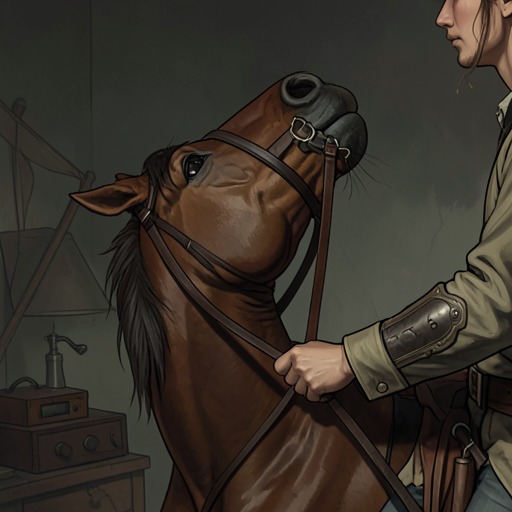
On the morning of the incident, the mistress directs York to raise the horses’ heads and rejects what she regards as indulgence. York acts on that instruction. He first draws Black Beauty’s head back and fastens the rein so tightly that it is almost intolerable; while another groom holds Ginger, York goes to shorten her rein. Ginger has anticipated what is coming. As York removes the rein from its fitting to adjust it, she seizes the moment to resist. Her action follows the tightening of the restraint and the immediate attempt to make it tighter still.
The Rebellion and Its Immediate Consequences
Ginger’s sudden movement knocks York’s hat off and nearly unbalances the groom. The two men try to control her, but she continues struggling, and the carriage pole makes it impossible to separate the horses without first freeing them from the vehicle. York orders the black horse unhitched and calls for a winch to unscrew the pole; a footman brings a knife in case the traces cannot otherwise be released. The practical urgency of these instructions shows how quickly a routine adjustment has become an emergency involving the whole carriage team.
In the struggle, Ginger goes over the pole and falls. Before the men can take further action, York sits on her head to prevent her from continuing to struggle. The groom frees Black Beauty from Ginger and the carriage and leads him to his stall. The episode is recounted from Black Beauty’s perspective: he is agitated, sore in one leg, and still held with his head drawn up by the rein attached to his saddle. His predicament is a sharp contrast to the immediate effort to release him from the carriage; he has been unhitched, but the restraint itself remains in place.
Ginger is brought back by two grooms, bruised from the incident. York then examines Black Beauty, releases his head, and finds a painful swelling above the hock where Ginger struck him. He orders it treated with hot water and lotion. These consequences are shared but unequal: Ginger’s resistance has brought the carriage to a halt and left her too hurt to continue, while Black Beauty is treated for his injury and returned to work afterward.
Responsibility and Limits of Intervention
Away from the men, York acknowledges that he expected trouble from the check-reins. His private reaction points to a conflict between practical knowledge and obedience: he sees the risk, but has not prevented the rein from being tightened. He blames the mistress’s insistence and says he would rather receive orders directly from the Earl of W——. When the Earl learns what happened, he blames York for yielding to his wife; York replies that he would prefer to take orders from his lordship. Yet the exchange produces no lasting change. The same arrangements continue, leaving Black Beauty to draw the carriage under the check-rein.
That failure to alter the practice gives the incident its larger force. Earlier in the book, the people at Birtwick Park are presented as advocates of humane treatment: the Squire and Farmer Grey have worked for years to remove check-reins from cart horses, and the mistress sometimes stops to explain their cruelty to drivers. The Earlshall episode places that principle under pressure. Knowledge that a restraint is harmful does not, by itself, protect the horses when those with immediate authority continue to demand it. York’s misgivings are real, but his compliance leaves the animals to bear the cost.
Elsewhere, the narrative repeatedly treats speaking up as a duty rather than an optional kindness. When Joe sees horses being flogged at a brick-yard, he seeks help and agrees to give evidence; John tells him that people who witness cruelty should interfere. A gentleman speaking with Jerry similarly argues that refusing to expose wrongdoing makes the bystander complicit. These episodes do not change the Earlshall outcome, but they clarify what is missing there: York recognizes the danger, yet the warning does not become effective intervention.
Aftermath and Narrative Significance
Once her bruises have healed, Ginger is never put into the carriage again. One of the Earl of W——’s younger sons says he would like her as a hunter, but the account does not describe what follows that proposal. Black Beauty, by contrast, must continue pulling the carriage. He is given Max as a new partner; Max has always been accustomed to the tight rein and says he endures it because he must, while warning that it will shorten both horses’ lives. The reassignment thus contains no general reform: Ginger is removed from this particular work, but the restraint remains part of Black Beauty’s daily conditions.
The chapter’s title, “A Strike for Liberty,” frames Ginger’s resistance as more than a disruption of a journey. Her refusal briefly interrupts a system that expects the horses’ bodies to conform without protest. Yet the conclusion is deliberately limited: the carriage is stopped, the horses are separated, and Ginger leaves carriage service, but the people’s practices do not change. The contrast between the brief interruption and the unchanged rein turns the incident into a critique of cruelty sustained by habit, fashion, and delegated authority.