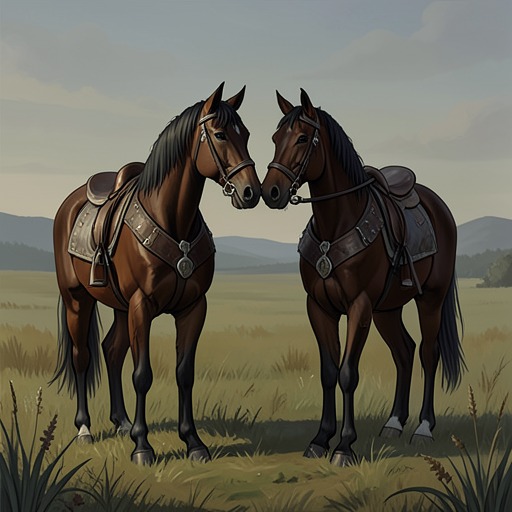
Ginger’s defensive temperament
Black BeautyGinger’s defensive temperament is a history written into her responses to people: after neglect and repeated rough handling, she learns to expect harm and to protect herself with resistance. Her gradual change at Birtwick Park, where kindness replaces punishment, makes the contrast between a supposedly difficult horse and the conditions that formed her behavior central to her story.
Origins of Distrust
Ginger describes an early upbringing without the individual care that Black Beauty received. Taken from her mother after weaning, she was kept with other young colts under a caretaker who provided food and winter shelter but little personal attention. Boys using a footpath through the field threw stones at the horses to make them run. Ginger was not struck, but she saw another colt injured, and the repeated disturbance helped teach the young horses to regard boys as enemies. Her early freedom in the meadows gave way to suspicion before she had much experience of a trustworthy human bond.
Her first breaking-in intensified that suspicion. Several men cornered and restrained her, then forced on a halter and bit and dragged her away while another man drove her from behind. She understood the episode as force without an opportunity to learn what was wanted. The abrupt change from open fields to confinement in a stall left her fretting and longing to get free. In her account, this was not evidence of innate malice: it was the beginning of a defensive response to being handled as an object rather than approached with patience.
Resistance to Training and Fashion
Ginger remembers Mr. Ryder as a person who might have handled her gently, but he left the difficult work to his son, Samson, and another experienced man. Samson’s hard manner convinced her that he meant to wear down her spirit and make her obedient. When she did not perform as required, he made her run repeatedly on a long rein until tired. She believed his drinking made these sessions worse. After a particularly demanding day, she was given little rest before another session with a saddle and a new bit. When the bit hurt and she resisted, Samson punished her; she fought back, eventually throwing him and escaping to the far end of the field. The episode fixed the association between training and threat: she was left hungry, tired, and unable to rest comfortably in her tack until Mr. Ryder came with oats and coaxing. His gentleness could calm her where force had intensified her resistance.
A dealer later sold Ginger to a fashionable owner in London, where the check-rein was fastened far tighter than before. She had to hold her head raised for long periods, and the equipment caused discomfort in her mouth and neck. Waiting for the owner at parties or entertainments was especially difficult: restlessness brought punishment rather than reassurance. The owner cared about the appearance of the carriage, while the coachman described Ginger as irritable and expected her to become accustomed to the rein. Her account distinguishes willingness to work from willingness to endure needless discomfort. As her distress and restlessness grew, she began snapping and kicking when people approached to harness her. During one attempt to harness her to the carriage, she plunged and kicked until she broke through the harness and got free, ending her stay there.
Defensive Behavior Repeats
At Tattersall’s, Ginger’s appearance and way of moving attracted another dealer, who tried different bits and found that she could be driven without a check-rein. He sold her as a quiet horse to a country gentleman, and she initially did well there. The situation changed when the gentleman’s old groom left and a new groom arrived. This man spoke roughly and struck her when she did not move at once in the stall. Ginger came to hate and fear his treatment; after he hit her about the head with a riding whip, she bit him, and he stopped entering her stall. The contrast is important: she remained quiet with her master, but the master accepted the groom’s account of her and sold her. Her protective behavior thus carried consequences beyond the immediate conflict, even when it was directed at the person mistreating her.
By the time she reached Birtwick Park, Ginger had concluded that people were natural enemies and that she had to defend herself. She doubted how long the more considerate treatment there would last. Her guardedness was therefore not simply a reaction to one handler or one kind of equipment. It had accumulated across separation, rough training, fashionable restraint, and repeated changes of owner and groom. Each new setting offered a chance of safety, but her experience gave her reason to expect that kindness might be temporary.
Kindness and Change at Birtwick Park
Ginger did bite James Howard once, and John Manly advised trying kindness rather than punishing her. James returned with his arm bound, brought her a bran mash, and stroked her. Ginger did not snap at him again. This response marks a change in the pattern she had learned: instead of meeting her defensive act with retaliation, James approached her calmly, making a different relationship possible. John Manly’s advice also treats her conduct as something shaped by experience and potentially changed through care, not as proof that she could only be controlled by force.
Over the following weeks, Black Beauty observes Ginger becoming gentler and more cheerful, and losing the watchful, defiant expression she had turned toward unfamiliar people. James Howard notices her whinnying after him following a moment when he rubbed her forehead. Squire Gordon, too, sees that she is happier and strokes her neck; Ginger raises her nose to him in a friendly, trusting gesture. The change is conveyed through ordinary signs of approach and response: she seeks contact, accepts touch, and no longer treats every person as a likely threat. Squire Gordon expects her recovery to continue, while John Manly describes kindness as the treatment she needs.
Significance and Limits
Ginger’s story challenges the label of bad temper by tracing behavior to specific treatment. Her resistance repeatedly follows distress or rough handling: the tiring training, the tight check-rein, the groom’s blows. Where people respond with patience, her hostility eases. The contrast with Black Beauty’s protected upbringing makes their different temperaments legible as consequences of different histories, rather than as a simple division between a good horse and a bad one. Black Beauty initially thinks Ginger may be making the worst of her past, but later observes the change himself, giving her account confirmation through the narrative’s witness.
That improvement at Birtwick Park is real but does not erase the broader uncertainty of Ginger’s life. In a later encounter outside a park where music is playing, Black Beauty recognizes her in an old, worn-out chestnut horse waiting beside the cab. The scene confirms how greatly her circumstances and condition have changed, but the available account does not establish what became of her temperament or explain the intervening events. Her period of trust at Birtwick Park therefore stands as a meaningful recovery, not proof that later hardship was prevented. Across these episodes, Ginger’s defensiveness reveals how treatment can produce distrust—and how humane handling can begin, without guaranteeing, its undoing.