Ginger’s ruined health
Black BeautyGinger’s ruined health develops through repeated overexertion rather than a single mishap. The narrative first registers the damage in her strained returns from hunting and short coughs, then shows a steeplechase worsening her condition despite a warning that she was not fit to race. Rest brings her briefly back into the company of Black Beauty, but the later sight of her working as a worn-out cab horse in London makes clear how far her strength and appearance have declined. Her history gives physical consequence to the novel’s criticism of careless riding and the assumption that a willing horse can be pushed indefinitely.
Early Signs of Strain
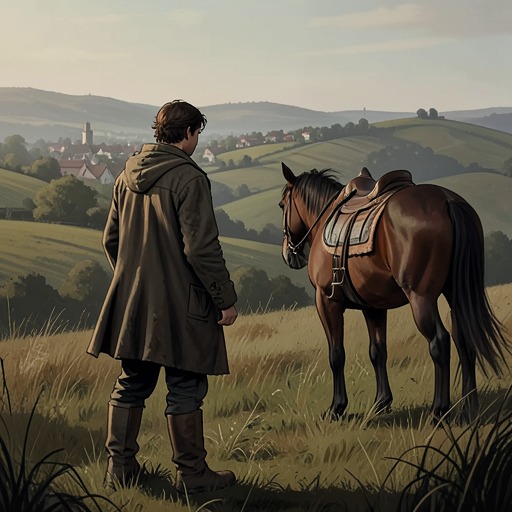
During the period when Lord George took Ginger hunting, she initially enjoyed the activity. Yet her returns sometimes showed that the effort had been too much: Black Beauty could see she was strained, and she occasionally gave a short cough. Ginger did not complain, but her symptoms were visible enough to make Black Beauty anxious. Her high spirit therefore cannot be taken as evidence that the work is harmless; the narrative sets her willingness to go against the signs her body gives afterward.
York had already questioned the way she was being ridden. He considered a steady hand important in training a horse through its first hunting season and objected to leaving that work to an inexperienced or unsuitable rider such as Lord George. The warning establishes that her later decline was not presented as unforeseeable. Her condition was already giving cause for concern, and someone familiar with horses had identified the risk in the way she was being handled.
The Steeplechase and Worsening Condition
The strain deepened when Lord George decided to ride Ginger in a steeplechase. Her groom told him that she was slightly strained and not fit for the race, but Lord George did not accept the warning. During the event he urged her to keep pace with the leading horses. Ginger’s spirit carried her into the first three finishers, but that achievement came at a physical cost: her breathing was affected and her back was strained. The race turns her performance into an ironic measure of the danger. She can still compete, but finishing near the front does not mean she has come through unhurt.
The account links this episode to a larger pattern of hard riding. Lord George was young, rode forcefully, and hunted whenever he had the opportunity, paying too little attention to the limits of his horse. The groom’s warning, York’s earlier concern, and Ginger’s prior coughing all point in the same direction: her decline followed repeated signs of strain that were disregarded. The narrative does not make a single race the whole explanation; it presents the steeplechase as a further demand on a horse already being overworked.
Rest and Reunion with Black Beauty
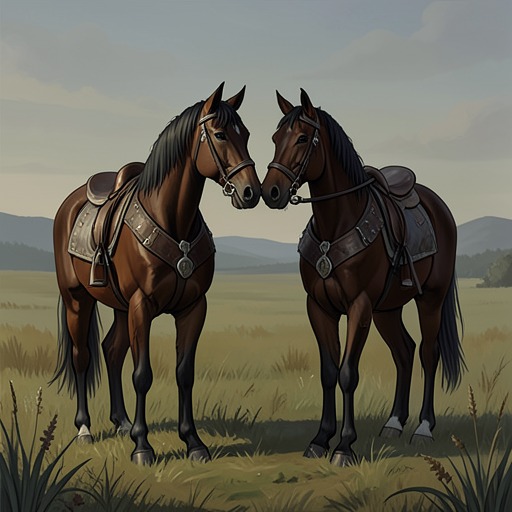
After Black Beauty’s knees had healed enough for him to be put in a small meadow, he was kept there alone for a time. He enjoyed the grass and liberty but missed the company of other horses, especially Ginger, with whom he had become a close friend. When a man eventually brought her into the meadow and released her, the two greeted each other with evident pleasure. Their reunion, however, was not a return to their former life of strength. Ginger had been turned out to see whether rest would help after hard riding had ruined her condition.
The meadow gives them time together, but it does not restore what they have lost. They feed, lie down beside one another, and spend long periods beneath a lime tree with their heads close together. They no longer gallop as they once had. Black Beauty’s damaged knees and Ginger’s decline have different immediate causes, but both horses recognize that they are no longer what they had been. Their companionship remains a comfort, while their reduced activity makes the lasting consequences of their treatment plain.
Later Condition in London
Ginger is later encountered beside Black Beauty while their cabs are waiting outside a park where music is playing. She arrives in a shabby, old cab as a worn chestnut horse, with an unkempt coat, a visibly weakened stance, and legs that appear unsteady. When a small lock of Black Beauty’s hay is blown within reach, she stretches her neck to pick it up and looks for more. The brief gesture makes her need for food concrete without turning the encounter into a spectacle: she is working, yet even this small opportunity to find hay matters.
At first Black Beauty struggles to recognize her. The neck that had once been arched and glossy is now straight and fallen; her legs and joints have changed under hard work, and her face no longer has its former liveliness. Her sides heave and she coughs frequently, signs that her breathing remains poor. When she recognizes Black Beauty, he moves nearer so they can speak more privately, while their drivers stand some distance away. The evidence records the beginning of their conversation but does not supply the full account Ginger gives him, so her later history cannot be specified from this scene alone.
Significance and Limits of the Record
Ginger’s condition is presented through observable changes across time: coughing after hunting, worsening strain after the steeplechase, a period of rest, and an eventual return to demanding work in a cab. The sequence distinguishes temporary recovery from restored health. Time in the meadow lets her share Black Beauty’s company, but the later encounter shows that her physical decline has continued or become more pronounced rather than being undone by that respite.
Because the story is told through Black Beauty’s first-person testimony, Ginger’s suffering reaches the reader through what he sees and through the parts of her experience she tells him. Her symptoms and altered appearance make the consequences legible even where the account leaves details of her intervening life unstated. Her history also sharpens the novel’s contrast between a horse’s spirited willingness and the judgment required of the person who controls its work: eagerness to run is not proof of fitness, and warnings matter precisely because the animal cannot choose the demands placed upon it.