Golden Rule
Black BeautyThe Golden Rule gives a practical shape to the book’s ethic of kindness: people should act toward others as they would hope others would act toward them. It is not presented only as a maxim to admire. Through Jerry Barker and Polly Barker, the principle is tested against the claims of Sunday rest, tired horses, work, and urgent human need—and is shown in decisions that cost time and effort. The rule also extends the novel’s concern for humane treatment beyond the human characters: the condition of the horse doing the work remains part of the moral question.
Principle and the Sunday dispute
The chapter title, “The Golden Rule,” identifies reciprocity as the governing idea of the episode. In the discussion leading into it, Larry raises the difficulty that people might be unable to reach their preferred preachers if cabmen refused Sunday work. Jerry does not claim the authority to make other people’s plans for them. He answers instead that someone unable to walk far can go to a nearer church, and that rain can be met with a mackintosh, as on a weekday. His point is that inconvenience does not by itself make a necessary choice impossible, and that the standard of right conduct applies to cabmen as well as churchgoers.
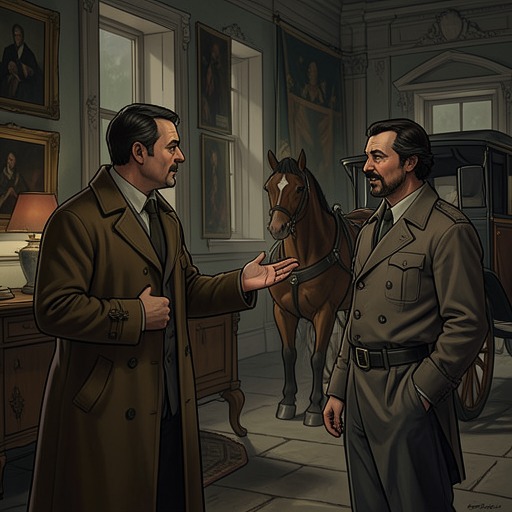
This exchange places the principle beside a competing obligation rather than treating it as a slogan without circumstances. Sunday matters to Jerry: he and the horses are tired, and he fears losing their day of rest. Polly’s appeal does not dismiss that concern. She acknowledges that the loss pinches everyone, including herself, but asks him to imagine what he would want if his own mother were dying. She also argues by analogy with pulling a poor animal out of a pit: if that rescue would not spoil the Sabbath, helping a woman reach her dying mother should not either. The rule works here through an imaginative exchange of places, while the horse’s need for rest remains visible in the decision.
Dinah Brown’s journey
Dinah Brown’s emergency makes that argument concrete. Her mother is dangerously ill, and Dinah has been told that she must go at once if she hopes to see her alive. The destination is more than ten miles away in the country. Taking the train would still leave four miles to walk, an impossible prospect for Dinah, who is weak and has a baby only four weeks old. Her request is therefore not ordinary Sunday convenience but a plea for help under severe constraints.
Jerry initially hesitates, not because he disputes the urgency, but because he is thinking of the lost Sunday and the tiredness of both himself and the horses. Polly answers by placing herself in Dinah’s position and invoking the help she would want if her own mother were dying. Jerry accepts the appeal and says he will be ready when the clock strikes ten. He also asks butcher Braydon to lend his light trap, knowing that it is not used on Sunday and that it would make a considerable difference to the horse. The practical arrangement matters: compassion does not require ignoring the animal’s burden, but finding a way to reduce it while meeting Dinah’s need.
The sick child and the free cab ride
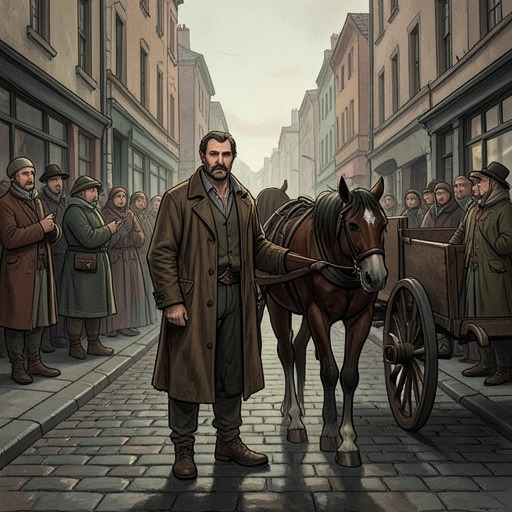
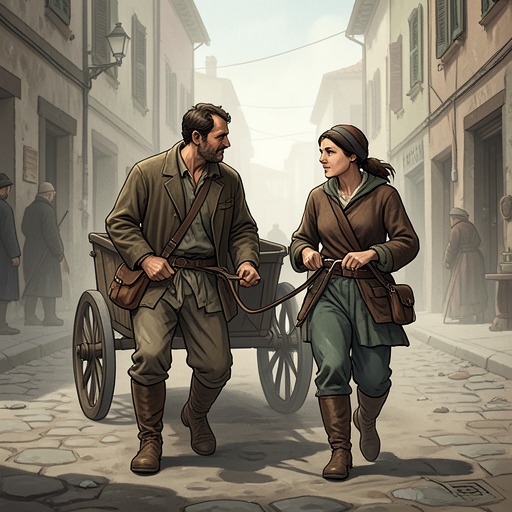
Later, on a crowded election day, Jerry’s conduct gives the same ethic another form. A young woman carrying a heavy child approaches him in bewilderment and asks for directions to St Thomas' Hospital. She has come from the country that morning, is unfamiliar with London, and has an order for her four-year-old son, who is in pain and cannot walk. The hospital is three miles away. With crowds filling the streets, cabs rushing among voters, and two people already knocked down, Jerry sees that walking would put both mother and child at risk; rain is also coming on.
The woman refuses his first offer of a ride because she has only enough money to get home. Jerry then makes the help free. He explains that he has a wife and dear children and knows a father’s feelings; he would be ashamed to let a woman and sick child face that danger when he can take them safely. Her gratitude is immediate, but the episode’s emphasis is on the decision itself: he does not turn a vulnerable stranger’s lack of money into a reason to leave her to manage alone. He carries her and the child to the hospital, where she thanks him for bringing her when she could not have got there by herself.
Witness, action, and meaning
The cabman’s kindness is observed through Black Beauty, whose account links human generosity to the horse’s experience of work. On the election day, the streets are full of cabs bearing candidates’ colours; horses are having a hard time while some passengers, many half-drunk, cheer from the windows. In contrast to that heedless crowd, Jerry has fed Black Beauty crushed oats wetted with bran, shares Polly’s meat pie nearby, and then uses the cab to help the stranger. The juxtaposition makes humane conduct visible not as an abstract quality but as attention—to a sick child, to a frightened mother, and to the horse whose strength is being used.
After watching the woman enter the hospital, Jerry quietly recalls, “Inasmuch as ye have done it to one of the least of these.” He pats Black Beauty’s neck, his familiar gesture when something pleases him. The biblical words and the touch complete the scene without turning it into a public display: service is rendered, the vulnerable are helped, and the horse is included in the narrator’s perception of the moment. Across the Sunday journey and the hospital ride, the Golden Rule becomes a test of what a person does when another’s need is immediate—and of whether kindness can be made practical without forgetting those who bear its costs.