Harm to Animals Caused by Fashion
Black BeautyHarm to Animals Caused by Fashion is the novel’s critique of human practices that alter animals for appearance, status, or fashionable performance at the expense of their comfort and natural capacities. It links visible conventions, such as tail docking and elevated head carriage, to less visible costs: lost function, restricted movement, distress, and lasting physical strain. By giving animals the chance to describe those consequences, the narrative turns fashion from an abstract preference into an account of what other beings are made to endure.
Altering Bodies for Appearance
Sir Oliver supplies the clearest personal testimony. His tail, once long, was cut short when he was young, leaving only a small remainder. He explains that the procedure was deliberate, not an accident, and that its consequences extended beyond the pain of the operation: without a full tail, he could no longer brush flies away from his sides and hind legs. The loss is therefore both an imposed alteration to his appearance and a permanent deprivation in daily life.
Sir Oliver places the practice within a custom of breeding and display. In his youth, he says, a well-bred young horse was expected to have a docked tail. Fashion could make an injury seem like a normal mark of good breeding, while the animal’s own needs counted for less than human judgment about what looked right. His account challenges the assumption that fashionable convention is harmless merely because it is widespread.
His story of Skye, a brown terrier who lived near his stall, extends the criticism beyond horses. Skye’s five puppies were taken away and returned with shortened tails and their ear flaps cut. Sir Oliver recalls their mother tending them, and stresses that the removed ear flaps would have protected sensitive parts of the ears from dust and injury. The puppies’ bodies were altered to create a desired look, although the changes also removed protective features. By setting that practical loss beside the fashion-driven treatment, the episode makes cosmetic alteration appear not simply unnecessary but indifferent to what the animal’s body is for.
Restraining Natural Movement
The discussion of Blinkers and check-reins broadens the argument from alteration to control. Justice observes that Blinkers are said to prevent horses from shying, but questions why riding horses are not routinely fitted with them if seeing the surrounding world is inherently dangerous. He argues that horses accustomed to seeing their carts and surroundings may understand them better than objects glimpsed only in fragments. He allows that some nervous horses, especially those frightened or hurt when young, might benefit; his objection is to treating restraint as universally necessary rather than considering individual circumstances.
Sir Oliver adds examples in which restricted sight may increase danger. He recalls a hearse whose horses went over the edge of a pond on a dark night; both horses drowned, and the driver barely escaped. A visible white rail was put up afterward. In another accident, a carriage was overturned after its lamp went out, and Colin, who wore Blinkers, was badly hurt. Sir Oliver argues that a horse with the full use of his eyes might have seen the danger. These recollections do not establish that equipment alone caused each accident, but they challenge the assumption that limiting an animal’s perception automatically makes travel safer.
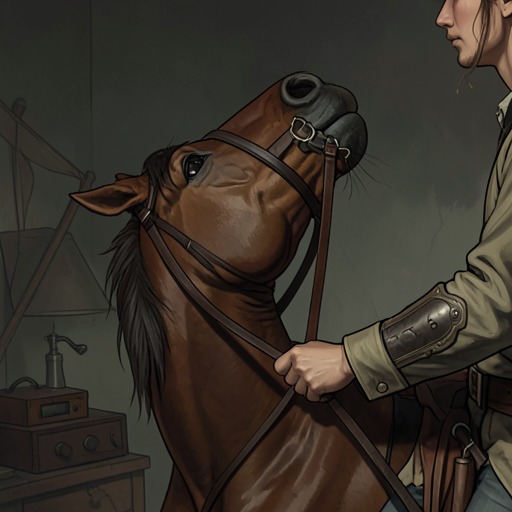
The case against the check-rein is framed around the difference between a freely carried head and one held up by force. In a conversation about a new team, Squire Gordon tells their owner that a horse’s head may look elevated without being tied into position. He compares constrained horses to soldiers whose heads are fastened back: the posture might look orderly on parade, but it would impede their strength and movement in action. In a horse, he argues, restraint can fatigue and fret the animal, burden its joints and muscles, and reduce its ability to recover from a false step. The fashionable outline thus conflicts with the body’s practical need to move freely.
Fashion Sustained by Custom and Demand
The novel shows that these practices persist because people value the appearance they produce. Ginger connects the treatment of horses’ mouths in London with the same impulse that led Sir Oliver to lose his tail: fashion. In another exchange, a horse reports what a dealer said about training horses to carry their heads higher and step higher. Customers wanted that look, the dealer explained, even though the training was harmful; it was profitable because worn or diseased horses could be replaced with another pair. Fashion here is not merely an individual preference. It is reinforced by trade and by a market that can turn damage into repeat business.
The pressure also appears within the household routines of Black Beauty’s later service. When the horses are first put to a check-rein, York says they have not been reined up for three years and that introducing it gradually would be safer. The lady orders their heads higher because, in her view, the horses are not fit to be seen otherwise. That demand makes the conflict explicit: York’s caution concerns the animals’ adjustment, while the order concerns their appearance. Black Beauty later describes four months in the carriage wearing the rein. The imposed position and the bit’s action caused him to froth at the mouth; the rein pressed on his windpipe, made breathing uncomfortable, and left his neck and chest strained and painful, with his mouth and tongue tender. What could be admired by onlookers as a spirited appearance was, from the horse’s perspective, evidence of discomfort.
Resistance, Care, and the Animal’s Testimony
The novel sets fashionable restraint against sustained efforts to change custom. Squire Gordon and Farmer Grey had worked together for more than twenty years to abolish check-reins on cart horses, and their district seldom used them. The mistress also sometimes stopped when she saw a heavily laden horse with its head strained up, got out of the carriage, and reasoned with the driver about the practice. These interventions treat fashion as something open to challenge: convention may be repeated, but it can be questioned by people willing to address those who impose it.
The form of the book strengthens that challenge. As an autobiography of a horse, it presents judgments about grooming and equipment alongside their consequences as lived bodily experience. Sir Oliver can explain what a docked tail prevents him from doing; Black Beauty can distinguish an elegant-looking posture from the strain it causes. The animal accounts also complicate easy defenses based on safety: the discussion of Blinkers considers possible exceptions without accepting that every horse must be restrained, and Squire Gordon’s argument measures the rein against the work a horse must perform.
The recurring contrast is between what human observers admire and what animals experience. A short tail may be treated as a sign of breeding; a raised head may satisfy a viewer; a familiar restraint may pass for good practice. But the accounts of lost function, constrained movement, and physical discomfort disclose the cost concealed by those appearances. Fashion’s harm lies not only in a single imposed alteration, but in the habit of treating an animal’s body as material to be redesigned for human approval.