Horses’ Freedom and Domestication
Black BeautyHorses’ Freedom and Domestication is a central tension in Black Beauty: a horse may be trained for human use and still need room to move, exercise, rest, and act according to its nature. The narrative distinguishes necessary training from needless constraint, and humane work from exploitation. Its contrasting accounts of open fields, the stables at Birtwick Park, Ginger’s experience of fashionable harness, and the London cab trade show that domestication can mean care and companionship—or a life organized around labor with little regard for the animal’s limits.
From open meadow to trained work
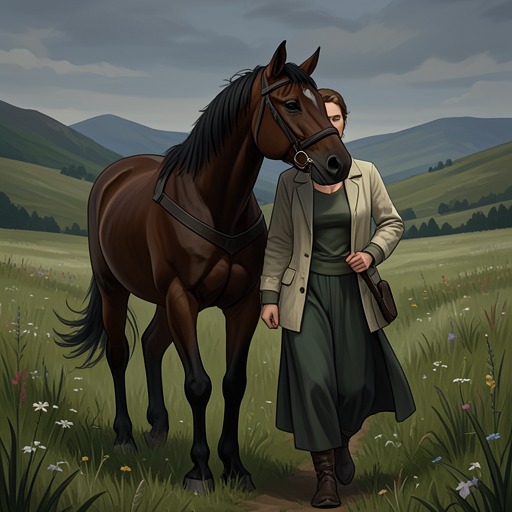
Black Beauty’s earliest remembered home is a meadow with a pond, trees, a grove, and a running brook. As a young foal, he stays beside his mother, feeding on her milk and resting near her at night; once old enough to eat grass, he remains in the meadow while she goes out to work. This beginning establishes both freedom as a lived condition—movement through a familiar landscape—and the early bond between a foal and its mother. The open setting is not presented as idleness: it is the place where a young horse grows before being asked to serve people.
At four, Black Beauty is examined by Squire Gordon, and his owner undertakes to train him gently rather than frighten or hurt him. The book explains breaking in as a broad education in service. A horse learns to wear a saddle and bridle, carry riders, accept collar and other harness, stand while equipment is fitted, and pull a cart or chaise at the pace its driver requires. The expected obedience reaches beyond particular tasks: the trained horse is meant not to start at what it sees, speak to other horses, or express its own will. This account makes domestication an alteration of everyday bodily freedom, not merely the acquisition of a skill.
Black Beauty initially accepts the bit and bridle through a combination of oats, patience, kind words, and gentle handling. The contrast matters: training imposes human purposes, but its manner changes what that imposition means to the horse. The narrator’s description of equipment and obedience also makes clear that being well treated does not erase the limits of a working animal’s life. The question is whether people recognize those limits and respond to them.
Liberty within a kind home
At Birtwick Park, Black Beauty is well fed, has a light, airy stable, and is treated kindly. He nevertheless identifies liberty as what he misses. For three and a half years he had enjoyed open space; now he spends most of his time in a stable, with a bit, blinkers, and straps, and must remain steady when called upon. He does not describe himself as rejecting his new home. Rather, his account holds two truths together: care makes his circumstances good, while confinement remains a loss for a young horse with strength and spirits.
Insufficient exercise brings that conflict into daily routine. When Black Beauty feels too full of energy to keep still, John Manly recognizes playfulness rather than deliberate misconduct. He speaks firmly when necessary, then gives the horse a brisk trot of several miles beyond the village before bringing him home. His response meets a need through exercise instead of punishment. Black Beauty’s fondness for John also makes the groom’s voice and touch effective forms of guidance: authority here depends on a relationship of trust, not simply on physical restraint.
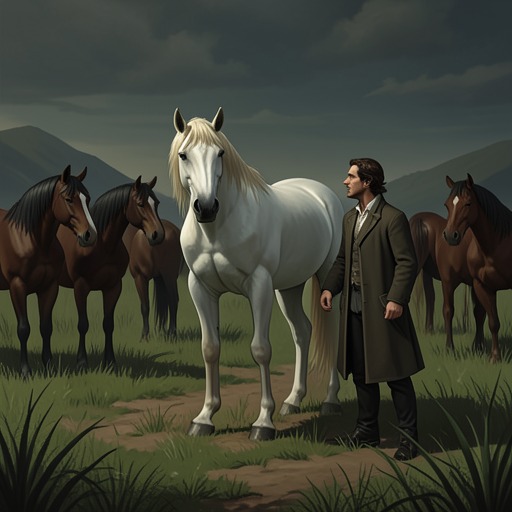
On fine summer Sundays, when the carriage does not go out because the church is nearby, the horses sometimes receive several hours in the home paddock or old orchard. They can gallop, lie down, roll, graze, and stand together under a chestnut tree. These intervals are limited, but their importance lies in how plainly the story connects freedom with ordinary actions: moving at will, resting on the ground, and being among other horses. They are not luxuries detached from good care; they are part of what makes a horse’s life livable.
Ginger and restraint in the name of fashion
Ginger’s account exposes the other side of domestication. Separated from her mother after weaning, she grows up among young colts without the individual kindness Black Beauty remembers. Her breaking-in is conducted by force, and the experience leaves her distressed by confinement and distrustful of people. The contrast is not that she lacks spirit while Black Beauty possesses it: her account shows that early handling and the conditions of training shape how a horse experiences human control.
Later, a dealer drives Ginger with a check-rein, and the fashionable household that buys her keeps it tighter because her owners and coachman think the raised head looks stylish. The rein restricts her ability to lower or move her head freely, and she describes sustained discomfort, worsened by waiting for long periods at social events and being punished for impatience. The episode links fashionable appearance to the horse’s restricted movement: the human preference is visible, while the cost is borne by the animal. Ginger’s comparison with Black Beauty’s less restrictive upbringing makes the contrast between training for useful cooperation and restraint for display especially sharp.
Work, rest, and the costs of ownership
The cab-horse episodes extend the issue from individual handling to the organization of work. Black Beauty observes that he is comparatively fortunate because Jerry Barker owns him and has a direct interest in treating him well and not overworking him. By contrast, large cab owners rent horses to drivers for a daily sum. Drivers must earn enough to pay the owner before they can provide for themselves, creating pressure to keep both cab and horses working. The horse’s workload is therefore shaped not only by a driver’s disposition but also by the financial arrangement governing the job.
Seedy Sam describes that pressure in exact terms: some drivers owe eighteen shillings a day for a cab and two horses, with nine shillings required from each horse before the driver earns anything. He reports spending fourteen or sixteen hours on the stand and going ten or twelve weeks without a Sunday. On one day, a six-mile fare brings three shillings, followed by a return without a fare; another journey and a further return leave the horse covering eighteen miles while the driver calculates the revenue against the day’s obligation. These details connect the cabman’s lack of rest and economic security to the horse’s extended labor. The account does not excuse cruelty; it shows how the structure of the work can place people under pressure that is passed on to animals.
Black Beauty’s own later experience under Nicholas Skinner makes the value of rest concrete. At Skinner’s establishment there is no Sunday rest, even in summer, and passengers may hire the cab for long country journeys without getting out to walk up steep hills. Black Beauty recalls the contrast with Jerry’s routine, which included a bran mash with niter on Saturday nights in hot weather and two nights plus a whole day of rest before work resumed on Monday. The recollection ties recovery to specific care and a recurring weekly pause, rather than treating endurance as an unlimited resource. The cab trade’s six-day license also appears as a practical boundary: Jerry refuses a proposed Sunday fare because his license does not permit him to carry one then.
Humane responsibility and the meaning of freedom
The book’s ethical standard is expressed through conduct as well as principle. At Birtwick Park, Squire Gordon and Farmer Grey have worked for years to remove check-reins from cart horses in their district. Black Beauty also recalls the household challenging cruelty toward animals, and James Howard’s account of confronting a boy who had harmed flies presents kindness to vulnerable creatures as a matter of responsibility. Joe Green’s decision to report a man flogging two horses at a brick-yard, and his willingness to give evidence if the case goes before a magistrate, turns concern into intervention. These episodes show that humane treatment is not confined to private affection: people who witness preventable suffering can act against it.
The ending gives the concept a personal resolution without suggesting that work itself must disappear. After a year in a happy place, Black Beauty finds his strength and spirits returning; Joe is a kind groom, his work is easy and pleasant, and the household promises that he will never be sold. The narrator often imagines the orchard at Birtwick Park and the old friends beneath its apple trees. That remembered scene brings together companionship, space, and safety. Across the book, responsible domestication is therefore measured not by obedience alone, but by whether human arrangements preserve the horse’s capacity for movement, rest, attachment, and a secure home.