Hotspur
Black BeautyHotspur’s change from a supposedly unsuitable runaway to a valued cab horse turns on the difference between controlling a horse and understanding what he needs. His history is related to Black Beauty by people who know it, then confirmed through Hotspur’s own account of adjusting to a new kind of work. The episode makes his recovery a practical example of how equipment, exercise, and handling can shape a horse’s behavior.
Identity and Arrival
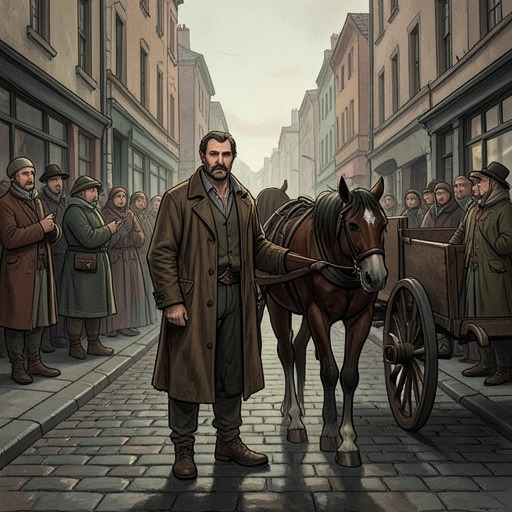
After Captain became too old to continue cab work, Jerry Barker needed another horse. Hotspur came to his attention through an acquaintance who was an under-groom in a nobleman’s stable. He was a valuable young horse, but an earlier runaway had ended his prospects there: he had collided with a carriage, thrown his lordship, and been cut and blemished. The coachman was instructed to sell him as best he could.
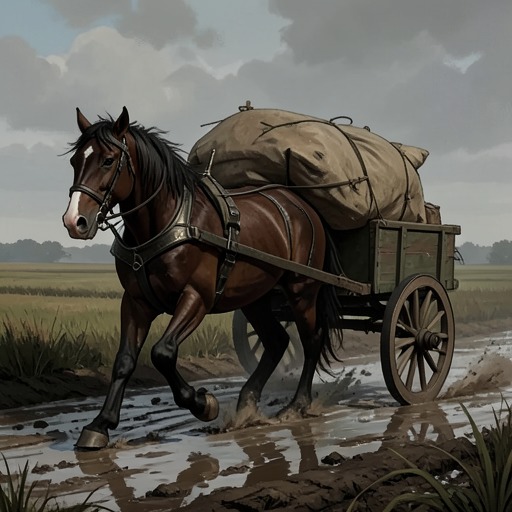
Hotspur was five years old, tall as Captain, and brown without a white hair. Black Beauty describes his head as handsome. His appearance and the account of his accident place him in a revealing contradiction: he is still a strong, impressive young horse, yet a single incident has made him unwanted in the setting where he was kept. Jerry does not treat the runaway alone as proof that Hotspur is vicious. He is willing to consider him if the horse is neither vicious nor hard-mouthed.
The Accident and Its Causes
The under-groom rejects the idea that Hotspur was vicious. In his view, the horse’s tender mouth was central to what happened. Hotspur had recently been clipped, the weather was bad, and he had not had enough exercise; when he finally went out, he was full of energy. The coachman then harnessed him tightly, using a martingale, a Bearing rein, a sharp curb, and reins attached at the bottom bar. The groom believed this combination, imposed on a spirited horse with a sensitive mouth, had driven him into a state of agitation.
This explanation shifts attention from a horse’s apparent misbehavior to the circumstances in which it occurs. Hotspur’s previous stable had treated restraint as a way to manage him, though the groom identifies the tight equipment and lack of exercise as part of the problem. Jerry’s response is measured: he says he can manage high spirits if they are not joined to vice or a hard mouth, and goes to see the horse rather than accepting the label attached to his history.
Adjustment to Cab Work
Hotspur arrives at Jerry’s stable restless. On his first night he does not lie down; instead, he repeatedly jerks his halter rope through its ring and knocks the block against the manger, keeping Black Beauty awake. The next day, after five or six hours in the cab, he returns quiet and sensible. Jerry pats him and talks to him, and the two soon seem to understand one another. Jerry expects that an easy bit and plenty of work will make Hotspur gentle.
Hotspur’s own later account qualifies the apparent success. At first he considers standing in a cab rank a considerable fall in status. Yet by the end of the week he tells Black Beauty that an easy mouth and a free head compensate for much of what he dislikes about cab work. He finds the work less degrading than the previous arrangement that fastened his head and tail together while he was under saddle. His adaptation is therefore not presented as a simple change in temperament: the new work is acceptable to him in part because it leaves him less constrained.
Work for Jerry’s Family
Hotspur’s usefulness extends beyond Jerry’s ordinary cab work. When Jerry is ill, Harry explains that Hotspur is so spirited that keeping him short of corn has not resolved the problem. Governor Grant offers to take Hotspur out for a good spell of work and give Polly half of what the horse earns, helping with the cost of feeding the horses while Jerry cannot work. Grant and Harry harness Hotspur and take him out, and Grant continues for a week or more, brushing aside thanks by describing the arrangement as fortunate for his own horses as well.
This episode shows Hotspur accepted into a wider circle of care and practical dependence. His strength and work provide help to Jerry’s household at a difficult time, while Grant’s arrangement gives the horse regular employment rather than treating his energy as a defect to be suppressed. Hotspur’s story remains brief, but its movement—from a failed sale after a runaway to a useful, better-understood working horse—supports one of the book’s recurring contrasts: a horse’s conduct cannot be separated from the conditions under which people ask him to work.