James Howard
Black BeautyJames Howard is a stable boy at Birtwick Park whose kindness is expressed through skilled, attentive work rather than grand declarations. He helps care for Black Beauty and Ginger, leads both horses to safety during a stable fire, and leaves for a higher position so that he can better support his mother. His short stay brings together the book’s emphasis on humane treatment, practical competence, and the sacrifices involved in changing one’s circumstances.
Identity and Character
Black Beauty describes James as gentle and pleasant, like John Manly in his manner toward the horses. His kindness belongs to the ordinary routines of stable life: the narrator regards him as a trustworthy presence alongside John, and consequently feels well cared for. James is not shown as a distant authority. He works in the yard and has direct contact with the animals whose comfort and safety depend on the people around them.
The account of James’s school days adds a sharper edge to this gentleness. Recalling a boy who had mistreated flies, James says that he confronted him and then explained the reason for his action to the schoolmaster. He brought forward the evidence of what had happened, and the schoolmaster used the incident to address the boys about cruelty to the weak and helpless. James’s story presents him as someone who does not regard suffering as private or unimportant; he is prepared to speak plainly about it and to make the case for intervention. The anecdote also gives context to the humane atmosphere at Birtwick, where concern for animals is treated as a matter of conduct, not merely sentiment.
Care and the Stable Fire
James’s most urgent test comes when fire threatens the stable. The hostler has tried unsuccessfully to lead the horses out, and the growing danger leaves them frightened and unwilling to move. James enters with a calm voice, approaches Black Beauty, puts on his bridle, and ties a scarf lightly over the horse’s eyes before coaxing him outside. The scarf and the familiar, reassuring manner are practical parts of the rescue: James gets the horse moving without adding to the confusion.
Once Black Beauty is safe in the yard, James hands him to another man and immediately goes back into the stable for Ginger. Black Beauty’s whinny helps Ginger find courage to come out, but it is James who returns through the smoke leading her. She is coughing, and James cannot yet speak when Squire Gordon asks whether he is hurt. The sequence makes his courage inseparable from his care for both horses: he does not stop after getting himself or the first animal to safety.
After the horses have been taken to a hotel stable, Squire Gordon entrusts them to James, telling him to order whatever he thinks they need. That confidence recognizes his judgment as well as his bravery. The following morning, while the journey is delayed, James attends to the harness and carriage and seeks further information about the fire. The narrative shows him returning to responsible work as soon as the immediate danger has passed, not treating the rescue as a reason to withdraw from his duties.
Training Joe Green and Leaving Birtwick
Before James leaves, Joe Green begins learning the work that will be required of him. James shows him how to sweep the stable, bring in straw and hay, clean harness, and help wash the carriage. Because Joe is too short to groom Black Beauty and Ginger, James teaches him on Merrylegs, who is to be under Joe’s charge with John’s supervision. Merrylegs initially dislikes being handled by an inexperienced boy, but by the end of the second week he thinks Joe may turn out well. The transition therefore takes place through patient instruction and practice, rather than through an abrupt transfer of responsibility.
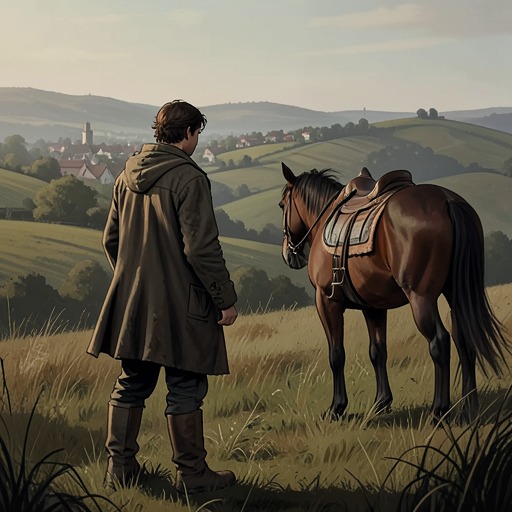
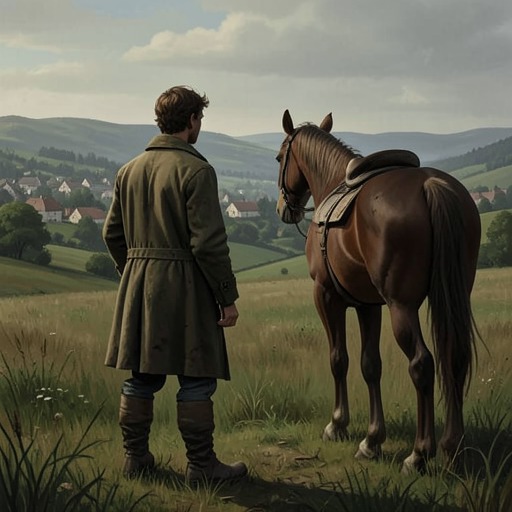
James is visibly downhearted on the morning he must leave. He tells John Manly that he is leaving behind his family, John, a good master and mistress, the horses, and his old companion Merrylegs. The new place will hold no one he knows. His decision is not presented as a rejection of Birtwick: he accepts the move because the higher position will let him help his mother more. John acknowledges the difficulty of leaving home for the first time and encourages him to expect that he will make friends and succeed. James’s departure is thus both a personal separation and a practical advancement made for his family’s benefit.
Narrative Role and Significance
James’s presence links humane principles to ordinary acts of work. His remembered school incident shows him speaking against cruelty; the fire places that concern under immediate pressure, when safe action depends on steadiness, knowledge of the horses, and willingness to return for another animal. These episodes do not make him a formal advocate or a public figure. Instead, they show how responsibility operates at close range: a stable boy notices what animals need, teaches a successor, and acts when danger makes delay costly.
The first-person account is limited to what Black Beauty witnesses or later learns, so James is revealed through gestures, words reported by others, and the narrator’s experience of his handling. His role consequently remains concentrated but distinct. He is a capable young worker, a trusted rescuer, a teacher to Joe, and a son whose prospects are bound to his mother’s welfare. His departure closes his time at Birtwick without supplying an account of what follows at the new place; what remains is the impression of kindness joined to competence, and of a necessary choice made at the cost of a valued home.