Jerry Barker
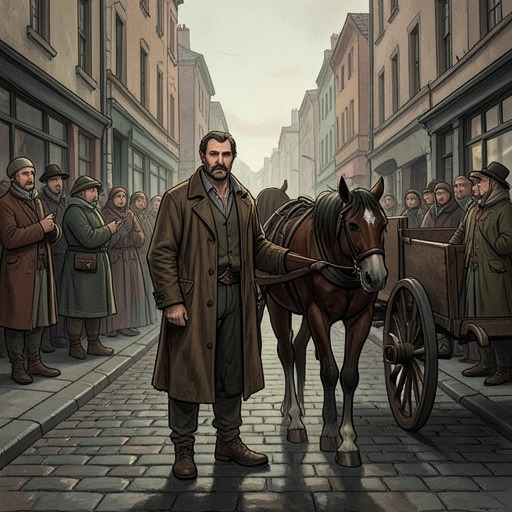
Black BeautyJerry Barker is a London cabman whose ownership of his cab and horses allows him to treat them with unusual care, but whose decency is more than a matter of practical self-interest. He handles Black Beauty gently, refuses Sunday work despite losing a valuable customer, and helps others without demanding extra payment. Through Jerry, the novel connects humane treatment of horses with fairer working conditions for the people who drive them.
Identity and Household
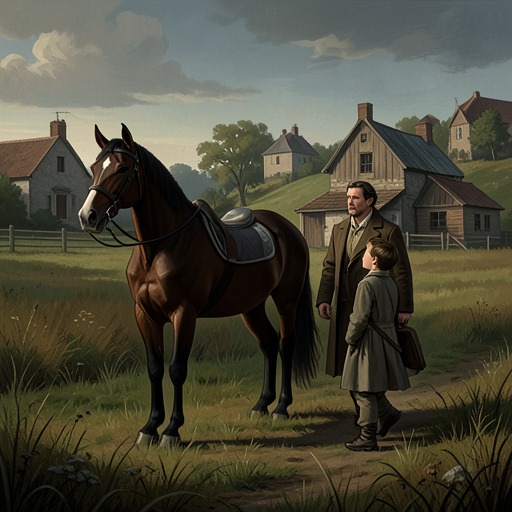
Black Beauty first meets Jerry when Jerry buys him at a fair for twenty-four ten. The sale is paid on the spot; Jerry gives the horse oats, waits while he eats, and leads him from the fair to an inn where saddle and bridle are ready. They set out for London half an hour later, travelling by country roads before entering the city. At the cab stand, Jerry greets Governor Grant, an acquaintance who asks whether he has found a good horse.
Jerry brings Black Beauty to a narrow London street, where his wife, Polly Barker, and their children, Harry Barker and Dolly Barker, hurry out to welcome him. The family’s lively greeting and shared care for the newcomer introduce a household marked by affection. Jerry owns his cab and two horses. The other is Captain, an old, large-boned white horse who once served with a cavalry regiment in the Crimean War. Jerry’s family are fond of one another, and Black Beauty remembers them as exceptionally merry and close-knit.
The family soon makes friends with the new horse. Polly offers him an apple, Dolly gives him bread, and both speak to him gently. Because they do not know how Black Beauty acquired his damaged knees, Jerry decides to give him the benefit of the doubt and values his firm, neat step. He and Polly agree to call him Jack, continuing the name of an earlier horse. Their welcome gives Black Beauty not only shelter, but a place in the family’s daily affection.
Care and Work with Black Beauty
Jerry’s care is visible in ordinary stable and harness routines. Before taking Black Beauty out in the cab, he checks whether the collar and bridle fit comfortably and adjusts the crupper until the harness sits properly. There is no check-rein or curb, only a plain ring snaffle. Black Beauty experiences the absence of restrictive equipment as a relief, and the episode distinguishes Jerry’s attention to comfort from the harsher practices he encounters elsewhere.
The family also shares responsibility for the horse’s needs. Harry helps Jerry from early morning and feeds and waters Black Beauty after school. Jerry does not treat this care as separate from work: fitting the harness correctly and making sure the horse is fed are part of how he runs his cab. His ownership gives him a direct interest in Black Beauty’s condition, but the narrative also presents kindness as a consistent feature of his character, not merely a business calculation.
Black Beauty’s account of Jerry emphasizes his good temper, strength of principle, and cheerfulness. Jerry enjoys making little songs and singing them to himself. He is also willing to defend his choices to other cabmen. After declining an offered half-crown for an unusually quick journey to a train, he explains that the fare was enough and that he and Black Beauty may choose to make a fast run for their own reasons. When a fellow driver suggests that such conduct will keep him from becoming rich, Jerry answers that wealth is not among the commandments and says he does not expect to be less happy for remaining poor.
Rest, Principle, and the Cab Trade
Jerry’s refusal to work on Sundays rests on experience as well as conviction. He has a six-day cab licence. Years earlier, he held a seven-day licence, but the continuous work left neither him nor his horses a day of rest, and kept him from spending Sundays with his family or attending worship. For the five years before the conversation with a prospective customer, he has kept the six-day arrangement and considers it better for the household and the horses.
The customer argues that a short Sunday journey would be easy work and offers to ensure that Jerry does not lose money by accepting it. Jerry remains unwilling to give up his day off. He points to the rule of one day’s rest in seven and says that he is stronger and healthier with the weekly break; the horses are fresher and wear out less quickly as well. He adds that the arrangement has allowed him to put more money into the savings bank than before. Rest, in his account, is neither idleness nor a luxury: it sustains health, family life, religious practice, and the working lives of his horses.
That position contrasts with the precarious circumstances of drivers who rent their cabs and horses from large owners. The novel describes how the pressure to meet daily charges can pass down the chain: owners demand payment from drivers, who then depend on the horses’ continued labour to support themselves. Seedy Sam explains the severity of that arithmetic: some drivers must pay eighteen shillings a day for a cab and two horses before earning anything for themselves, while the regulated fare within the four-mile radius is limited to sixpence for each mile after the first. A long journey with no return fare can leave a driver and horse exhausted while still failing to cover the day’s costs. Jerry’s independently owned cab gives him a greater ability to choose humane working conditions, but the contrast also shows that individual virtue cannot remove the economic pressures borne by less secure drivers and their horses.
Generosity and Regard for Others
Jerry’s principles also appear in acts of assistance that bring him no stated financial reward. After taking a sick child to hospital, he watches the child’s companion enter and expresses his gratitude through a quiet religious reflection, then pats Black Beauty’s neck, a familiar gesture when he is pleased. His concern extends beyond the animal in his care: he recognizes another person’s need and helps her reach the hospital.
The kindness shown to Jerry’s household is returned when he can no longer work. As his health improves, Governor Grant brings Hotspur to the family, and for more than a week Jerry’s son Harry takes the horse out. When Harry thanks him, Governor Grant makes light of the help, saying that his own horses needed rest. The assistance gives the family practical support at a moment when Jerry’s illness has disrupted their livelihood.
Illness and Change of Circumstances
Jerry grows steadily better, but his doctor warns that he must not return to cab work if he wants to live to old age. The advice closes off the occupation that has supported his family and shaped his care of Black Beauty. The children hold discussions about what their parents will do and how they might earn money. Their concern makes the consequence of Jerry’s recovery plain: getting well does not mean that he can resume his former work.
The novel does not resolve the family’s financial future in this episode. Instead, Jerry’s departure from cab driving marks the limit of what personal kindness and careful management can guarantee in a livelihood tied to physical capacity. His example remains distinct, however, from the arrangements that deny drivers and horses rest. His six-day practice had shown that a working life could be organized around humane limits; illness now forces the family to confront the cost of maintaining those limits when the breadwinner can no longer work.
Narrative Role
Jerry is a counterexample to the claim that cab work must involve cruelty. Black Beauty’s experiences under his care include comfortable harness, considerate handling, regular rest, and the remembered Saturday bran mash that contrasts with later deprivation. Jerry’s decency does not make him wealthy or immune to illness, but it lets the horse distinguish between hardship imposed by a system and choices made by the people within it.
The horse’s first-person account gives Jerry’s conduct its force through concrete routines and consequences: a harness adjusted for comfort, a Sunday licence kept despite a customer’s offer, and a family that must reconsider its income when illness ends his work. His character joins kindness to practical judgment. In the novel’s account of labour, the welfare of horses and the welfare of cabmen are linked, and Jerry’s humane household briefly demonstrates what that relationship can look like when care and rest are treated as necessities rather than expendable costs.