Jerry Refuses to Carry Passengers on Sundays
Black BeautyJerry Barker’s refusal to carry passengers on Sundays turns a proposed church journey into a test of whether he will trade a hard-won day of rest for a good customer. He will not change his six-day cab license, even when Mr. Briggs offers to make the arrangement financially worthwhile. The decision costs the family work for a time, but it also makes visible the human and animal price of seven-day cab labor—and the value Jerry places on rest, worship, and life with Polly and their children.
The request and the six-day license
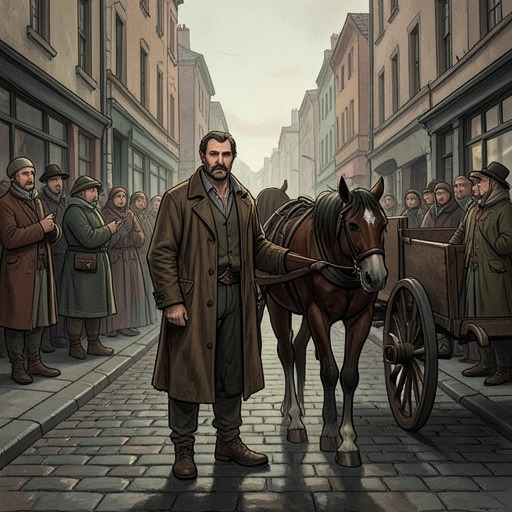
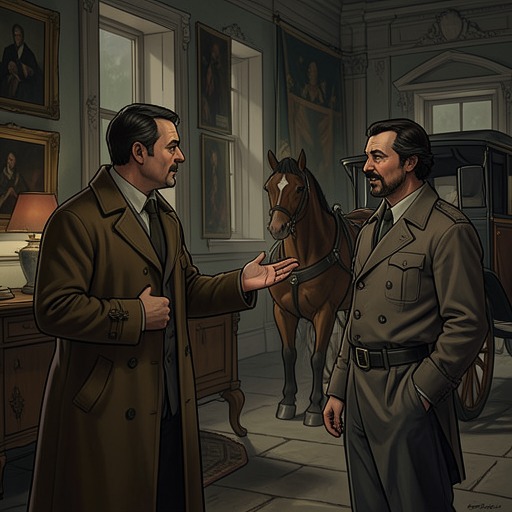
One morning, as Jerry was putting Black Beauty into the shafts and fastening the traces, Mr. Briggs came into the yard with a regular arrangement in mind: Jerry should take Mrs. Briggs to the New Church on Sunday mornings, which lay too far for her to walk. Jerry explained that he held a six-day license and therefore could not legally take a fare on Sunday. Mr. Briggs did not know this and proposed that Jerry alter the license, assuring him that he would not lose money by doing so. He also stressed that Mrs. Briggs preferred Jerry as her driver.
The offer mattered because the Briggses were unusually good customers. As Jerry later explained to Polly, Mrs. Briggs paid fairly for long shopping trips and calls; she did not haggle over the fare or try to shorten the time charged. Her journeys were easy work for the horses, unlike hurried trips to catch trains. Jerry acknowledged both the value of the custom and the possibility that refusing the request might cost them the account. His refusal was not made in ignorance of what the family stood to lose.
Jerry had once held a seven-day license. For five years, however, he had chosen the six-day one. He recalled the earlier routine as work without a day’s rest, Sundays included, leaving him no Sunday with his family and no chance to attend a place of worship, as he had been accustomed to do before becoming a cab driver. The book’s accompanying licensing note adds historical context: a few years earlier the annual charge had been reduced and the price difference between six- and seven-day licenses abolished. Jerry’s decision is thus presented as a deliberate choice about how to use the available license, not as an unavoidable consequence of a higher fee for Sunday work.
A family decision, not a lost fare alone
Mr. Briggs accepted that people should have rest and be able to go to church, but argued that a single short journey would leave Jerry the afternoon and evening free. He also invoked the value of his custom. Jerry answered with a broader principle: the day of rest, he believed, had been made for people and animals alike, and he found himself stronger and healthier when he observed it. The horses, too, stayed fresher and wore down less quickly. He said that other six-day drivers shared his experience, and that he had saved more money than before. In his account, rest did not simply cost income; it helped preserve health and made life more sustainable.
At home, Jerry asked Polly what she thought, laying out both sides plainly: the Briggses were dependable customers, and refusal could mean losing them altogether. Polly’s answer was firm. Even if Mrs. Briggs paid a sovereign every Sunday, she would not have Jerry return to seven-day work. She remembered the family’s former life without Sundays: Jerry had scarcely any time for the children, and the family could neither worship together nor enjoy a quiet day. Although the household had to manage the costs of oats, hay, the license, and rent, Polly preferred a harder struggle to a return to that routine. She also expected that Harry would soon begin earning something, but did not treat that future income as a reason to surrender the rest day now.
Polly began to cry as she spoke of what the family would lose. Jerry reassured her that he had already told Mr. Briggs the same thing and would stand by his decision. He said that he would not return to the old arrangement even for twice the earnings, then left for the cab stand. The scene makes the refusal a shared household commitment: Jerry takes the decision into the yard, but Polly’s memory of their former life confirms what the choice protects.
The cost and the return of the account
Three weeks passed without another order from Mrs. Briggs, leaving Jerry to take whatever jobs came from the stand. The work was harder for both horse and driver, and Jerry took the loss to heart. Polly continued to encourage him with their familiar counsel to do their best and leave the rest. The delay gives the decision a real cost: Jerry does not immediately receive a reward for principle, and the family must live through the uncertainty created by losing a regular customer.
Two or three weeks later, as Jerry and Black Beauty returned to the yard late in the evening, Polly ran across the road with her lantern to tell him that the situation had changed. Mrs. Briggs’s servant had asked Jerry to take her out the following day at eleven o’clock. The servant explained that Mr. Briggs had been displeased when Jerry refused Sunday work and had tried other cabs, but none suited Mrs. Briggs. Some drivers went too fast, others too slowly, and none kept a cab as clean as Jerry’s; she wanted his cab again. Jerry laughed at Polly’s news, which vindicated her patient confidence, then went to take Jack’s harness off and make him comfortable before supper.
The return is not a conversion by Mr. Briggs to Jerry’s view of Sunday labor: the account comes back because the other cabs fail to meet Mrs. Briggs’s standards. But the outcome shows that Jerry’s refusal does not permanently erase the value of his reliable service. The sequence moves from a tempting offer, through a period of lost work, to the customer’s return on Jerry’s terms. His commitment survives the interval in which there is no guarantee it will pay.
Sunday rest amid cab labor
The episode’s meaning sharpens against the book’s account of cab work under different ownership. Jerry owns his cab and horses, so his interest in treating Black Beauty well is joined to his own well-being; even a less kindly owner would have reason not to overwork his own animals. The narrator contrasts this with horses belonging to large cab owners and hired out to drivers, where men under pressure to meet the daily charge have powerful incentives to extract as much work as possible.
Seedy Sam describes that pressure in exact terms: in the busy season, some drivers had to pay eighteen shillings a day for a cab and two horses before earning anything for themselves. He says that he worked fourteen or sixteen hours a day, had gone ten or twelve weeks without a Sunday, and had six children, only one of whom earned. He also describes low fares and long journeys that left a horse working without a return passenger. These circumstances do not make Jerry’s household identical to Sam’s, but they expose why a nominally short Sunday trip cannot be judged only by its distance: hours of work, the driver’s need to earn, and the horse’s loss of rest belong to the same system.
Later, Black Beauty experiences the harsher arrangement directly under Nicholas Skinner, where there is no Sunday rest and summer excursions can take a heavily loaded cab ten or fifteen miles into the country and back. The contrast gives Jerry’s earlier insistence practical force. His refusal protects a weekly pause for his family and keeps his horses fresher, while the surrounding episodes show how easily the demands of cab ownership and low-paid driving can remove that pause. In this episode, Sunday is not an empty interval between working days; it is the boundary Jerry chooses to defend.