Joe Green
Black BeautyJoe Green develops from a small, inexperienced stable boy into a capable and morally decisive groom. His story links the ordinary work of learning to care for horses with two defining tests: his failure to understand what Black Beauty needs after an exhausting ride, and his later willingness to challenge a carter mistreating horses. Years afterward, recognition of Black Beauty turns that apprenticeship into a reunion and an opportunity for renewed care.
Identity and Entry into the Stable
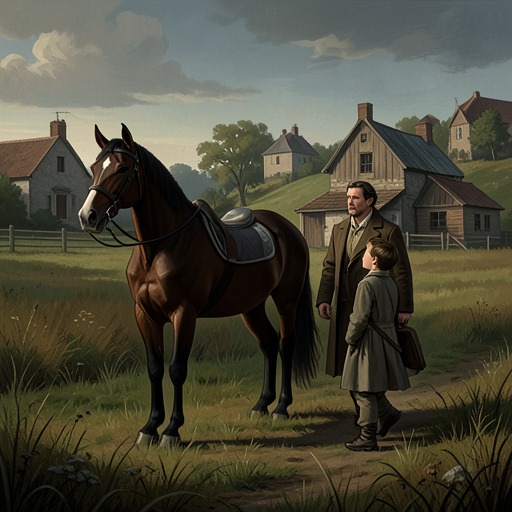
Joe is introduced as the fourteen-and-a-half-year-old son of Thomas Green, living at the lodge at Birtwick Park. When James Howard is preparing to leave, John Manly identifies Joe as his replacement. James is surprised that the new stable hand is still a child, and John answers with Joe’s age. The exchange sets up a practical transition: Joe is young, but he is to learn the work before taking responsibility.
The next day, Joe comes to the stable to learn as much as he can before James departs. James teaches him to sweep, bring in straw and hay, clean harness, and help wash the carriage. Joe is too short to groom Black Beauty or Ginger, so James gives him practice with Merrylegs, whom Joe is to care for under John’s supervision. Joe is bright, attentive, and regularly comes to work whistling. Merrylegs initially resents being handled by a boy who knows little, but by the end of the second week even he expects Joe to turn out well. That gradual change offers an early measure of the trust Joe earns through consistency.
Learning Care Through Mistake
Joe’s first important failure comes after Black Beauty has carried the doctor at speed on an urgent journey to save the mistress. The horse returns exhausted, trembling, and soaked through. John Manly is not there to supervise; Joe’s father has been sent to the next village, leaving the boy to manage as best he can. Joe rubs Black Beauty’s legs and chest, but, thinking the horse too hot for a covering, does not put on the warm cloth. He gives him cold water, hay, and corn, then leaves, believing he has done right.
Black Beauty soon begins to tremble and suffer, and John returns to find him in pain. John covers him with warm cloths and makes warm gruel. The horse later develops a severe inflammation of the lungs, and John nurses him day and night. The account preserves the distinction between a harmful result and Joe’s intention: Joe is inexperienced and misjudges the immediate needs of an overheated horse, rather than acting from indifference. John’s sharp private frustration does not define Joe’s character; the narration explicitly maintains that he is a good boy. The episode makes care a learned practice requiring knowledge as well as goodwill.
This lesson belongs to a wider stable culture in which humane treatment is expected, not treated as an optional kindness. At Birtwick, the household is described as protective of animals, and John later makes that ethic explicit when Joe confronts cruelty at the brick-field. Joe’s early mistake and later intervention therefore form a significant contrast: he first discovers the limits of good intentions, then learns to apply concern with judgment and action.
Intervention at the Brick-Field
As Joe becomes more trusted, he is occasionally allowed to ride Black Beauty, though his small size means he is seldom permitted to exercise him or Ginger. One morning, while John is away with Justice in the luggage cart, the master sends Joe with a note to a gentleman’s house about three miles distant and instructs him to ride steadily. Joe delivers it and is returning quietly when he reaches the brick-field.
There he sees a heavily loaded cart stuck in deep, muddy ruts. The two horses are straining without moving it while the carter continues to flog them. Joe pulls up and tells the man to stop: the wheels are too deeply stuck for the horses to move the cart. He offers to help lighten the load, but the carter refuses. Joe does not treat the abuse as someone else’s business. He rides to the brick-yard’s owner, explains what is happening, and agrees to give evidence if the carter is brought before a magistrate.
When Joe returns, his anger is so visible that John asks what has happened. John approves his intervention and tells him that cruelty and oppression are everyone’s business to oppose when they witness it. Joe is reassured by this approval and resumes his stable work, cleaning Black Beauty’s feet and rubbing him down with more firmness than usual. The moment advances his development beyond competent service: he is prepared to interrupt his own journey, seek someone with authority, and stand behind his account. The evidence establishes that he is called for testimony, but does not state the legal outcome.
Recognition and Reunion
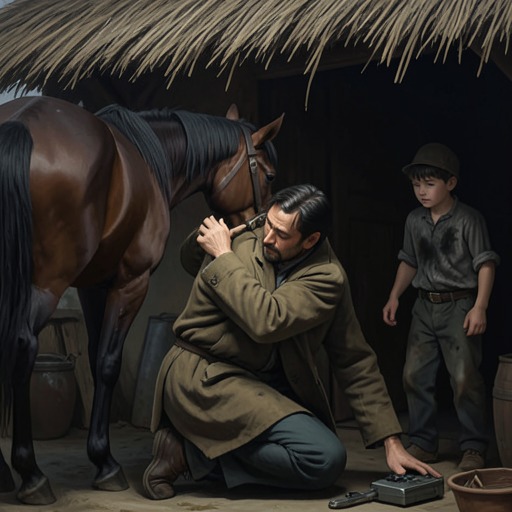
Years later, Joe is working as a groom in the household to which Black Beauty has been brought. The horse is placed in a comfortable stable and left to rest. While cleaning his face the next day, Joe notices that his white forehead star resembles the mark of the horse he once knew. A knot in the neck, left where Black Beauty had been bled, makes him look more closely. He checks the white foot and the small patch of white hair on the middle of the back, the mark John Manly had called Beauty’s three-penny bit, and recognizes his former charge.
The recognition is physical and specific: Joe reconstructs the horse’s identity from marks accumulated across a life of service. Black Beauty cannot confidently say he remembers the grown man before him, but recognizes Joe and responds as a friend. Joe, by contrast, is overjoyed and immediately connects the reunion with his earlier mistake, recalling that he had nearly killed Black Beauty through ignorance. He also notices the horse’s damaged knees and wonders who treated him badly, promising that the horse will have better care in his new home. His concern is no longer the untested concern of a child; it is informed by experience and by the history visible in the horse’s body.
Character Arc and Narrative Role
Joe’s path is built from recurring acts of learning. James Howard first teaches him the routines of stable work; John Manly supervises him and later affirms his public intervention. Merrylegs’s shift from irritation to confidence registers Joe’s growing practical skill, while Black Beauty’s illness shows why kind intention alone cannot replace sound knowledge. At the brick-field, Joe’s moral understanding becomes action, and his agreement to testify gives his concern a public consequence.
The later reunion brings those strands together without erasing the earlier error. Joe recognizes Black Beauty through scars and identifying marks, and the horse answers with trust despite the gap in his own memory. Joe’s readiness to care for the injured animal again gives the reunion its force: the apprentice who once did not know how to protect him has become the groom who can recognize both the horse and the history of what he has endured. Through Joe, the narrative presents humane treatment as something learned in practice, tested by intervention, and renewed through responsibility.