John Manly
Black BeautyJohn Manly is the coachman at Birtwick Park whose practical skill and attentive care help make it a humane home for Black Beauty. His importance lies not in a dramatic rise or fall, but in the steady connection between what he has learned from hardship and how he treats people and horses: he fits equipment carefully, responds to illness with sustained nursing, and hopes to give young horses a fair start.
Identity and Background
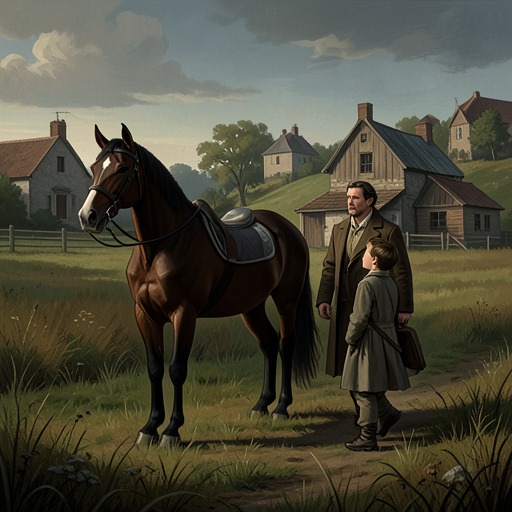
John lives with his wife and their young child in the coachman’s cottage near the stables. He has served the household for fourteen years, long enough to become a familiar and trusted presence in the stable. His work is skilled as well as physical: he observes a horse’s movement, adjusts tack to fit, and understands that a horse’s condition depends on more than simply completing its task.
His sense of responsibility grew out of a difficult beginning. When he was about Joseph’s age, his parents died within ten days of each other, leaving him and his crippled sister Nelly without relatives to support them. He was a farmer’s boy whose earnings could not provide for both of them. The mistress arranged a room for Nelly with Widow Mallet, found her knitting and needlework when she could manage it, and sent meals and other necessities when she was ill.
The master, in turn, took John into the stable as an apprentice to the coachman Norman. The household provided his food, a bed in the loft, clothes, and three shillings a week, allowing him to help Nelly. Norman trained him with patience rather than dismissing him as an inexperienced boy. When Norman died, John succeeded him; by the time he recounts this history, he earns the top wages and can save for uncertain times. His account makes his place in the household more than a matter of employment: he remembers the specific acts of care that enabled him and Nelly to live securely.
Care and Skill in the Stable
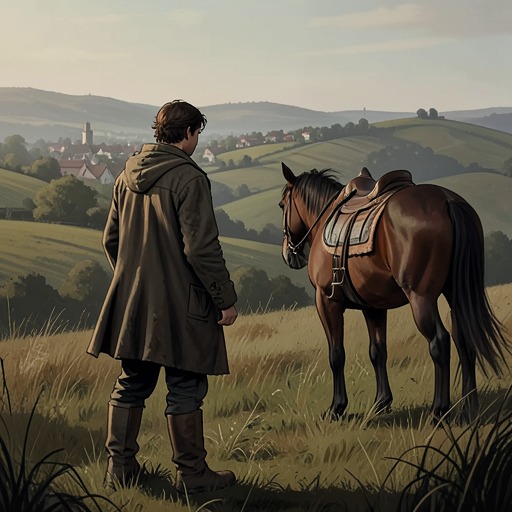
John’s treatment of Black Beauty puts that experience into daily practice. When asked to try the young horse, he first adjusts the bridle straps with care, checking that they fit comfortably. The saddle proves too narrow for Black Beauty’s back, so John immediately fetches another. He introduces the horse to the ride at a walk, then a trot and canter, before letting him gallop on the common. The sequence shows both confidence in his own judgment and attention to the horse’s comfort; he does not treat a poor fit as something the animal must simply endure.
That gentleness belongs to a wider household ethic. Black Beauty describes the people at Birtwick as kind to animals and notes that the servants follow the same example. John is among those who make that principle concrete through stable work. He understands that a horse can be frightened or harmed by mistaken handling, and his later choice of a profession rests on the same observation: young animals can be spoiled by wrong treatment when the right person might have guided them better.
John also speaks of kindness as a matter of conduct, not merely belief. When James Howard recounts how cruelty toward helpless creatures was condemned at school, John affirms that religion without kindness to people and animals is hollow. The exchange fits his own history: he has benefited from compassion, and he recognizes an obligation to pass it on rather than treating assistance as something owed only to oneself.
Black Beauty’s Emergency and Illness
John’s care is tested when Black Beauty is ridden hard to fetch a doctor for the mistress. On the return journey the doctor, a heavier and less practiced rider than John, lets the horse catch his breath on the hill. At home, Black Beauty is exhausted, soaked, and trembling. Joe Green does what he knows, but misses the warm covering and gives the horse cold water. John, who has had to walk eight miles back, arrives to find him in pain; he covers him with warm cloths and prepares warm gruel.
The episode distinguishes good intentions from informed care without making Joe’s error a matter of malice. Black Beauty develops a serious inflammation in his lungs, and John nurses him night and day, sometimes getting up two or three times in a single night. The master also visits. The horse’s account makes the cause and consequence plain: the demanding ride has left him dangerously ill, while close attention and warmth become central to his care. John’s presence is not a single rescue gesture but sustained work through a long recovery.
Loyalty, Departure, and a New Vocation
As the household prepares to leave Birtwick, John must decide what kind of work to seek. He turns down other offers in favor of a position with a first-rate colt-breaker and horse-trainer. He wants to help young animals that might otherwise be frightened or spoiled by poor handling, and hopes that giving them a fair start will allow him to do some good. The master considers him especially suited to the work, offers to contact his agent in London, and promises to provide a character reference.
The decision extends John’s experience beyond one stable. At Birtwick, care has been shaped by patient teaching, proper equipment, and attention to distress; in his proposed new work, he hopes to carry those lessons to other young horses. His response to the household’s departure also reflects the attachments formed there. He is deeply moved by the master’s thanks for his long service and expresses gratitude for what the master and mistress have done for him and Nelly. He leaves not by rejecting that bond, but by carrying its example into the work he chooses next.
Narrative Role
John is seen principally through Black Beauty’s animal-centered testimony. His character emerges from observable acts: a bridle fitted carefully, a saddle replaced when it does not fit, warm coverings brought to a sick horse, and repeated journeys from bed to stable during the night. The narration also gives him space to explain his past in his own reported account, linking the help he received as a boy to his later regard for kindness and service.
In this way, John stands between humane intention and practical knowledge. Goodwill matters, but the incidents involving Black Beauty show that a horse’s welfare also depends on knowing how to fit equipment, recognize need, and respond appropriately. His proposed work as a trainer gives that lesson a forward direction: the care he learned and received at Birtwick may, through his hands, give other horses a better beginning.