Larry
Black BeautyLarry is a London cabman whose brisk pursuit of fares and habitual use of the whip set him against Jerry Barker’s more humane standards of work. He is not presented through a private history so much as through successive exchanges on the cab stand: a race to catch a train, an argument about money and horse-driving, and a dispute over Sunday work. Together, these moments make him a vivid counterpoint to Jerry and a participant in the book’s account of the pressures borne by working cabmen and their horses.
Identity and Working Habits
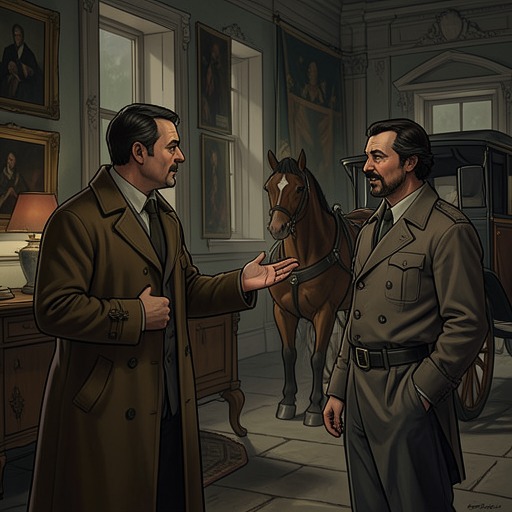
Larry drives a cab alongside Jerry Barker in London. The narrative first shows him in action when two late passengers ask Jerry to hurry them to the Victoria for the one o’clock train, offering an extra shilling. Jerry refuses to put on the steam merely for the tip and keeps to his regular pace. Larry, whose cab is standing next to theirs, immediately offers his own horse and cab, assuring the passengers they will arrive in time. After shutting them in, he winks toward Jerry and jokes about Jerry’s conscience; then he lashes his already jaded horse and sets off as fast as he can.
The scene establishes more than a difference in driving style. Jerry’s refusal is not a refusal to travel quickly under any circumstances: he is willing to go at a good fair pace and to hurry when he knows why. What he rejects is needless exertion bought by a passenger’s extra money. Larry, by contrast, accepts the fare and presses a tired horse hard. Jerry pats Black Beauty on the neck and remarks that the shilling would not justify that treatment. The juxtaposition makes the horse’s condition, rather than the passengers’ urgency alone, the measure of the two drivers’ choices.
Money, Whips, and Responsibility
Larry later predicts that Jerry will never become rich, directly linking Jerry’s restraint to his prospects for earning. Jerry answers that wealth is no guarantee of happiness and that he has never found a commandment requiring a person to become rich. Governor Grant tells Larry that Jerry would deserve any wealth he gained, while warning Larry that his spending on whipcord will keep him poor. Larry’s response is that a driver must use the whip if a horse will not go without it.
Jerry challenges the assumption behind that defense. He says Larry does not take the trouble to find out whether his horses might go without the whip; he keeps flicking it, changes horses often, and gives them neither peace nor encouragement. Larry attributes his circumstances to bad luck. The exchange thus turns an argument about earnings into one about responsibility: Jerry treats a horse’s willingness and condition as things a driver must cultivate, while Larry presents the whip as a necessity and his poor results as misfortune. The repeated contrast between encouragement and punishment also anticipates the book’s wider concern with how human handling shapes a horse’s response.
Sunday Work and Religious Argument
Larry’s practical outlook appears again when Jerry refuses a regular Sunday fare. A gentleman asks Jerry to take Mrs. Briggs to church, explaining that the New Church is too far for her to walk. Jerry says his six-day cab license makes Sunday driving illegal. When the customer offers to arrange a change, Jerry still loses the fare rather than abandon the limit he has accepted. The incident is not Larry’s decision, but it becomes a public point of dispute among the cabmen, in which Larry openly takes the opposing side.
After Jerry loses his best customer, Larry says he will take a shilling whenever he can and doubts that religious people are better than anyone else. Jerry distinguishes religion from the conduct of people who claim it: hypocrisy, anger, and unpaid debts do not make religion itself false. When another driver complains that churchgoers’ Sunday travel keeps cabmen working, Jerry argues that drivers themselves must uphold a day of rest instead of waiting for customers to change. Larry presses the practical objection of what worshippers would do without cabs to reach their preferred preachers. Jerry answers that they could walk to a nearer church or go in the rain, and that a good person would find a way to do what is right.
Larry’s opposition therefore has a material as well as a religious dimension. He speaks for taking available earnings; Jerry insists that the custom of Sunday work can persist because drivers continue to supply it. Their disagreement exposes the tension between an individual cabman’s immediate need for fares and the possibility of collective refusal. The narrative does not make Larry a detached theologian: his skepticism is voiced in the same language of money and opportunity that frames his conduct on the road.
The Cab Trade and Larry’s Narrative Role
The broader conditions of cab work give context to, but do not excuse or specifically define, Larry’s choices. Seedy Sam describes the strain of renting a cab and two horses for eighteen shillings a day, with nine shillings to be earned from each horse before he can begin providing for himself. He says he works fourteen or sixteen hours, has gone ten or twelve weeks without a Sunday, and must support six children, only one of whom earns. Under the four-mile fare rules he describes, a six-mile journey earns three shillings, and the horse may have to travel the return distance without a fare. Sam’s account makes visible the economic pressures that can drive a cabman to overwork a horse; it is Sam’s testimony, not a set of circumstances the story explicitly assigns to Larry.
Black Beauty’s later service under Nicholas Skinner supplies a further contrast between Jerry’s stable routine and a regime without Sunday rest. In the heat of summer, Black Beauty is made to carry full cabs on long country journeys, often up steep hills, and is whipped with a sharp lash that sometimes draws blood. The narrator recalls the bran mash with niter and the uninterrupted rest he had received with Jerry, and measures his new exhaustion against that earlier care. Larry’s scenes do not place him in Skinner’s stable, but his willingness to lash a jaded horse and his defense of the whip resonate with the book’s account of how working arrangements and driving habits can consume horses’ strength.
Larry’s narrative importance lies in this recurring contrast, not in a transformation or resolution of his own. He voices the pull of quick earnings against Jerry’s limits, and his familiar appeal to bad luck against Jerry’s insistence that a driver has choices about how he treats a horse. Set beside Sam’s account of cabmen’s hardship and Black Beauty’s later experience of relentless work, Larry’s conduct belongs to a larger pattern: economic pressure is real, but the animal bears its bodily cost. The scenes leave that tension open while making the difference between Jerry’s restraint and Larry’s methods unmistakable.