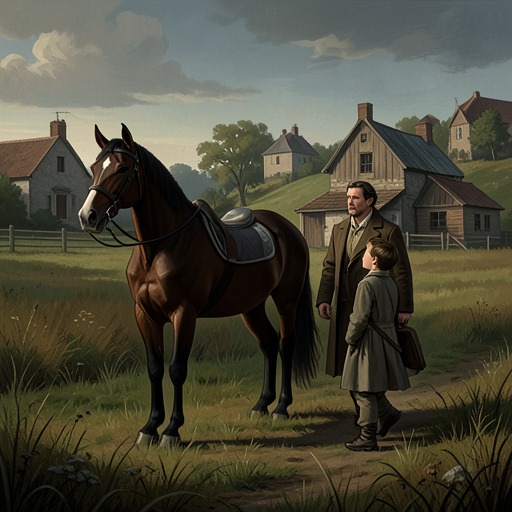
Mr. Barry
Black BeautyMr. Barry is a businessman living in Bath whose brief ownership of Black Beauty shows how humane intentions can be undermined when an owner depends on others for an animal’s daily care. He buys the horse on a doctor’s advice that he take exercise, treats him well, and orders ample food. Yet his limited knowledge and trust in his groom leave him unaware of theft and neglect until another horseman draws his attention to the evidence. Once Black Beauty’s condition and the stable’s failures are exposed, Barry has him treated, then gives up keeping a horse.
Identity and Purchase
Barry is unmarried and much occupied with business. After a gentleman who had tried Black Beauty with a saddle recommended him to a friend seeking a safe, pleasant riding horse, the previous owner sold the horse to Barry in summer. The purchase is presented as a practical response to medical advice: Barry’s doctor has recommended riding for exercise, and Barry acquires a horse for that purpose.
The account distinguishes Barry’s decency from expertise. He treats Black Beauty well, but knows little about horses. He hires a stable near his lodgings and entrusts the horse’s daily management to a groom. Barry’s good intentions are evident in the provisions he orders: the best hay, plenty of oats, crushed beans and bran, and green fodder as the groom considers necessary. Black Beauty hears the order and initially believes he is well provided for. The gap between the owner’s instructions and the animal’s actual care becomes the central problem of Barry’s ownership.
Care Entrusted to a Groom
For the first few days, the arrangement appears sound. The groom keeps the stable clean and airy, grooms Black Beauty thoroughly, and is consistently gentle. His previous employment as a hotel hostler and his manner of handling the horse reinforce the impression that Barry has hired a capable caretaker. The early routine gives Barry little apparent reason to suspect that the horse’s needs are not being met.
The change is first registered through Black Beauty’s feed. His oats become scarce; beans remain, but are mixed with bran, and the quantity of oats falls to no more than about a quarter of what it should be. Although the grass fodder is good, it cannot maintain his condition without the ordered grain. After two or three weeks, his strength and spirits begin to decline. This continues for about two months, while Barry does not recognize what is wrong. The horse can perceive and describe the shortage, but cannot tell his owner what he needs—a limit that makes the narrator’s animal perspective crucial to the episode.
Black Beauty also sees the groom arrive around six each morning with a boy carrying a covered basket. When the harness-room door is ajar, he observes them taking oats from the bin and putting them into a small bag. The ordered food is therefore not merely being portioned poorly: some of it is being stolen. Barry’s trust in the person charged with caring for the horse leaves him unable to see the difference between the provisions he prescribed and the food Black Beauty actually receives.
The Problem Is Exposed
Barry learns that something is wrong during a country visit to a farmer friend, who notices that Black Beauty looks worse than when Barry first acquired him. Barry says the horse has seemed less lively but reports that the groom attributes the weakness to the season. The farmer rejects that explanation: it is only August, and, given the horse’s light work and good food, he should not be losing condition. His observation tests the groom’s account against the circumstances Barry believes to be true.
The farmer examines Black Beauty and finds him warm and damp despite Barry’s having ridden gently. He advises Barry to inspect the stable more closely and warns that some people will rob a voiceless animal of its food. He also directs his own man to give Black Beauty a generous feed of bruised oats. The scene supplies the contrast on which the episode turns: Barry’s instructions promise ample food, while the horse’s condition and the farmer’s examination indicate that the promise is not being fulfilled. Black Beauty’s testimony to the theft gives the reader a further explanation that Barry himself could not obtain from the horse.
A separate failure of care emerges when Black Beauty’s feet are examined. He has thrush, his feet are very tender, and the farrier associates the condition with foul stable conditions and litter that has not been properly cleaned. The treatment includes cleansing and dressing his feet, daily removal of the litter, a clean floor, bran mashes and some green food while he recovers. With this care, his spirits return. The episode thus links the horse’s decline not to a single mistake but to two neglected responsibilities: providing the food Barry ordered and maintaining the stable conditions his health required.
Sale and Narrative Significance
Once Black Beauty’s feet are sound, Barry sells him. The farrier’s treatment has helped restore the horse, but the experience has changed Barry’s plans: disgusted at having been deceived twice by grooms, he decides to stop keeping a horse and hire one when he wants to ride. The account does not specify the circumstances of the second deception, so Barry’s decision is best understood as a response to repeated breaches of trust rather than attributed to a more particular cause.
Barry is neither indifferent to Black Beauty nor able to protect him simply by wishing him well. He orders good food and employs a groom who initially appears competent, but his distance from the everyday work of the stable allows theft and poor conditions to persist. The episode makes that distance visible through the horse’s knowledge: Black Beauty hears the order, feels the shortage in his declining condition, and witnesses the removal of the oats, yet cannot communicate any of it to his owner. Barry’s story therefore reinforces the autobiography’s attention to the difference between an animal’s prescribed care and its lived experience. His eventual decision to give up horsekeeping ends his brief responsibility for Black Beauty, but only after another person has noticed what the horse himself could not report.