Overwork and exhaustion among working horses
Black BeautyOverwork and exhaustion among working horses in Black Beauty are not simply the result of individual cruelty: they are produced by working arrangements that make rest costly, drive drivers to keep horses moving, and leave the animals to bear the physical consequences. Through Black Beauty’s account of cab work, the novel traces that pressure from daily fares and rental charges to exhaustion, collapse, and the prospect of being discarded. It also contrasts such conditions with care that recognizes a horse’s limits and gives recovery a real chance.
The Working Conditions Behind Exhaustion
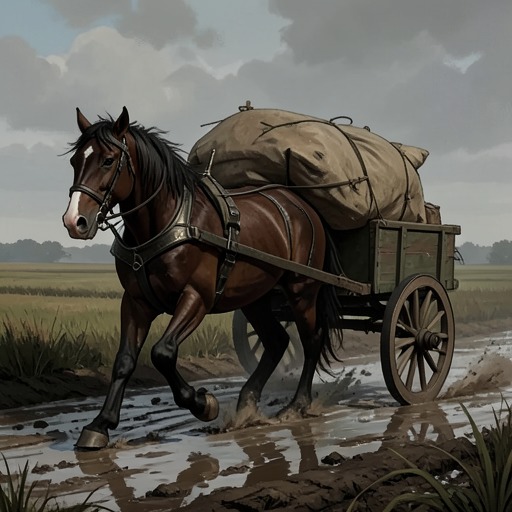
The book presents exhaustion as cumulative. Cab horses may be kept at work for long hours, denied a weekly day of rest, and expected to continue under loads and schedules that take little account of heat, fatigue, or the difficulty of a route. In Black Beauty’s later employment under Nicholas Skinner, Sunday rest disappears. On summer Sundays, groups of passengers hire the cab for journeys ten or fifteen miles into the country and back; they generally remain aboard even on steep hills and in hot weather. Black Beauty recalls longing for the Saturday-night bran mash and the unbroken rest he had received while working for Jerry Barker. Under Skinner, he instead becomes so worn and feverish that eating is difficult.
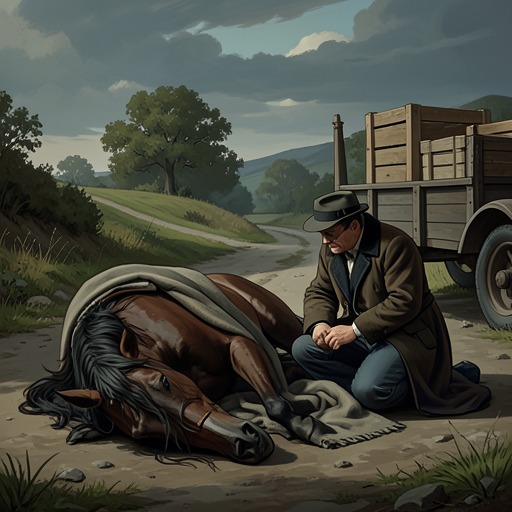
The account also distinguishes a horse’s capacity to work from the conditions imposed on it. Black Beauty continues trying despite harsh treatment, but effort cannot replace food, rest, or humane limits. His later journey from a railway station is especially demanding: he has had neither food nor rest since morning, is burdened with heavy luggage, and is repeatedly urged forward. At Ludgate Hill he collapses. The episode makes exhaustion legible as the outcome of accumulated demands, not a failure of willingness.
Economic Pressure Passed Down the Line
A conversation among cab drivers explains why the system persists. Seedy Sam describes paying eighteen shillings a day to use a cab and two horses, leaving nine shillings to earn from each horse before he can provide for himself and his family. He says he works fourteen or sixteen hours a day and has gone ten or twelve weeks without a Sunday. He has six children, only one of whom earns, and has even pawned his clock to meet what he owes. His account places the driver’s hardship alongside the horse’s: both are pressed by obligations set by the cab owner and by fares that, in his view, do not provide a workable margin.
Sam gives specific examples of how mileage and low returns intensify the pressure. A six-mile journey has earned him only three shillings, and he has had to return without a fare. On another trip, a three-mile fare, luggage, and a later return journey leave the horse with eighteen miles of work for six shillings in fares. Under the stated limit, fares within the four-mile radius cannot exceed sixpence for each mile after the first. Sam argues that when a tired horse is still expected to earn enough to cover the daily charge, the driver is pushed toward using the whip to keep it moving. This does not excuse mistreatment; it shows how economic arrangements can make a driver’s immediate survival compete with the horse’s need to stop.
The drivers’ different positions matter. Black Beauty observes that a cabman who owns his horse, or drives for a good master, has more reason and opportunity to treat it well than a man who rents animals and must first cover a fixed daily payment. Governor Grant initially challenges Sam over the condition of his horse, then accepts that the pressures Sam describes are real and recognizes the animal’s suffering. The exchange refuses an easy separation between human hardship and animal welfare: the same system can exploit both, even though the horse has no control over the terms of work.
From Wear to Physical Consequences
Ginger’s history shows how exhaustion can continue through successive sales. After a year away from work at Earlshall, she is considered fit to return and is sold to a gentleman. A longer gallop brings back her earlier strain; after rest and treatment, she is sold again, and changes hands several times at declining value. Eventually she enters the cab trade. Once her weakness is known, her owners treat her as an animal to be worked until she is used up. At the stand, Black Beauty recognizes her as a worn, weakened horse. Her account links earlier damage, repeated resale, and relentless work: recovery is interrupted because her usefulness to successive owners is measured by what she can still earn.
Black Beauty’s own collapse makes the consequences immediate. After he falls on Ludgate Hill, he is taken to a nearby stable, where he receives a well-littered stall and warm gruel. By evening he is sufficiently recovered to be led back to Skinner’s stable. A farrier judges that the case is overwork rather than a specific disease, and says that six months’ rest could make him capable of working again, although his strength is then spent. Skinner would rather sell an exhausted horse than keep a meadow for convalescence. The farrier’s assessment thus exposes a conflict between what recovery requires and what the owner’s business accepts.
Care, Rest, and the Possibility of Recovery
Skinner agrees, reluctantly, to have Black Beauty fed and cared for because the farrier advises that recovery may increase his sale value. The stableman carries out the order more willingly than Skinner gives it. Ten days of complete rest, oats, hay, bran mashes, and boiled linseed improve Black Beauty’s condition; on the twelfth day after the collapse, he is taken to a sale outside London. The recovery does not erase the circumstances that brought him down, but it demonstrates that exhaustion is not proof that a horse is beyond help. Food, time, and attentive care make a difference where forced labor has depleted his strength.
Other episodes in the book clarify that not every illness has the same cause. After an urgent ride for a doctor, Black Beauty reaches home drenched and profoundly tired; inadequate attention to warming and care is followed by severe illness, and John Manly nurses him through it. In another case, a farrier diagnoses thrush in Black Beauty’s tender feet and attributes it to a foul, inadequately cleaned stable. These incidents distinguish exertion, poor aftercare, and unsanitary conditions rather than treating all suffering as one undifferentiated effect of overwork. Together, they make the horse’s condition dependent not only on hours worked but also on the knowledge and care of the people responsible for him.
Narrative and Ethical Significance
Because Black Beauty is narrated as a horse’s autobiography, exhaustion is reported as lived experience rather than as a tally of labor alone. The narrative sets concrete measures—hours, fares, distances, rent, and missed rest days—beside the horse’s changing ability to work and recover. Ginger’s successive decline and Black Beauty’s collapse expose what a market calculation can conceal: an animal’s diminished strength is treated as a reason to extract what remains, rather than as evidence that its needs have been ignored.
The contrast with Jerry Barker and the humane household at Birtwick Park gives the account a practical counterpoint. Black Beauty remembers rest and cooling bran mash under Jerry, and the household at Birtwick Park is described as protective of animals and opposed to cruel treatment. The book’s criticism is therefore not that work itself must inevitably destroy horses, but that work organized without rest, sound care, or regard for limits turns their endurance into a resource to be spent. By connecting the driver’s economic pressure to the horse’s exhaustion, the narrative asks readers to see both the immediate act of overwork and the system that repeatedly makes it seem necessary.