Polly Barker
Black BeautyPolly Barker is Jerry Barker’s wife, a practical partner in the family’s cab work and a forceful defender of the rest and family life that their household has struggled to regain. She helps care for the cab and its horses, encourages Jerry through difficult periods, and makes clear that earning more money is not worth surrendering every Sunday. Her judgment is neither rigid nor indifferent: when Dinah Brown urgently needs a ride to her dying mother, Polly argues that helping her is consistent with the very principle of care that Sunday rest is meant to protect.
Household and Work
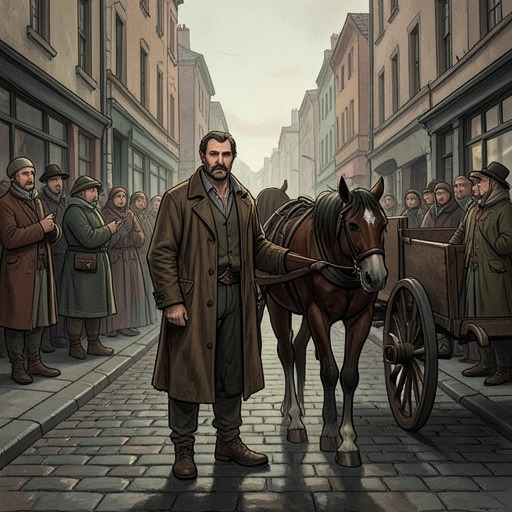
Polly’s life is closely bound to the daily work of Jerry’s cab. In the mornings, she and Dolly come to help prepare it, brushing and beating the cushions and cleaning the glass, while Harry rubs the harness and Jerry grooms Black Beauty and Captain in the yard. The children’s help is willing, and their laughter makes the stable feel different from a workplace governed by scolding and hard words. Polly is not simply waiting at home while Jerry works: she takes part in the household routine that keeps the cab and family going.
The work is organized around family cooperation, but it remains demanding. Jerry has chosen a six-day license, which prevents him from legally taking Sunday fares. When Mr. Briggs asks him to take Mrs. Briggs regularly to church, he points out that changing to a seven-day license would mean giving up the day the family now calls its own. Polly understands the economic appeal of keeping a valued customer. Mrs. Briggs pays fairly, and the journeys are easier on the horses than hurried trips to catch trains. Even so, Polly tells Jerry that she would not have him return to seven-day cab work, even if Mrs. Briggs offered a sovereign for every Sunday journey.
Sunday Rest and Family Priorities
Polly’s argument is grounded in remembered hardship, not in a comfortable refusal to work. She recalls that Jerry and the family once had almost no Sundays: he scarcely had time for his children, and they could not go to worship together or enjoy a quiet day as a family. She acknowledges that their present earnings can be tight when they must meet the costs of oats, hay, the license, and rent, but would rather struggle than return to that earlier life. She also looks ahead to Harry earning something, while making clear that the family’s regained time together matters now.
Jerry agrees with her and stands by the six-day arrangement. The decision has a cost: three weeks pass without another order from Mrs. Briggs, leaving Jerry to rely on jobs from the stand, which make the work harder for both man and horse. Polly responds by cheering him up rather than treating the lost customer as proof that their choice was mistaken. Her support helps turn the decision from a private sacrifice into a shared household commitment.
Compassion in Practice
Polly’s defense of Sunday rest does not become an inflexible rule that overrides another person’s urgent need. When Dinah Brown receives word that her mother is dangerously ill, she asks Jerry to drive her more than ten miles into the country. Taking the train would still leave her with four miles to walk, an impossible prospect given her weakness and the fact that her baby is only four weeks old. Jerry initially worries about losing the Sunday: the horses are tired, and he is tired too.
Polly answers by applying the standard she believes should govern the family’s conduct toward others. She asks Jerry to consider what he would want if his own mother were dying, and argues that helping Dinah would not violate the Sabbath. She compares the journey to rescuing a poor animal from a pit: an act of necessary aid, not ordinary commercial work. Her reasoning persuades Jerry. To reduce the strain on the horse, he arranges to borrow Mr. Braydon’s light trap, which is not used on Sundays; Polly goes to tell Dinah that Jerry will be ready at ten. The episode shows her adapting a principle to circumstances rather than abandoning it.
Care, Pressure, and the Cab Trade
Polly’s choices sit within a trade in which financial pressure can bear on both drivers and horses. Black Beauty distinguishes Jerry’s position, in which the driver owns the horse and cab and has an interest in treating the horse well, from the arrangements of large cab owners who rent them to drivers for a daily sum. Seedy Sam describes the pressure such drivers face: daily charges, low fares, long hours, and little or no rest can make both a man’s livelihood and a horse’s welfare precarious. Polly’s determination to protect the family’s Sundays is therefore part of a larger effort to prevent work from consuming every hour of human and animal life.
The novel also places her family’s chosen limits beside the harsher conditions Black Beauty later experiences under Nicholas Skinner, where there is no Sunday rest. That contrast gives practical weight to Polly’s earlier insistence: rest is not merely an abstract preference but a condition that affects the horse’s work and recovery as well as the family’s life. The narrative does not present Polly as able to remove the trade’s economic pressures; it shows her using the choices available to her household to resist them.
Encouragement and Character
Polly’s care is visible in ordinary acts as well as decisions. During the Christmas week, Jerry’s cough is bad and the work runs late. Because he has most of the evening work, and because Jerry is more concerned that Hotspur might catch cold, Black Beauty is given much of it. However late Jerry returns, Polly stays up and comes out with a lantern to meet him, anxious about his welfare. Her vigil makes the festive season’s unevenness plain: while people attend parties and entertainments, the cabman and horse remain at work, and someone at home waits for them.
In another conversation, Jerry speaks of his wife as Mary; elsewhere the narrator calls her Polly. The lady who asks after Mary has previously been Polly’s mistress and is concerned about Jerry’s health, which has been affected by a cough and work in all hours and weather. Her offer to help Jerry find other work if he needs to leave cab driving places Polly’s family concerns within a wider network of care, though the evidence does not describe a resulting change in his employment. Polly’s importance lies in the choices and support the narrative does show: she helps sustain the household, protects time for her family, and urges Jerry to make room for compassion when a person’s urgent need calls for it.