Reuben Smith’s Fatal Ride
Black BeautyReuben Smith’s Fatal Ride is the episode in which Reuben Smith’s relapse into drunkenness turns a routine return journey into a fatal accident. His failure to attend to Black Beauty’s loose shoe, followed by driving the horse at speed over a dangerous road, leads to Smith’s death and lasting harm to the horse. The inquest clears Black Beauty of blame, but the consequences extend beyond the road: Smith’s widow, Susan, and their six children lose their home.
Assignment and history
The journey takes place in early April, while the family is expected to return sometime in May. With the light brougham due for refurbishment and Colonel Blantyre obliged to rejoin his regiment, Smith is assigned to drive the colonel to town and ride back. Black Beauty is selected for the return trip. At the station, Colonel Blantyre entrusts Smith with the horse and emphasizes that Black Beauty is to be kept for the lady rather than subjected to rough riding by inexperienced people.
Smith’s appointment rests on a recovery that has appeared dependable. He had previously been dismissed after drunkenness made him unable to hold the reins while driving a party home from a ball. His wife and children then had to leave their cottage by the park gate. York later interceded with the Earl, and Smith was taken back after promising not to drink while living there. He had kept that promise long enough for York to regard him as trustworthy, and his skill and honesty made him seem particularly suitable to fill York’s place during his absence. The assignment therefore carries a sharp reversal: Smith is given responsibility because he has been trusted to overcome the very weakness that will govern the ride.
Delay and the failing shoe
After leaving the carriage at its maker’s, Smith takes Black Beauty to the White Lion and asks the hostler to feed the horse and have him ready at four o’clock. A nail in one of Black Beauty’s front shoes has worked loose on the way. The hostler notices it shortly before four and asks whether the shoe should be examined. Smith dismisses the concern, saying it will last until they get home. That disregard is a marked departure from his usual attention to loose nails.
Smith does not arrive at the yard until five. He first says he will leave at six, having met old friends, but continues to delay; he finally calls for Black Beauty close to nine. By then his voice is rough and loud, and he appears to be in a bad temper. The landlord warns him to take care, but Smith responds angrily and rides out. The departure is already late, the shoe remains unsecured, and the journey begins in darkness.
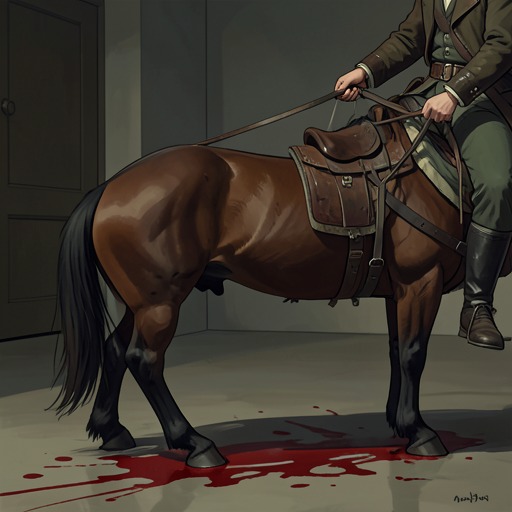
Smith soon urges Black Beauty into a gallop, repeatedly using the whip even though the horse is moving at full speed. The recently mended road is stony, and the loosened shoe grows less secure as they travel. Near the turnpike gate it comes off. Because Smith is drunk, he does not notice that anything is wrong with the horse’s pace. Beyond the gate lies a stretch newly covered with large, sharp stones. Smith nevertheless continues to drive Black Beauty at speed, leaving the horse unable to travel safely without the shoe. The preventable warning at the inn has become an immediate danger on the road.
The fall and Smith’s death
Black Beauty eventually stumbles and falls heavily onto both knees. Smith is thrown from the horse. Black Beauty gets to his feet and moves to the roadside, where the surface is clear of stones; Smith remains on the ground and does not rise. The horse is in pain and cannot help him. With no immediate assistance nearby, Black Beauty stays at the scene, listening for approaching people, horses, or wheels.
Nearly midnight, a horse’s steps approach from the direction of the woods on the road to Earlshall. Black Beauty recognizes Ginger in a dog-cart and neighs; Ginger answers. The men travelling with her stop and identify Smith. They find that he is dead, and then notice Black Beauty’s injured knees. Their first impression is that the horse must have thrown his rider, but the horse has not left the spot. This encounter brings help to Black Beauty while also confirming that the accident has ended in Smith’s death.
Rescue, inquiry, and consequences
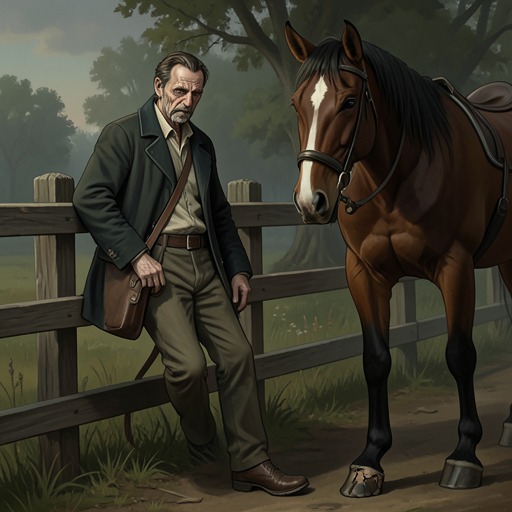
Ned takes Smith’s body away, while Robert examines Black Beauty’s foot, binds it, and leads him home. The walk is more than three miles, and Black Beauty limps painfully; Robert repeatedly pats and encourages him. At the stable, Robert wraps the horse’s knees in wet cloths and applies a bran poultice to the foot. The recovery is long. The farrier treats the knees, and although Black Beauty returns to work, the injuries leave a permanent blemish.
Because Smith’s death is sudden and no one witnessed the fall, an inquest is held. The White Lion’s landlord and hostler, along with other witnesses, establish that Smith was intoxicated when he set out. The toll-gate keeper reports that he rode through at a hard gallop, and Black Beauty’s lost shoe is recovered among the stones. Together, these details make the circumstances clear, and Black Beauty is formally cleared of blame. The inquiry turns what might have been treated as an unexplained fall into a chain of evidence linking Smith’s condition, his speed, and the failed shoe to the accident.
The verdict does not restore Smith’s family. Susan is described as nearly out of her mind with grief and repeatedly blames drink for what has happened. After Smith is buried, she and the six children, without a home or relations to rely on, must leave the cottage by the tall oak trees and enter the Union House. Black Beauty, meanwhile, is put into a small meadow for a period of recovery. When Ginger is later brought there, she too has been ruined by hard riding. The accident thus marks not only Smith’s death but a broader turn in the horses’ fortunes, from trusted service toward injury, separation, and uncertain recovery.
Narrative significance
The ride is shaped by the distance between Smith’s reputation and his conduct. He had been restored to employment on a promise, and his ordinary care with horses had helped make that promise credible. Yet a single journey exposes the limits of that trust: he ignores the loose shoe, fails to recognize the danger, and presses on when the road and the horse require caution. The event’s cause is not presented as an unavoidable mishap; the delayed departure, the dismissed warning, the darkness, the missing shoe, and Smith’s intoxication accumulate into a preventable disaster.
The account is also structured around a question of responsibility. Black Beauty’s silence and inability to assist Smith leave the horse exposed to suspicion, but his staying at the scene and the physical evidence gathered afterward establish what happened. The inquest corrects the initial assumption that the horse caused the fall. At the same time, the official clearing of Black Beauty cannot undo his lasting blemish or the destitution of Susan and her children. The episode’s consequences therefore reach beyond the immediate reversal from a planned ride to a fatal accident: they show how one person’s relapse places both an animal and a dependent family at risk.