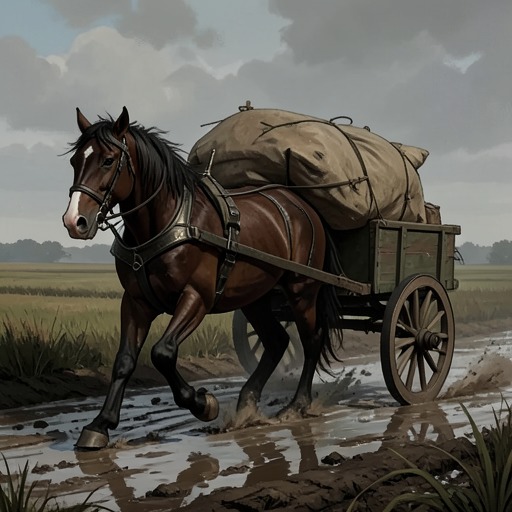
Seedy Sam
Black BeautySeedy Sam is a hard-pressed cab driver whose brief appearance in Black Beauty makes the economics of cab work visible from the rank itself. When challenged over his exhausted horse, he explains how daily charges, restricted fares, and family need leave drivers struggling to earn a living without overworking the animals in their care. His death soon afterward gives that argument a grim consequence: the absence of rest is not merely a complaint, but a condition that has worn him down.
Identity and Circumstances
Seedy Sam is introduced as a shabby, miserable-looking driver who brings a badly tired horse to the cab rank. His circumstances are presented through his own account and through the reactions of the other drivers, rather than through a history of his life. He has six children, says that only one of them earns anything, and describes himself as the family’s overburdened provider. Though only forty-five, he feels as if he has become an old man.
His poverty is concrete. He wants a warm coat and a mackintosh but cannot afford them while feeding his family. He has recently pawned his clock to pay Nicholas Skinner, the cab proprietor who charges him for the use of a cab and two horses. That lost household object gives a measure of the pressure behind his work: even the small security represented by the clock has been converted into rent.
The Economics of Cab Work
Seedy Sam argues that blame cannot be placed solely on the driver when the terms of work leave him so little room to choose. In the season, he says, cab and horse hire can cost eighteen shillings a day, which means that nine shillings must be earned for each horse before the driver can begin to make anything for himself. He has to meet that charge before providing for his family, and says that if the horses do not work, the family may go hungry.
The fare limits and the distances he describes make the arithmetic stark. Within the four-mile radius, a driver cannot charge more than sixpence a mile after the first mile. On the morning he recounts, a six-mile journey brings him three shillings; without a return fare, he and the horse must travel the distance back without adding to that income. A later three-mile fare includes luggage, some of it carried inside rather than charged as outside baggage, followed by a return fare for a shilling. Taken together, the journeys mean eighteen miles for the horse and six shillings for Seedy Sam, yet the horse still has three shillings to earn and the afternoon horse another nine before Seedy Sam can earn for himself.
His account links human hardship directly to animal exhaustion. He says that a tired horse may be kept moving only by the whip, while insisting that he does not mistreat his horse for its own sake. That explanation does not make the horse’s suffering less real; instead, it shows how a structure that demands continued work can turn a driver’s effort to survive into pressure on the animal. Seedy Sam identifies the owners’ charges and the low fares as parts of the same problem, while the horse bears the physical cost of making the numbers work.
The Confrontation at the Rank
The incident begins when Governor Grant sees Seedy Sam’s horse arrive in a visibly exhausted condition and rebukes the driver. Seedy Sam responds by directing attention to the people who set the charges and fares. He says that he is on the stand for fourteen or sixteen hours a day, has had no Sunday for ten or twelve weeks, and must work hard because Nicholas Skinner gives no day off if work can be found. He also describes customers scrutinizing fares and packing luggage into the cab, reducing opportunities for extra charges.
The other drivers gather around and nod in agreement. One says that the situation is desperate enough to explain why a man might sometimes do wrong or drink too much. Jerry Barker remains silent, but Black Beauty notices that he looks especially sad. The exchange broadens the scene beyond one driver: Seedy Sam’s circumstances are recognized by the men around him as a shared condition, not simply an individual failure of character.
Governor Grant first challenges Seedy Sam, but then concedes that the account is true and withdraws his rebuke. He acknowledges hardship for both man and horse, though he cannot say who can mend it. His final concern is immediate and modest: Seedy Sam might at least tell the horse that he is sorry. The response preserves the importance of kindness while also showing its limits. A kind word may matter to a horse, but it does not remove the working conditions that have brought the animal to the rank exhausted.
Death and Narrative Significance
A few mornings after the confrontation, another driver appears with Seedy Sam’s cab. The next morning, that same man reports that Seedy Sam has died at four o’clock. He had spent the previous day raving about Nicholas Skinner and about having no Sundays; according to the report, his last words returned to the rest he had never had. Governor Grant calls his death a warning to the drivers.
The sequence makes Seedy Sam’s warning inseparable from his fate. His case is not presented as a detached argument about fares: the man who explains the economics of relentless work is soon gone, while his place and cab pass to another driver. Through Black Beauty’s witness and Governor Grant’s changed response, Seedy Sam’s brief story connects the exhaustion of working horses to the insecurity of the people who drive them. It argues that humane treatment cannot be secured by telling an individual driver simply to work less when the costs, hours, and fare rules push both driver and horse toward more work.