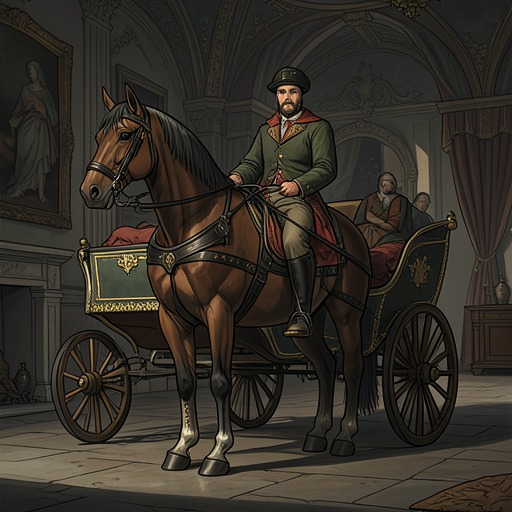
Sir Oliver
Black BeautySir Oliver is an old brown hunter kept at Birtwick after his working life has largely ended. Gentle enough to be trusted with children, he is also a sharp critic of fashionable practices that harm animals. His shortened tail is the evidence behind his most memorable testimony: what people call style can impose lasting pain, indignity, and practical loss on the creatures made to conform to it.
Identity and Life at Birtwick
Sir Oliver stands in a stable separate from Black Beauty and Ginger. Though past regular work, he is not entirely idle: he has the run of the park, sometimes does light carting on the estate, and can carry one of the young ladies when she rides with Squire Gordon. The narrative describes him as a favorite of his master, gentle, and dependable with a child. His remaining work is limited, but he continues to belong to the daily life of the household and its grounds.
His place among the horses is defined partly by contrast. Justice, a strong roan cob, is used for riding or the luggage cart; Merrylegs is also trusted with children. Sir Oliver shares that trustworthiness, but his age and retirement give him a different position: he is an experienced horse whose body records a practice the younger animals might otherwise know only as custom. Black Beauty is less intimate with the cob than with Ginger, who shares his stable, but Sir Oliver becomes an important voice in the conversations among them.
The Docked Tail and Its Consequences
Black Beauty has wondered why Sir Oliver’s tail is only six or seven inches long, with a tassel remaining at its end. During a holiday in the orchard, he asks how Sir Oliver lost it. Sir Oliver rejects the idea that it was an accident. When he was young, people restrained him and docked his long tail as part of a practice imposed on horses; he describes the experience as cruel and shameful, with pain that lasted for a long time.
The loss mattered beyond the initial suffering and the indignity of having part of his appearance taken away. A tail lets a horse brush flies from its sides and hind legs. Without one, Sir Oliver could no longer drive them off, leaving him exposed to repeated irritation. He calls this a lifelong loss, making plain that the consequences of the fashionable alteration did not end when the wound healed. His testimony grounds the argument in ordinary bodily function: the tail was not a needless ornament but something a horse used to protect itself.
Fashion and the Treatment of Animals
Sir Oliver identifies fashion as the reason for docking. In his youth, he says, well-bred horses were expected to have their tails cut, as though human taste mattered more than what an animal needed or what suited its natural form. Ginger connects his story with her own experience of having her head held up by a gag bit in London. Sir Oliver treats both practices as expressions of fashion, rather than as necessities of humane care.
He widens the discussion beyond horses by recalling a terrier who lived in his stall and had five puppies. A man took the puppies away; when their mother returned with them, their tails and the soft flaps of their ears had been cut. Sir Oliver remembers the mother tending them and presents the alterations as needless disfigurement. His point is not confined to his own injury: aesthetic conventions can affect different kinds of animals, removing or changing parts of their bodies without regard for their uses.
The exchange changes the mood of the younger horses. Black Beauty, hearing what happened and why, feels a bitterness toward human beings that he had not felt before. Ginger is also angered and condemns people for cruelty and ignorance. Sir Oliver’s personal account thus becomes more than reminiscence: it exposes a practice that had been normalized as fashionable and gives the other horses grounds to question that normalization.
Counsel and Narrative Significance
Sir Oliver is not only a witness to past cruelty but a settled presence among horses facing different burdens. When Ginger envies Black Beauty’s unspoiled mouth and attributes the difference to their breaking-in and her experience in London, Sir Oliver offers a perspective shaped by acceptance of their unequal circumstances. He reminds her that her ability to carry a tall man and her lively action are valued, and that horses must make the best of what comes so long as they are kindly treated. The reassurance does not erase Ginger’s experience; it shows his habitual effort to comfort her within the limits he recognizes.
His gentleness and his anger coexist. The horse trusted with children is also capable of fierce indignation when describing how a human fashion deprived him of a useful part of his body. That contrast makes his testimony especially forceful: the story does not present him as generally hostile to people, but as an animal whose own history gives him reason to judge their choices. In Black Beauty, where the horse’s first-person account makes animal experience available as testimony, Sir Oliver’s recollection turns an apparently minor detail—his short tail—into an argument about bodily need, human taste, and the lasting costs of treating living creatures as objects to decorate.