Squire Gordon
Black BeautySquire Gordon is the humane horse owner at Birtwick Park whose care and public interventions give practical shape to the book’s concern for animal welfare. In Black Beauty’s account, he is not merely a kind master within his own stable: he acts against cruelty beyond it, challenges practices that restrict horses, and encourages a knowledgeable stableman to make gentler training his vocation. His departure from Birtwick, brought on by his wife’s illness, ends this period of security for Black Beauty and the other horses.
Identity and Arrival at Birtwick
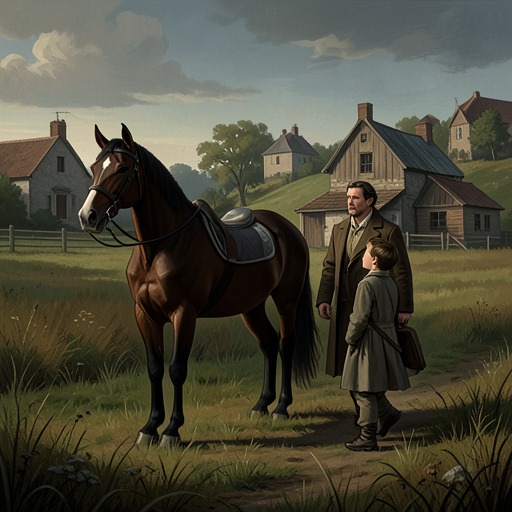
Squire Gordon enters Black Beauty’s story when the young horse is four. He examines Black Beauty’s eyes, mouth, and legs, then watches him walk, trot, and gallop. Gordon judges that the horse will do well once he has been properly broken in. He does not undertake the training himself: Black Beauty’s previous master says he will do it, unwilling to have the horse frightened or hurt, and begins the work the following day. The distinction matters to the account’s portrayal of humane handling: Gordon assesses the horse’s prospects, while the person then responsible for him carries out the training.
In early May, a man from Gordon’s household takes Black Beauty from his first home. At Birtwick Park, the estate includes a home paddock, an old orchard, and stables. The stable where Black Beauty is lodged has four stalls and a large window opening onto the yard. His stall is a loose box, so he is not tied up and can move about freely. The accommodation supplies a concrete measure of the conditions associated with Gordon’s household, rather than leaving its reputation for care as an abstract claim.
A Household Ethic of Care
Black Beauty recalls that the longer he lives at Birtwick, the more proud and happy he feels to belong there. Gordon and his wife are respected in the village for their kindness to people and animals; the household’s servants share that standard. Their concern extends beyond the horses in their care to donkeys, dogs, cats, cattle, and birds. If village children are known to treat an animal cruelly, word of it soon reaches the Hall. The account presents humane conduct as a household practice with consequences beyond the estate, reinforced by attention to how others behave.
Gordon’s response to an abused pony makes that ethic public. While riding Black Beauty, he sees a driver wrench the pony around and lash it after it turns toward the park gates. Gordon rebukes the man, arguing that the pony’s turn showed memory and intelligence: having been driven there before, it could have taken the turn as a sign that it was going to the same place again. He condemns the driver’s treatment and reminds him that people will be judged for their actions toward animals as well as toward other people. Black Beauty reports that Gordon rides home slowly afterward and can tell from his voice how deeply the encounter has upset him.
Advocacy Beyond the Estate
Gordon’s opposition to the check-rein is sustained rather than confined to a single confrontation. He and Farmer Grey have worked together for more than twenty years to have check-reins removed from cart horses; in their district, the devices are consequently seldom seen. The effort joins practical reform to the household’s personal example. Gordon’s wife sometimes stops the carriage when she sees a heavily loaded horse with its head strained upward, gets out, and tries to persuade the driver that the practice is both cruel and foolish.
Gordon also challenges the idea that a horse’s appearance or a driver’s preference is enough to justify restrictive equipment. When a friend asks his opinion of a handsome pair of gray horses, Gordon acknowledges their appearance but objects that the friend still clings to a scheme that worries the horses and diminishes their power. His criticism focuses on what the practice does to the animals, not simply on whether the team looks impressive. Together, these encounters show him speaking against mistreatment among people he knows as well as among drivers he meets on the road.
Relationships and Moral Example
Gordon’s relationships with the people around him reinforce his role as an advocate. He recognizes that John Manly understands horses and can earn their confidence. When John considers seeking a position as a colt-breaker and trainer, he explains that young animals are often frightened and spoiled by poor handling, and that he wants to give them a fair start. Gordon endorses the plan, tells John that he is especially suited to the work, and suggests that he might eventually establish himself. He offers help, provides the name and address of his agent in London, and says he will leave a reference for John. His support connects moral concern with a practical opportunity to improve how young horses are trained.
The book’s animal-autobiography form also shapes Gordon’s characterization. His conduct reaches the reader through Black Beauty’s first-person account: the horse observes the available space in the stable, witnesses Gordon’s interventions, and describes the household’s effects on the animals around it. Gordon’s principles are therefore shown not only in what he says to other people, but in the conditions horses experience and in the choices he makes when he sees cruelty.
Departure and Consequences
After Black Beauty has lived at Birtwick for three years, the household faces a painful change. Gordon’s wife is ill, and the doctor says she must leave at once for a warmer country for two or three years. Gordon begins arranging to break up the establishment and leave England. The horses experience the preparations as a period of unusual activity: Black Beauty and Ginger have full work while the household gets ready to go.
Gordon’s decisions about the horses reflect both the limits imposed by the family’s departure and his attempt to secure their future. He sells Black Beauty and Ginger to his old friend, the Earl of W——, believing that they will have a good place there. He gives Merrylegs to the vicar, with the condition that the pony must never be sold and, when no longer able to work, must be shot and buried. The arrangements separate the horses from the household that has cared for them, but they also show Gordon planning for their treatment after he can no longer keep them.
The departure also changes John Manly’s future. Gordon’s recommendation and agent’s contact give substance to John’s intention to work with young horses, while the breakup of the establishment ends their long association at Birtwick. Gordon’s role in the story is thus defined by a combination of care, intervention, and responsibility at parting: he seeks to make humane treatment a norm around him, then makes considered arrangements when circumstances force him to let the horses go.