Sunday rest
Black BeautySunday rest in Black Beauty is more than a day away from work: it is a shared necessity for horses and people, and a test of whether humane principles hold when income is at stake. The narrative gives the principle practical force through Jerry Barker’s refusal to drive fares on Sundays, the rest that helps Black Beauty and his stablemates recover, and the contrasting exhaustion of workers and horses whose livelihoods deny them a weekly pause.
Meaning and Practice
For Black Beauty, Sunday is the respite that makes the hard working week bearable. Jerry Barker keeps his horses supplied with food and fresh water, and their regular day off gives them time to recover and enjoy one another’s company. Rest is presented not as a luxury added to good treatment, but as part of the conditions that allow horses to continue working without being worn down as quickly.
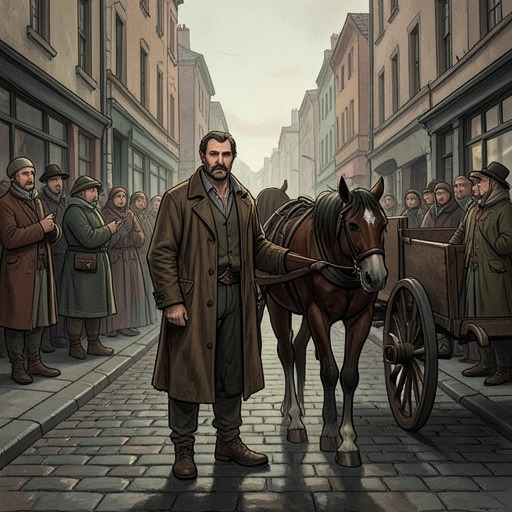
The stable routine makes that care concrete. Jerry’s horses are kept clean and given varied food and water; when they return warm, he withholds water until they have cooled. Against that daily attention, the Sunday pause provides a longer interval of recovery. Black Beauty associates the horses’ ability to sustain their work with having that regular day, and describes Sunday as a time for companionship as well as rest.
Jerry’s own experience reinforces the connection. He once held a seven-day cab license, but the uninterrupted work left him and his horses without a day off, deprived him of Sundays with his family, and kept him from attending worship as he had done before becoming a cabman. For the five years before the conversation with Mr. Briggs, he had instead held a six-day license. Jerry says that arrangement left him stronger and healthier, while his horses stayed fresher and were not used up nearly as quickly. He also says he had saved more money under the six-day schedule than under the seven-day one, challenging the assumption that giving up rest is necessarily the sounder economic choice.
The License Dispute
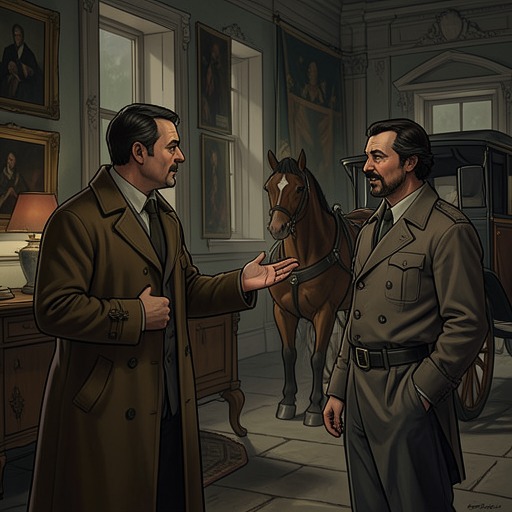
The principle is tested when Mr. Briggs asks Jerry to take Mrs. Briggs to church every Sunday. The journey is described as a short one, and Mr. Briggs offers to compensate Jerry for changing his license. Jerry answers that his six-day license does not permit him to take a Sunday fare. A note accompanying the episode explains that the annual license charge had been reduced and that the distinction between six- and seven-day cabs had been abolished in the period described; within the scene, however, Jerry still understands his license as a legal limit.
The customer’s request is persuasive on ordinary commercial grounds. Mrs. Briggs prefers Jerry, the household has given him good business, and the proposed job would be only one journey in the morning. Jerry acknowledges those advantages and says he would otherwise be pleased to oblige. He nevertheless refuses, because the arrangement would return him to a schedule without a weekly day for himself, his family, or his horses. The decision makes the six-day license a practical boundary: his commitment to rest is not merely an intention that can be set aside whenever a familiar customer asks.
Polly Barker supports that decision even though the family’s income is close enough that the cost of oats, hay, the license, and rent is a continuing concern. She remembers the former routine as leaving little time for Jerry to be with their children or for the family to worship together and have a quiet day. She would rather manage with less than return to that life, and Jerry confirms that he will keep the six-day arrangement even if he could earn twice as much by giving it up. When Mrs. Briggs’s business disappears for a time, Jerry has to depend on less predictable jobs from the stand, so the choice carries a real financial consequence rather than being cost-free.
A Right Shared by Workers and Animals
The cabmen’s discussion broadens the issue beyond one driver’s household. Truman argues that a weekly day of rest is a right for working people and animals, and that those rights should be kept for the next generation. Larry counters from immediate economic interest, preferring to take an available shilling. Jerry replies that individual Sunday work helps maintain the expectation that a cab will always be available: if drivers collectively refused Sunday fares, customers would have to make other arrangements. His reasoning links personal conduct to the working conditions sustained by a whole trade.
Jerry also rejects the idea that other people’s religious practice excuses a driver from attending to his own conscience. Some cabmen complain that churchgoers help create Sunday work by hiring cabs, while they themselves are left to work. Jerry accepts that customers contribute to the demand but argues that drivers still decide whether to make themselves available. The episode therefore places responsibility on both sides of the transaction without treating a worker’s choice as easy: refusing fares may mean losing business, but routinely accepting them helps preserve the system that denies rest.
The argument is sharpened by the contrast between self-employed or well-treated drivers and those who rent cabs and horses from large owners. Black Beauty explains that a driver who owns his horse has a direct reason to avoid overworking it. By contrast, where horses are hired out for a daily charge, drivers must first earn enough to pay the owner and then make a living for themselves. The pressure passes down the chain: owners set costs, drivers face long hours and uncertain fares, and horses bear the physical demands of work. Sunday rest is thus connected to control over the labor process and to who can afford to stop.
Exceptions, Exhaustion, and Consequences
The story does not treat the Sabbath principle as a rule that overrides every human need. After Jerry has maintained his Sunday boundary, Polly tells him that Dinah Brown must travel more than ten miles to reach her dangerously ill mother. Dinah is weak, has a four-week-old baby, and would still face a four-mile walk if she took the train. Jerry initially worries about losing the day of rest for himself and the horses; Polly asks him to consider what he would want if his own mother were dying. He agrees to take Dinah, and asks to borrow a light trap so that the journey will be easier for the horse. The episode distinguishes routine commercial work from an exceptional act of aid, applying the principle of consideration for others rather than reducing rest to inflexible observance.
The harm caused when rest is absent appears in the story of Seedy Sam. His account describes drivers who must meet heavy daily rental costs before earning anything for their families, long days on the stand, and weeks without Sundays. The fare and mileage limits he describes make it difficult to recover expenses; a journey can impose substantial work on a horse while bringing in little for the driver. Governor Grant recognizes the hardship affecting both man and animal, and the account ends with Sam’s death after a period of extreme distress. His last words return to the Sundays he never had, turning the missing day of rest into the defining mark of a life consumed by work.
The consequences are also visible in Ginger. After repeated changes of owner, she is hired out from a cab business where she is worked through the week without a Sunday off. She tells Black Beauty that the owner and hirer expect to recover their costs from her labor, while her weakness is disregarded. Her experience echoes the structure Sam describes: financial pressure is passed from owners to drivers and then borne by the horse. In another contrast, Black Beauty’s later work under Nicholas Skinner includes Sunday journeys into the country, sometimes ten or fifteen miles each way, with no weekly rest. He remembers the Saturday-night bran mash and the recovery that followed the two nights and day off he had enjoyed under Jerry; under Skinner, that restorative interval is gone.
Across these episodes, Sunday rest connects bodily welfare to family time, worship, and economic power. The narrative presents Jerry’s refusal as a personal practice with public implications, but also shows that a worker’s ability to hold that boundary depends on the arrangements governing licenses, fares, ownership, and daily costs. By giving horses’ fatigue and recovery a place in the account of work, Black Beauty makes rest a measure of whether people recognize animals as living partners in labor rather than resources to be used without pause.